Pole vs Poll
That is why they can be confusing, especially for English learners. But their meanings are completely different.
Pole usually refers to a long, straight object, a place at the top or bottom of Earth, or sometimes a person or thing at an extreme end.
You may see this word in phrases such as flag pole, North Pole, and telephone pole.
Poll, on the other hand, is usually connected with voting, surveys, or public opinion. You may hear someone say, “The poll shows that most people support the idea.”
You can also use poll as a verb when you ask people for their opinions.
The two words are also homophones in most standard varieties of English.
This means they have the same pronunciation but different spellings and meanings.
When you hear them in a conversation, you need to use the context to know which word the speaker means.
This small difference matters in school writing, news reports, elections, surveys, and everyday conversations.
Using the wrong word can change the meaning of your sentence.
By the end, you will know exactly when to use pole and when to use poll, along with simple rules, common mistakes, real-life examples, and an easy memory trick.
What Does “Pole” Mean?
Pole is a noun with several meanings. The most common meaning is a long, thin, straight object made from wood, metal, plastic, or another material.
For example, a person might use a pole to hold a flag, support a building, or carry something. You can also use a pole for activities such as fishing, skiing, or sports.
Pole as a Long Object
When pole means a long, straight object, it often refers to something used for support or as a tool.
Consider these examples:
- Pole vs Poll
- We put a wooden pole in the ground.
- The worker climbed the telephone pole.
- He used a metal pole to reach the high branch.
- Pole vs Poll
- She bought a new fishing pole.
- The children carried the bamboo pole together.
- A streetlight is attached to a tall pole.
In these sentences, pole refers to a physical object.
Pole as an End or Extreme Point
The word pole has another important meaning. It can describe one of the two opposite ends of something.
The best-known example is Earth.
The Earth has two geographic poles:
- North Pole
- South Pole
For example:
Pole vs Poll
You can also use pole for opposite ends in science. A magnet, for example, has a north pole and a south pole.
So, the word does not always mean a long stick. It can also mean an extreme end or point.
Pole in Other Expressions
You may see pole in many common expressions.
For example:
- flagpole — a tall pole used to display a flag
- telephone pole — a pole that supports telephone or communication wires
- pole vault — a sport in which an athlete uses a long flexible pole to jump over a bar
- Pole vs Poll
- South Pole — the southern geographic pole of Earth
There is also the phrase at opposite poles, which means two people or ideas are very different.
Example:
Their political opinions are at opposite poles.
Here, poles does not mean sticks. It means two very different ends or positions.
Grammar Rule for “Pole”
Pole is mainly used as a noun.
Its singular form is:
Pole vs Poll
Its plural form is:
poles
Examples:
Pole vs Poll
There are several wooden poles outside.
The word can also appear in compound nouns, such as flagpole and goalpost pole, depending on the context.
A Common Confusion with “Pole”
A learner may hear someone say:
Pole vs Poll
This sounds incorrect because poll does not normally mean a tall object.
The correct sentence is:
“The pole is very tall.”
A useful question to ask yourself is:
Am I talking about an object, an end, or the North/South Pole?
If yes, you probably need pole.
What Does “Poll” Mean?
Poll has a very different meaning from pole.
A poll is usually a process in which people are asked about their opinions, choices, or voting decisions. The results are then collected and studied.
For example:
Pole vs Poll
Here, poll means a survey of people’s opinions.
Poll as a Survey
A poll can ask people questions about almost anything.
For example, a company might ask customers:
Which product do you like best?
If hundreds of customers answer the question, the company can collect their answers and create a poll.
Examples:
- The online poll asked readers to choose their favorite movie.
- A new poll shows strong support for the team.
- Pole vs Poll
- The newspaper published the results of the poll.
- More than 1,000 people took part in the poll.
- The poll suggests that voters are worried about prices.
- Our class held a poll to choose the best project.
- Pole vs Poll
In all of these examples, poll is connected to asking people questions and collecting their answers.
Poll and Elections
Poll is also strongly connected with elections.
In election language, a poll can refer to voting itself, a place where people vote, or a survey that measures voter opinion, depending on the context.
For example:
Pole vs Poll
Here, polls refers to places or opportunities for voting.
You may also hear:
The latest poll puts the two candidates very close.
Pole vs Poll
The plural polls is especially common when talking about elections.
Poll as a Verb
Poll can also be used as a verb.
As a verb, poll can mean to ask people for their opinions or votes.
Examples:
We polled 500 students about the new school rules.
The website polled its readers about the issue.
Researchers polled voters before the election.
You can use different forms:
- Pole vs Poll
- polls
- polled
- polling
For example:
The researchers are polling voters.
The company polled its customers last week.
Grammar Rule for “Poll”
Poll can be both a noun and a verb.
As a noun:
The poll shows that most people agree.
As a verb:
The researchers polled 2,000 people.
This is an important difference from the most common use of pole, which is as a noun.
A Common Confusion with “Poll”
Some learners may write:
“The election pole shows that Candidate A is ahead.”
That is incorrect when you mean a survey of voters.
The correct sentence is:
“The election poll shows that Candidate A is ahead.”
Think about the meaning. You are not talking about a long object. You are talking about people’s opinions or voting choices.
Difference Between Pole and Poll
The biggest difference is simple:
Pole usually relates to a long object, an extreme point, or Earth’s geographic poles.
Poll usually relates to voting, surveys, or people’s opinions.
| Word | Main Meaning | Part of Speech | Example |
|---|---|---|---|
| pole | A long, thin object | Noun | The flag is on a pole. |
| pole | An extreme end or point | Noun | The magnet has two poles. |
| pole | North or South end of Earth | Noun | He wants to visit the North Pole. |
| poll | A survey of opinions | Noun | The poll shows strong support. |
| poll | Voting or election activity | Noun | Voters went to the polls. |
| poll | Ask people for opinions | Verb | We polled 500 students. |
Usage Difference
Use pole when you are talking about something physical or an extreme point.
The bird landed on the pole.
Pole vs Poll
The poll asked people which candidate they preferred.
The meanings do not overlap in normal everyday use.
Grammar Logic
The two words may sound the same, but spelling alone does not tell you the meaning.
Look at the words around them.
If you see phrases such as:
- flag
- telephone
- fishing
- North
- South
- magnetic
- wooden
- metal
Pole vs Poll
If you see phrases such as:
- voters
- election
- survey
- opinion
- results
- candidate
- public
- people
then poll is likely the correct word.
Sentence Structure Difference
Pole often appears with a physical object or location:
Pole vs Poll
The worker repaired the pole.
Poll often appears with people, opinions, or results:
The poll asked voters about the economy.
The poll showed a change in public opinion.
As a verb, poll is usually followed by the people who were asked:
The researchers polled 1,000 voters.
This structure is different from the usual noun use of pole.
Meaning Comparison
Compare these two sentences:
Pole vs Poll
The newspaper published a poll.
The first sentence talks about a physical object.
The second sentence talks about information collected from people.
That is the main difference you need to remember.
Grammar Rules You Must Remember
Rule #1: Use “pole” for a long, straight object
If you can imagine a long stick-like object, pole is usually the right word.
Pole vs Poll
The tent pole broke during the storm.
He carried a wooden pole.
A pole can be made from many materials, including wood, metal, and plastic.
Rule #2: Use “pole” for North, South, and opposite ends
Use pole when talking about Earth’s geographic poles or opposite ends.
The expedition traveled toward the North Pole.
Pole vs Poll
A magnet has a north pole and a south pole.
You can also use the word in a more general way:
The two ideas are at opposite poles.
Rule #3: Use “poll” for surveys and opinions
When people are asked questions and their answers are collected, use poll.
Pole vs Poll
A recent poll asked people about their favorite foods.
The election poll shows a close race.
Remember: opinions = poll.
Rule #4: “Poll” can be a verb
When you mean “ask people for their opinions,” poll can be used as a verb.
The researchers polled 2,000 adults.
The company is polling customers.
We polled our classmates about the trip.
The verb changes according to tense:
poll → polled → polling
Do not confuse this with pole, which does not have this survey meaning.
Common Mistakes Students Make
These mistakes happen because pole and poll are homophones. When learners hear the words, they cannot see the spelling.
The best way to avoid the problem is to focus on meaning and context, not sound.
Mistake 1: Using “pole” for a survey
❌ The school made a pole about the new uniform.
✅ The school made a poll about the new uniform.
The school is asking students for their opinions, so poll is correct.
Mistake 2: Using “poll” for a flag
❌ The flag is attached to a poll.
Pole vs Poll
A flag is attached to a long object, so use pole.
Mistake 3: Confusing “poll” with “pole” in elections
❌ The latest election pole shows that the candidates are close.
✅ The latest election poll shows that the candidates are close.
The word refers to a survey of voters.
Mistake 4: Writing “North Poll”
❌ North Poll
✅ North Pole
Pole vs Poll
The same applies to South Pole.
Mistake 5: Using “poll” when talking about a tent
❌ One of the tent polls is broken.
✅ One of the tent poles is broken.
The tent has physical support rods, so poles is correct.
Easy Correction Tip
When you are unsure, ask yourself:
“Is this about a thing or about people’s opinions?”
If it is about a thing or an extreme end → pole.
Pole vs Poll
This simple question will solve most cases.
Easy Trick to Remember the Difference
Here is a very easy memory trick:
POLL = PEOPLE’S OPINIONS
Both words in people’s opinions begin with the sound idea of P and can help you remember that poll is connected with asking people.
You can also remember:
POLL = QUESTIONS + VOTES + OPINIONS
For example:
Pole vs Poll
Think:
We asked people what they think.
Now think about pole.
Pole vs Poll
You can touch:
- a flagpole
- a telephone pole
- a tent pole
- a fishing pole
So remember:
Pole = physical object or end
Poll = people’s opinions or voting
There is one more useful trick.
Look at the vowels:
pole has o + le.
poll has o + ll.
You cannot depend on the spelling alone when you hear the word, but when writing, remembering the meaning will help you choose the correct spelling.
Daily Life Examples
Here are some simple examples that you may hear in real conversations.
Example 1: Flag
A: Where should we put the flag?
B: Put it on the pole near the entrance.
Here, pole means the tall object holding the flag.
Example 2: School Survey
A: Did you answer the school survey?
B: Yes. I voted in the online poll.
Here, poll means a survey.
Example 3: Election
A: Who is ahead in the election?
B: The latest poll says the race is very close.
The word refers to a survey of voters.
Example 4: Tent
A: Why can’t we put up the tent?
B: One of the poles is broken.
The poles are physical parts of the tent.
Example 5: Opinion
A: What do people think about the new rule?
B: We ran a poll to find out.
The poll collects people’s opinions.
Example 6: North Pole
A: Where does Santa live in many Christmas stories?
B: At the North Pole.
Here, Pole is part of a geographic name.
Example 7: Workplace Survey
A: Why did the manager send us that questionnaire?
B: She wants to poll the staff about the new schedule.
Here, poll is a verb meaning to ask people for their opinions.
Example 8: Telephone Pole
A: What is that tall wooden structure outside?
B: It’s a telephone pole.
This is a physical structure.
Example 9: Class Vote
A: How will we choose the class representative?
B: Let’s create a poll and let everyone vote.
The word refers to voting or collecting choices.
Example 10: Magnet
A: Why does the magnet have two ends?
B: It has a north pole and a south pole.
Here, pole means an opposite end of a magnet.
Practice: Choose the Correct Word
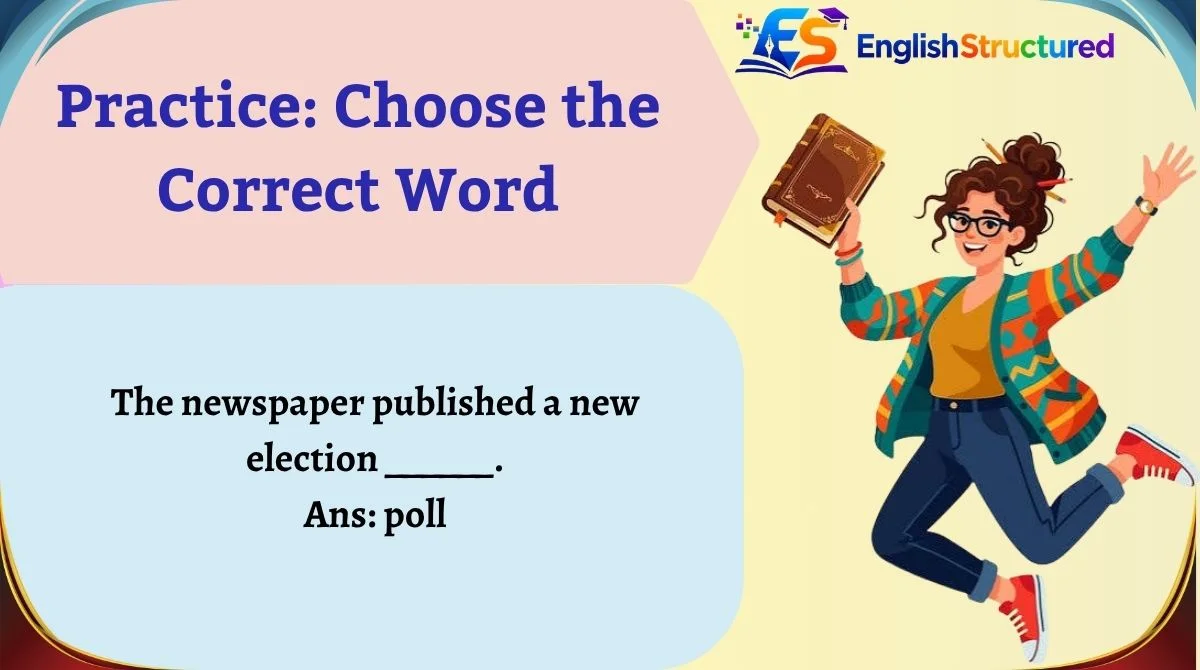
Choose pole or poll in each sentence.
1. The flag is attached to a tall ______.
2. The newspaper published a new election ______.
3. One of the tent ______ broke during the trip.
4. The company wants to ______ its customers.
5. Scientists study both the North ______ and the South ______.
Answers
1. pole
The flag is attached to a physical object, so pole is correct.
2. poll
An election poll measures people’s opinions or voting choices.
3. poles
Tent poles are physical support rods.
4. poll
As a verb, poll means to ask people for their opinions.
5. Pole, Pole
The correct names are North Pole and South Pole.
FAQs
What is the difference between pole and poll?
Pole usually means a long, straight object or an extreme end, such as the North Pole or a magnetic pole.
Poll usually means a survey of people’s opinions or voting choices. It can also be a verb meaning to ask people for their opinions.
Can “poll” be used as a verb?
Yes. Poll can be used as both a noun and a verb.
As a verb, it means to ask people for their opinions or votes. For example: “The researchers polled 1,000 voters.”
Is “pole” only used for a long stick?
No. A pole can mean a long, straight object, but it can also mean an extreme end or point.
For example, Earth has a North Pole and a South Pole, and a magnet has two poles.
Is “poll” formal or informal?
Poll is a normal English word used in both formal and informal situations.
You can see it in news reports, research papers, business surveys, elections, classrooms, and everyday conversations.
Why do pole and poll sound the same?
Pole and poll are homophones in most standard varieties of English. They have the same or nearly the same pronunciation but different spellings and meanings.
Their context tells you which word is intended.
Should I write “election pole” or “election poll”?
You should write election poll when you mean a survey of voters.
For example:
Pole vs Poll
Election pole is incorrect for this meaning.
Conclusion
Pole vs Poll
Use pole for a long physical object, such as a flagpole, tent pole, or telephone pole. It can also describe an extreme end, such as the North Pole, South Pole, or magnetic pole.
Use poll when you are talking about opinions, surveys, elections, or voting. Remember that poll can also be a verb: you can poll people when you ask them what they think.
The easiest memory trick is simple: pole is often something you can touch, while a poll is something that collects people’s choices or opinions.
These two words are easy to mix up because they sound the same. Don’t worry if you have made this mistake before.
Just stop for a second and ask what your sentence means. With a little practice, choosing pole or poll will become natural.