Beliefs or Believes
The two words look almost the same. They share the word believe, and only the last few letters are different. Because of this, learners may use one when they need the other.
For example, which sentence is correct?
- She believes that hard work brings success.
- Beliefs or Believes
Both sentences are correct, but the words have different jobs. Believes is a verb. It tells us what someone thinks or accepts as true.
Beliefs is a noun. It names the ideas, opinions, or things that a person accepts as true.
This difference may seem small, but it matters in daily English.
You may need these words when talking about family values, personal opinions, religion, trust, education, work, or life choices. Using the correct word makes your meaning clear.
The easiest way to understand the difference is to look at the job each word does in a sentence. Believes shows an action or state of mind. Beliefs names ideas or opinions.
By the end, you should be able to choose the right word with more confidence. You will also learn simple grammar rules, common mistakes, useful examples, and an easy memory trick.
What Does “Beliefs” Mean?
Beliefs is a plural noun. It means ideas, opinions, principles, or thoughts that people accept as true or important.
The singular form is belief.
- Beliefs or Believes
- Two or more ideas or opinions: beliefs
A belief can be personal. It can also be shared by a family, group, culture, or community.
For example:
Her belief is that kindness can change people.
Beliefs or Believes
Now look at this sentence:
Her beliefs guide the way she lives.
This sentence talks about several ideas or principles. Therefore, we use beliefs.
When Do We Use “Beliefs”?
Beliefs or Believes
Beliefs often relate to:
- Personal values
- Religious ideas
- Cultural traditions
- Moral principles
- Life views
- Ideas about people or the world
The word is often used after words such as my, your, his, her, our, and their.
Examples:
- My beliefs have changed over time.
- Your beliefs deserve respect.
- His beliefs affect his decisions.
- Her beliefs are different from mine.
- Our beliefs help shape our values.
- Beliefs or Believes
Grammar Rule for “Beliefs”
Beliefs or Believes
Correct:
Her beliefs are important to her.
Incorrect:
Her beliefs is important to her.
Beliefs or Believes
As a subject:
Their beliefs influence their choices.
As an object:
I respect their beliefs.
After a possessive word:
His beliefs are strong.
Examples of “Beliefs” in Sentences
- My beliefs help me make difficult choices.
- People may have different beliefs about success.
- Her beliefs are shaped by her family.
- Beliefs or Believes
- Their beliefs have changed over the years.
- Cultural beliefs can influence daily life.
- The group shared similar beliefs.
- Beliefs or Believes
Common Learner Confusion
Beliefs or Believes. This is understandable because many English verbs also end in s.
However, the s in beliefs makes the noun plural.
Compare:
- One belief
- Many beliefs
The word does not describe an action. It names ideas or opinions.
A useful question is:
Am I talking about ideas or opinions?
Beliefs or Believes
What Does “Believes” Mean?
Believes is a verb. It comes from the base verb believe.
To believe means to think that something is true, accept something as true, trust someone, or have faith in an idea.
The word believes is used mainly with:
- He
- She
- It
- A singular person
- A singular thing
For example:
Beliefs or Believes
Here, believes tells us what she thinks. It is the action or state of mind in the sentence.
Another example:
My teacher believes in me.
This means my teacher trusts my ability or thinks I can succeed.
When Do We Use “Believes”?
Use believes in the present simple tense when the subject is singular.
Examples:
- He believes the story.
- She believes in hard work.
- Beliefs or Believes
- The child believes in magic.
- Sara believes her friend.
- The manager believes the plan will work.
The word often comes after a singular subject.
Grammar Rule for “Believes”
In the present simple, English usually adds -s or -es to a verb when the subject is he, she, or it.
The base verb is:
believe
With I, you, we, and they, use believe.
- I believe you.
- You believe the news.
- We believe in fairness.
- They believe the story.
Beliefs or Believes
- He believes you.
- She believes the news.
- It believes the signal.
- Ahmed believes the story.
Examples of “Believes” in Sentences
- She believes that honesty is important.
- He believes his friend.
- My mother believes in being kind.
- The teacher believes every student can improve.
- Sara believes the weather will change.
- My brother believes that hard work pays off.
- He believes the information is correct.
- The child believes in fairy tales.
Common Learner Confusion
A common mistake is using believes after a plural subject.
Incorrect:
They believes in teamwork.
Correct:
They believe in teamwork.
Why? The subject they is plural. Therefore, the verb stays in its base form: believe.
Another mistake is using believe with she.
Incorrect:
She believe me.
Correct:
She believes me.
The subject she is singular, so the present simple verb takes -s.
Difference Between Beliefs and Believes
The main difference is simple:
Beliefs is a plural noun. It names ideas, opinions, or principles.
Believes is a verb. It shows what a person thinks, accepts, or trusts.
| Feature | Beliefs | Believes |
|---|---|---|
| Word type | Plural noun | Verb |
| Base word | Belief | Believe |
| Main meaning | Ideas or opinions accepted as true | Thinks something is true |
| Talks about | Things or ideas | An action or state of mind |
| Example | Her beliefs are strong. | She believes the story. |
| Usually follows | My, your, his, her, our, their | He, she, it, or a singular noun |
| Can be the subject | Yes | Usually no |
| Can show an action | No | Yes |
Usage Difference
Look at these two sentences:
Her beliefs are important.
The word beliefs names several ideas. It is a thing or concept.
Now look at this sentence:
She believes that kindness matters.
The word believes tells us what she thinks. It is the verb.
The first sentence answers:
What ideas does she have?
The second sentence answers:
What does she think?
Grammar Logic
English sentences often need a subject and a verb.
In this sentence:
She believes in herself.
- She = subject
- believes = verb
- in herself = extra information
Now look at this sentence:
Her beliefs give her confidence.
- Beliefs or Believes
- give = verb
- her confidence = object
Notice that beliefs is the subject. It is not the action. The action is give.
This is an important clue. If another verb comes after beliefs, then beliefs is probably being used as a noun.
Sentence Structure Difference
A common structure with believes is:
Singular subject + believes + information
Examples:
- She believes the answer.
- He believes in luck.
- Beliefs or Believes
A common structure with beliefs is:
Possessive word + beliefs + plural verb
Examples:
- My beliefs are personal.
- Her beliefs guide her.
- Beliefs or Believes
Meaning Comparison
Compare these sentences:
Ali believes in honesty.
This means Ali thinks honesty is important or trusts the value of honesty.
Ali’s beliefs include honesty and fairness.
This means honesty and fairness are part of Ali’s personal values.
The first sentence focuses on what Ali thinks.
The second sentence focuses on the ideas Ali holds.
Grammar Rules You Must Remember
Rule #1: “Beliefs” Is a Plural Noun
Beliefs or Believes
Correct:
Our beliefs are shaped by our experiences.
Incorrect:
Our believes are shaped by our experiences.
Why? The sentence needs a noun. Beliefs is the plural noun.
Beliefs or Believes
Rule #2: “Believes” Is Used with He, She, or It
Use believes with a singular third-person subject in the present simple.
Correct:
She believes that the plan is good.
Correct:
My father believes in hard work.
Incorrect:
She believe that the plan is good.
Beliefs or Believes
Rule #3: Use “Believe” with I, You, We, and They
Do not add -s after plural subjects or the pronouns I and you.
Correct:
I believe you.
Correct:
We believe in equal chances.
Correct:
They believe the news.
Incorrect:
We believes in equal chances.
The verb changes only with he, she, it, or a singular noun.
Rule #4: Use “Believe” After Do, Does, and Did
When you use do, does, or did, the main verb stays in its base form.
Correct:
Does she believe you?
Incorrect:
Does she believes you?
The word does already shows the third-person form. You do not add -s to believe again.
More examples:
- Do you believe him?
- Does he believe the story?
- Beliefs or Believes
- Why does your friend believe that?
Common Mistakes Students Make
Students often make mistakes because beliefs and believes have the same beginning. Their spelling is very close, but their grammar is different.
Mistake 1: Using “Believes” as a Noun
Incorrect:
Everyone should respect other people’s believes.
Correct:
Everyone should respect other people’s beliefs.
Beliefs or Believes
Easy correction tip:
After my, your, his, her, our, their, or a possessive noun, check whether you need belief or beliefs.
Mistake 2: Using “Beliefs” as a Verb
Incorrect:
She beliefs that he is honest.
Correct:
She believes that he is honest.
Why? The sentence needs an action word. Believes is the verb.
Easy correction tip:
After he, she, it, or one person’s name, check whether the present simple verb needs -s.
Mistake 3: Using “Believes” with “They”
Incorrect:
They believes in helping others.
Correct:
They believe in helping others.
Beliefs or Believes
Mistake 4: Using “Believes” After “Does”
Incorrect:
Does she believes you?
Correct:
Does she believe you?
After does, use the base form.
Mistake 5: Using a Singular Verb After “Beliefs”
Incorrect:
His beliefs is important.
Correct:
His beliefs are important.
Because beliefs is plural, use are, not is.
Mistake 6: Confusing “Belief” and “Beliefs”
Incorrect:
One of my beliefs are honesty.
Better:
One of my beliefs is honesty.
The phrase one of my beliefs is treated as singular because the main word is one.
Compare:
My beliefs are important.
Here, the main subject is beliefs, so use are.
Easy Trick to Remember the Difference
A simple memory trick is:
BeliefS = ideaS
Both words end in s because they are plural nouns.
Think:
- belief = one idea
- beliefs = many ideas
Now remember:
She believeS
The s in believes matches the singular subjects he, she, and it in the present simple.
You can use this quick question:
Am I naming ideas, or am I saying what someone thinks?
Beliefs or Believes
Example:
Their beliefs are different.
If you are saying what one person thinks, use believes.
Example:
She believes they are different.
Another useful clue is the word before it.
Look before the word:
- Her beliefs → noun
- She believes → verb
The first sentence starts with a possessive word: her.
The second sentence starts with a subject: she.
This small check can help you choose quickly.
Daily Life Examples
These examples show how the words appear in normal conversations.
- A: Why does Sara help everyone?
B: She believes that kindness matters. - A: Do you believe his story?
B: Yes, I think he is telling the truth. - A: Are your beliefs the same as your parents’ beliefs?
B: Some are, but some are different. - A: Why does your brother work so hard?
B: He believes that effort brings success. - A: I respect your beliefs.
B: Thank you. I respect yours too. - A: Does your teacher believe in you?
B: Yes, she always encourages me. - A: Their beliefs affect how they celebrate holidays.
B: That makes sense. - A: Why does he believe the message?
B: Because it came from a trusted friend. - A: Our beliefs can change as we grow.
B: Yes, life teaches us many things. - A: She believes we can finish today.
B: I hope she is right.
Beliefs or Believes. Believes often appears when someone is thinking, trusting, or accepting something.
Practice Section
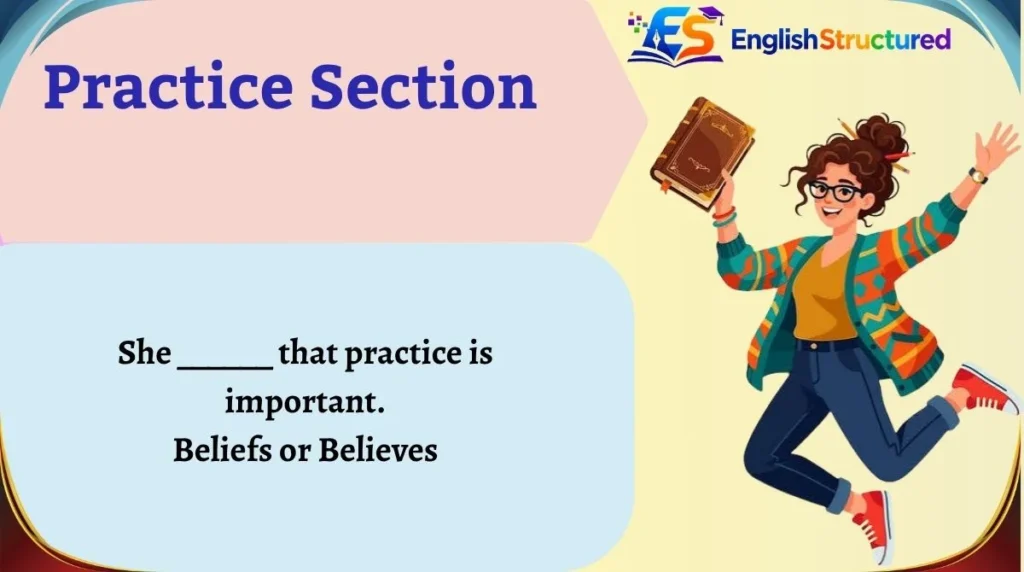
Choose the correct word: beliefs or believes.
1. She ______ that practice is important.
2. My personal ______ guide my choices.
3. He ______ that his friend is honest.
4. Their ______ are different from ours.
5. My teacher ______ every student can learn.
Answers
- Beliefs or Believes
The subject is she, so we use the singular present verb. - beliefs
The sentence talks about personal ideas and values. - believes
The subject is he, so the verb takes -s. - beliefs
The sentence refers to several ideas or opinions. - believes
The subject is my teacher, which is singular.
FAQs
What is the difference between beliefs and believes?
Beliefs or Believes. Believes is a verb. It means that one person thinks, trusts, or accepts something as true.
Can we use “believes” in questions?
Yes, but usually after does, use the base verb believe, not believes.
Correct:
Does she believe you?
Incorrect:
Does she believes you?
Is “beliefs” formal or informal?
Beliefs can be used in both formal and informal English. You may hear it in everyday conversations, school discussions, news reports, and serious writing. The meaning depends on the context.
Is “believes” formal or informal?
Believes is also suitable for both formal and informal English. It is a normal present-tense verb. You can use it in conversation, essays, reports, and professional writing.
Why does “believes” end in “s”?
In the present simple tense, English adds -s or -es to many verbs when the subject is he, she, it, or one person or thing. Therefore, we say she believes but they believe.
Can “beliefs” be used as the subject of a sentence?
Yes. Because beliefs is a noun, it can be the subject.
Example:
Her beliefs influence her decisions.
Beliefs or Believes
Conclusion
The difference between beliefs and believes becomes much easier when you remember their jobs. Beliefs is a plural noun. It names ideas, opinions, values, or principles.
Believes is a verb. It tells us what a person thinks, accepts, trusts, or has faith in.
Beliefs or Believes. If you are describing what he, she, or one person thinks, use believes.
Compare these sentences one more time:
Her beliefs are important to her.
She believes that kindness is important.
The first sentence names her ideas. The second sentence explains what she thinks.
Do not worry if you still need time to remember the difference. Grammar becomes easier through practice.
Read short sentences, make your own examples, and notice whether the word is acting as a noun or a verb.
Beliefs or Believes