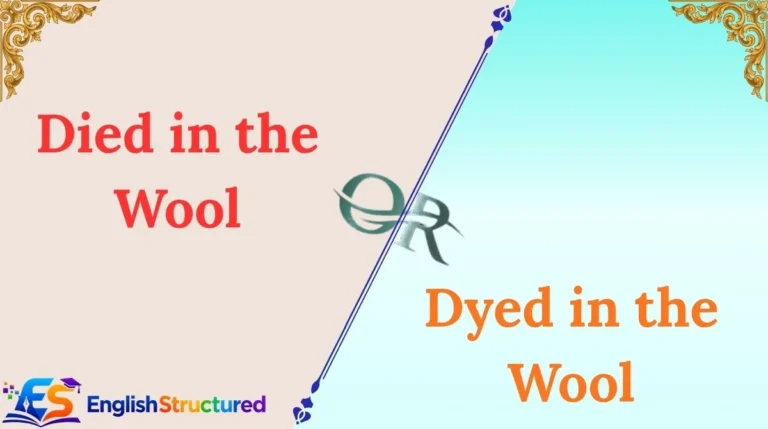
Died in the Wool or Dyed in the Wool
Many English learners confuse died and dyed because the two words sound almost exactly the same when spoken.
But there is an important difference. Died comes from the verb die, while dyed comes from the verb dye. They have completely different meanings and uses.
The confusion becomes even greater because the common English expression is “dyed in the wool,” not “died in the wool.”
It is an idiom used to describe a person whose beliefs, habits, or qualities are deeply fixed and unlikely to change.
For example, if someone has loved football since childhood and still loves it after many years, you might call that person a dyed-in-the-wool football fan.
The phrase has an interesting connection with wool and color. Wool that was dyed before it was made into cloth kept its color deeply.
English speakers began using this idea to describe people whose beliefs or characteristics were just as deeply fixed.
By the end of this guide, you will know exactly when to use died, when to use dyed, why dyed in the wool is correct, and how to remember the difference without getting confused again.
What Does “Died” Mean?
Died is the past tense of the verb die.
The verb die means to stop living. When we talk about something that happened in the past, we use died.
Simple definition
Died in the Wool or Dyed in the Wool
For example:
The old dog died last year.
This tells us that the dog is no longer alive and that this happened in the past.
Died in the Wool or Dyed in the Wool
When should you use “died”?
Use died when talking about the death of a person, animal, plant, or sometimes something that is described as living.
For example:
- My grandfather died when I was young.
- The bird died after becoming sick.
- Died in the Wool or Dyed in the Wool
- The fish died because the water was dirty.
You can also use died in a figurative way.
For example:
Died in the Wool or Dyed in the Wool
Here, nobody is talking about a living thing. The phrase means that the fire gradually became weaker.
Similarly:
The sound died away.
This means the sound slowly disappeared.
Grammar rule for “died”
Died in the Wool or Dyed in the Wool
The basic pattern is:
Subject + died + extra information
Examples:
Died in the Wool or Dyed in the Wool
My cat died last month.
The flowers died in the heat.
Died in the Wool or Dyed in the Wool
For example:
❌ He did died yesterday.
✅ He died yesterday.
When you use did to make a question or negative sentence, use the base verb die, not died.
For example:
Did he die yesterday?
Not:
Died in the Wool or Dyed in the Wool
And:
He did not die yesterday.
Not:
Died in the Wool or Dyed in the Wool
Examples of “died”
Here are some simple examples:
- Died in the Wool or Dyed in the Wool
- The plant died because nobody watered it.
- The injured bird died during the night.
- His favorite actor died at an old age.
- Several fish died when the lake became polluted.
- The fire died down after an hour.
- The music slowly died away.
- Died in the Wool or Dyed in the Wool
Why do learners confuse “died” with “dyed”?
The main reason is pronunciation.
Died and dyed are pronounced the same way in standard English. They are homophones.
That means they sound alike but have different spellings and meanings.
Compare:
- Died in the Wool or Dyed in the Wool
- dyed → from dye → changed the color of something
So, when you hear the expression aloud, you cannot always know which spelling is being used. You need to understand the meaning and look at the context.
What Does “Dyed” Mean?
Dyed is the past tense and past participle of the verb dye.
To dye something means to change its color by using a special coloring substance.
Simple definition
Died in the Wool or Dyed in the Wool
For example:
She dyed her hair black.
This means she used hair dye to change the color of her hair.
You can dye many things, including:
- clothes
- wool
- fabric
- hair
- yarn
- leather
- other materials
When should you use “dyed”?
Died in the Wool or Dyed in the Wool
For example:
The fabric was dyed blue.
Died in the Wool or Dyed in the Wool
The wool was dyed green.
The base verb is dye.
Its common forms are:
- dye — present/base form
- dyed — past tense
- Died in the Wool or Dyed in the Wool
- dyeing — -ing form
Notice something important: dyeing has an extra e.
That spelling helps distinguish it from dying, which means becoming dead or approaching death.
Compare:
She is dyeing her hair.
This means she is changing the color of her hair.
Died in the Wool or Dyed in the Wool
This means the plant is losing life.
Grammar rule for “dyed”
Dyed can work as a past-tense verb:
Died in the Wool or Dyed in the Wool
It can also work as a past participle in passive sentences:
The dress was dyed blue.
And it can be used as an adjective:
He wore a dyed cotton shirt.
The meaning stays connected to color.
Examples of “dyed”
Here are eight easy examples:
- Died in the Wool or Dyed in the Wool
- The artist dyed the cloth bright yellow.
- My mother dyed the old curtains blue.
- The wool was dyed before it was woven.
- He dyed his jeans a darker color.
- Died in the Wool or Dyed in the Wool
- The yarn was dyed red and purple.
- She bought a beautifully dyed scarf.
“Dyed” in the expression “dyed in the wool”
Now we reach the important expression.
The correct idiom is:
Died in the Wool or Dyed in the Wool
Not:
❌ died in the wool
The expression comes from the idea of wool being colored deeply.
If wool is dyed before it is turned into finished cloth, the color can become deeply fixed in the material. This led to the figurative meaning of something being deeply fixed or firmly established.
Today, dyed-in-the-wool is most often used for a person who has very strong and long-standing beliefs, habits, interests, or loyalties.
For example:
She is a dyed-in-the-wool supporter of the team.
This means she is a very loyal supporter and is unlikely to change her loyalty.
Difference Between “Died” and “Dyed”
The easiest way to understand the difference is to remember their original verbs.
| Word | Base Verb | Meaning | Example |
|---|---|---|---|
| died | die | stopped living | The bird died. |
| dyed | dye | changed color | She dyed the dress. |
Died in the Wool or Dyed in the Wool
1. “Died” is about death
Use died when something or someone has stopped living.
The dog died yesterday.
The word is connected to life and death.
2. “Dyed” is about color
Died in the Wool or Dyed in the Wool
She dyed the fabric blue.
The word is connected to color and dye.
3. The idiom uses “dyed”
The expression is:
dyed in the wool
Died in the Wool or Dyed in the Wool
If you write:
He is a died-in-the-wool fan.
you have changed the word to died, which means something stopped living. That does not make sense in the idiom.
The correct form is:
Died in the Wool or Dyed in the Wool
Meaning of “dyed-in-the-wool”
The idiom means deeply committed, strongly loyal, or firmly fixed in a belief or habit.
For example:
She is a dyed-in-the-wool romantic.
This means romance is a deeply rooted part of her personality.
Another example:
He is a dyed-in-the-wool cricket fan.
This means he has been a very loyal cricket fan for a long time.
Sentence structure
When used before a noun, the phrase is normally written with hyphens:
Died in the Wool or Dyed in the Wool
a dyed-in-the-wool traditionalist
a dyed-in-the-wool fan
The hyphens show that the whole phrase works together as an adjective describing the noun.
When the expression is used after a linking verb, you may see it without the same hyphenation:
Died in the Wool or Dyed in the Wool
However, the common adjective form before a noun is:
She is a dyed-in-the-wool supporter.
Meaning comparison
Think of the two words this way:
Died = death
Died in the Wool or Dyed in the Wool
Dyed in the wool = deeply fixed or firmly loyal
That simple chain solves most of the confusion.
Grammar Rules You Must Remember
Rule #1: “Died” comes from “die”
Use died as the past form of die.
The old man died peacefully.
The word describes death or, in some expressions, the ending of something.
Remember:
die → died
Not:
die → dyed
Rule #2: “Dyed” comes from “dye”
Use dyed when talking about changing the color of something.
She dyed her shirt green.
The verb forms are:
dye → dyed
Remember that the word is connected with color.
Rule #3: “Dyed in the wool” is the correct idiom
The established expression is:
dyed in the wool
It describes someone whose beliefs, qualities, habits, or loyalties are deeply fixed.
For example:
He is a dyed-in-the-wool traditionalist.
Do not replace dyed with died.
❌ a died-in-the-wool traditionalist
✅ a dyed-in-the-wool traditionalist
Rule #4: Use hyphens when the phrase comes before a noun
When dyed-in-the-wool comes directly before a noun, hyphens make the phrase function clearly as one adjective.
For example:
She is a dyed-in-the-wool Democrat.
He is a dyed-in-the-wool football fan.
They are dyed-in-the-wool supporters.
You will also find the expression written without hyphens when it follows a verb:
He is dyed in the wool.
For learners, the easiest rule is this:
Before a noun → usually use “dyed-in-the-wool.”
Common Mistakes Students Make
This confusion usually happens because died and dyed sound the same.
English has many homophones, so listening alone does not always tell you which word to write.
Mistake 1: Writing “died in the wool”
❌ He is a died-in-the-wool football fan.
✅ He is a dyed-in-the-wool football fan.
Why is the first sentence wrong?
Because the idiom comes from dyeing wool, not from something dying in wool.
Mistake 2: Thinking “dyed” means dead
Some learners see dyed and connect it with died.
They are not related.
Died → from die
Dyed → from dye
The spelling difference is small, but the meaning is completely different.
Mistake 3: Using “died” because it sounds natural
When people hear:
dyed in the wool
they may write what they think they hear:
died in the wool
This is a common spelling mistake caused by the words being homophones.
The best solution is to memorize the idiom as one complete expression:
dyed-in-the-wool
Mistake 4: Forgetting the hyphens
You may see:
a dyed in the wool supporter
A clearer standard form when the phrase comes before a noun is:
a dyed-in-the-wool supporter
The hyphens show that dyed-in-the-wool describes the supporter as one unit.
Mistake 5: Confusing “dyeing” and “dying”
This is another common problem.
She is dyeing her hair.
She is changing its color.
She is dying.
She is approaching death.
The extra e in dyeing is important.
Easy correction tip
Whenever you see the phrase in the wool, think about color.
Wool can be dyed.
It does not “die” as part of this expression.
So:
wool → dye → dyed in the wool
Easy Trick to Remember the Difference
Here is a simple memory trick that works well for beginners.
“DYE” has E for “extra color”
Think:
DYE = color
If you are talking about changing the color of clothes, hair, wool, or fabric, use dye/dyed.
She dyed her hair.
Now connect that idea to the idiom:
dyed in the wool
The wool has been given color.
From there, the idiom developed a figurative meaning: something is deeply fixed.
“DIE” is about life
Think:
DIE = no more life
Past tense:
Died in the Wool or Dyed in the Wool
The plant died.
So the two words can be remembered like this:
Died → death
Dyed → color
Dyed in the wool → deeply fixed
If you remember only those three lines, you will avoid the most common mistake.
Daily Life Examples
Here are some natural examples showing how native speakers might use these words.
Example 1
A: Is Tom still a huge football fan?
Died in the Wool or Dyed in the Wool
Here, Tom’s loyalty to football is very strong.
Example 2
A: What happened to the old plant?
B: It died because we forgot to water it.
Here, died refers to the plant losing its life.
Example 3
A: Why is your shirt a different color?
B: I dyed it blue yesterday.
Here, dyed means changed the color.
Example 4
A: Does Sarah still love that band?
B: Yes. She’s a dyed-in-the-wool fan.
Her loyalty has lasted for a long time.
Example 5
A: What happened to the flowers?
B: They died in the heat.
The word refers to living plants.
Example 6
A: Did you buy that scarf?
B: Yes. It’s hand-dyed.
The scarf was colored by hand.
Example 7
A: Will your father ever change his opinion?
B: Probably not. He’s a dyed-in-the-wool traditionalist.
His views are deeply established.
Example 8
A: What did you do to your jeans?
B: I dyed them black.
The jeans were given a new color.
Example 9
A: Why did the candle stop burning?
B: The flame slowly died down.
Here, died down is a figurative use of die.
Example 10
A: Is your brother still a cricket fan?
B: Of course. He’s a dyed-in-the-wool cricket supporter.
His support is strong and long-lasting.
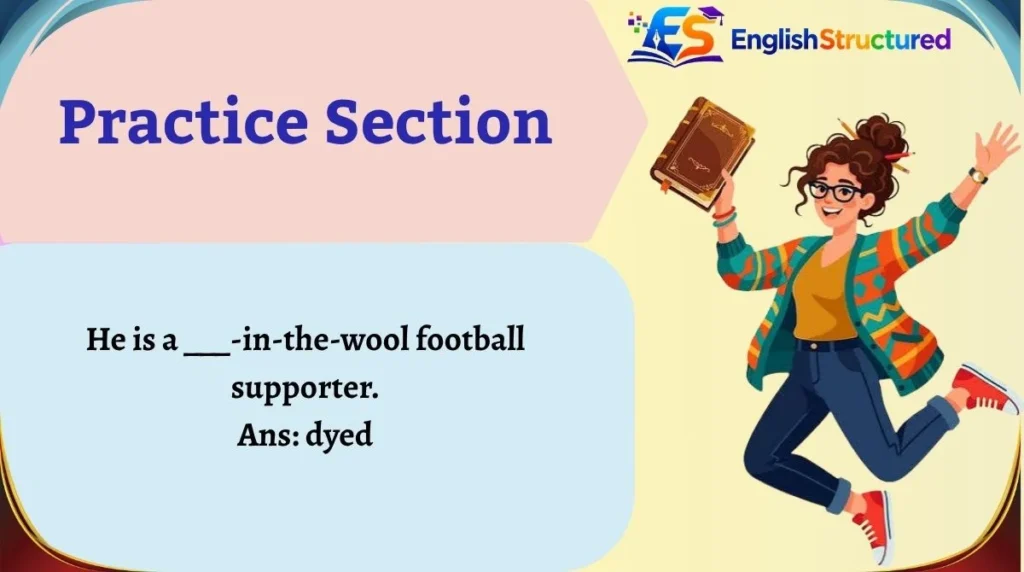
Practice Section
Choose the correct word: died or dyed.
1. She ___ her hair purple last week.
2. The old tree ___ during the storm.
3. He is a ___-in-the-wool football supporter.
4. The fabric was ___ red.
5. My grandfather ___ many years ago.
Answers
1. dyed
She dyed her hair purple.
The hair changed color.
2. died
The tree died during the storm.
The tree lost its life.
3. dyed
He is a dyed-in-the-wool football supporter.
The expression means he is deeply loyal to the team or sport.
4. dyed
The fabric was dyed red.
The fabric was given a different color.
5. died
My grandfather died many years ago.
The word comes from die.
Quick test
Ask yourself one question:
Am I talking about death or color?
Died in the Wool or Dyed in the Wool
If the answer is color, use dyed.
If you mean someone is deeply loyal or firmly committed, use dyed-in-the-wool.
FAQs
What is the difference between “died in the wool” and “dyed in the wool”?
Dyed in the wool is the correct expression. It means someone has a deeply fixed belief, quality, habit, or loyalty.
Died comes from die and means stopped living. It is not the word used in this idiom.
Is “died in the wool” correct English?
Not when you mean the common idiom.
The standard expression is dyed in the wool. The word dyed refers to coloring wool, which provides the image behind the expression.
So write:
Died in the Wool or Dyed in the Wool
What does “dyed-in-the-wool” mean?
Dyed-in-the-wool means deeply committed, firmly loyal, or unlikely to change.
It is often used for someone’s beliefs, political views, habits, personality, or loyalty to a group, sport, or activity.
For example:
Died in the Wool or Dyed in the Wool
Is “dyed-in-the-wool” formal or informal?
It is a normal English idiom and can appear in both everyday and written English.
It is especially useful when you want to emphasize that someone’s belief or loyalty is very strong and deeply rooted.
The exact tone depends on the situation.
Why are “died” and “dyed” so confusing?
They are homophones, which means they have the same or nearly the same pronunciation but different meanings and spellings.
Died comes from die.
Dyed comes from dye.
The context tells you which word is correct when you are listening.
Can “dyed in the wool” describe a person?
Yes. In fact, this is one of its most common uses.
It describes someone whose beliefs, habits, qualities, or loyalties are deeply established.
For example:
He is a dyed-in-the-wool supporter of the club.
This means he is a very loyal supporter.
Can “dyed-in-the-wool” describe things other than people?
Yes. It can describe a person’s type, belief, attitude, or loyalty, and it can sometimes describe groups or strongly established characteristics.
For example:
Died in the Wool or Dyed in the Wool
The phrase focuses on something that is deeply rooted and difficult to change.
What is the easiest way to remember “died” and “dyed”?
Remember two words:
Died = death.
Dyed = color.
Then remember:
Died in the Wool or Dyed in the Wool
If the sentence is about coloring fabric, hair, wool, or clothes, think dyed. If it is about someone losing their life, think died.
Conclusion
Died in the Wool or Dyed in the Wool
Died is the past form of die and refers to someone or something stopping life. Dyed is the past form of dye and refers to changing the color of something.
When you are talking about a person’s deeply fixed beliefs, habits, qualities, or loyalty, the correct expression is dyed in the wool. Before a noun, it is commonly written as dyed-in-the-wool.
A simple memory trick can save you every time: died = death, dyed = color. Then connect dyed with wool because wool can be colored with dye.
Once you understand the meaning behind the expression, the spelling becomes much easier to remember.
Keep noticing these words in real English, and soon you will use died, dyed, and dyed-in-the-wool naturally and confidently.