Excess or Excessive
They both relate to having more than is needed or considered reasonable.
However, they are different parts of speech, and that small grammar difference changes how they work in a sentence.
For example, you can say, “The excess water was removed,” but you cannot normally replace excess with excessive in that sentence.
You would say, “The water was excessive” only in a different structure, and even then, a more natural sentence might be “There was an excessive amount of water.”
This difference matters in everyday English, school writing, emails, conversations, and formal writing.
Choosing the wrong word can make a sentence sound unnatural, even when the general meaning is clear.
The good news is that the rule is quite simple once you understand the job each word does. Excess is mainly a noun or adjective, while excessive is an adjective.
Their meanings are closely connected, but their sentence patterns are different.
By the end of this guide, you will know when to use each word, how they differ, which common mistakes to avoid, and how to remember the difference without memorizing complicated grammar rules.
What Does “Excess” Mean?
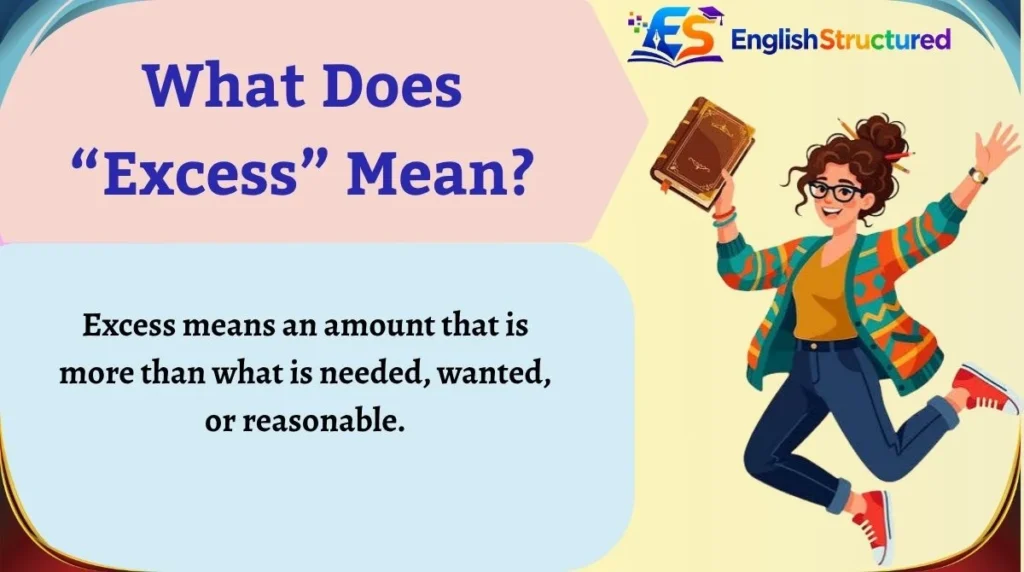
Excess means an amount that is more than what is needed, wanted, or reasonable.
It can work as a noun and, in some situations, as an adjective. This is one reason learners sometimes find it confusing.
As a noun, excess refers to the extra amount itself. Think of it as “too much” or “the extra part.”
For example:
- Excess or Excessive
- We have an excess of food after the party.
- The company sold its excess stock.
In the first two examples, excess refers to an extra amount. In the third, excess describes the stock.
Excess as a Noun
When excess is a noun, it often refers to something that exists beyond the required or normal amount.
A useful pattern is:
Excess or Excessive
Examples:
- There was an excess of water in the basement.
- The factory produced an excess of goods.
- An excess of sugar can affect the taste of the drink.
- Excess or Excessive
- The excess of traffic caused delays.
- The store needs to reduce its excess inventory.
- The excess was returned to the supplier.
- She donated the excess to a local charity.
Notice that excess can name the extra amount. It is not simply describing something as “too much.”
Excess as an Adjective
Excess can also be used before a noun to mean extra or more than necessary.
For example:
- The excess baggage was expensive.
- We removed the excess water.
- The company has excess supplies.
- He sold his excess furniture.
- The excess weight made the box difficult to carry.
- The farmer stored the excess grain.
Excess or Excessive
Compare these two sentences:
There was an excess of food.
Here, excess is a noun.
The excess food was donated.
Here, excess works as an adjective before food.
That small difference is important.
When Should You Use “Excess”?
Use excess when you want to talk about the extra amount itself or something that is extra.
It is especially common with words such as:
- excess baggage
- excess weight
- excess water
- excess money
- Excess or Excessive
- excess demand
- excess supply
- excess energy
- Excess or Excessive
For example, if an airline allows you to take 20 kilograms of luggage but your bag weighs 25 kilograms, the extra five kilograms can be described as excess baggage.
You can also say:
“You will have to pay for the excess.”
Here, the excess means the amount above the allowed limit.
A Common Learner Confusion
Excess or Excessive
They cannot.
For example:
❌ The company used excessive supplies.
This may be grammatically possible in a particular context, but it does not have the same simple meaning as excess supplies. Excessive emphasizes that the amount is too great, while excess supplies usually means supplies left over or supplies beyond what is currently needed.
A clearer distinction is:
Excess or Excessive
Excessive = too much / greater than reasonable
That basic idea will help you in most situations.
What Does “Excessive” Mean?
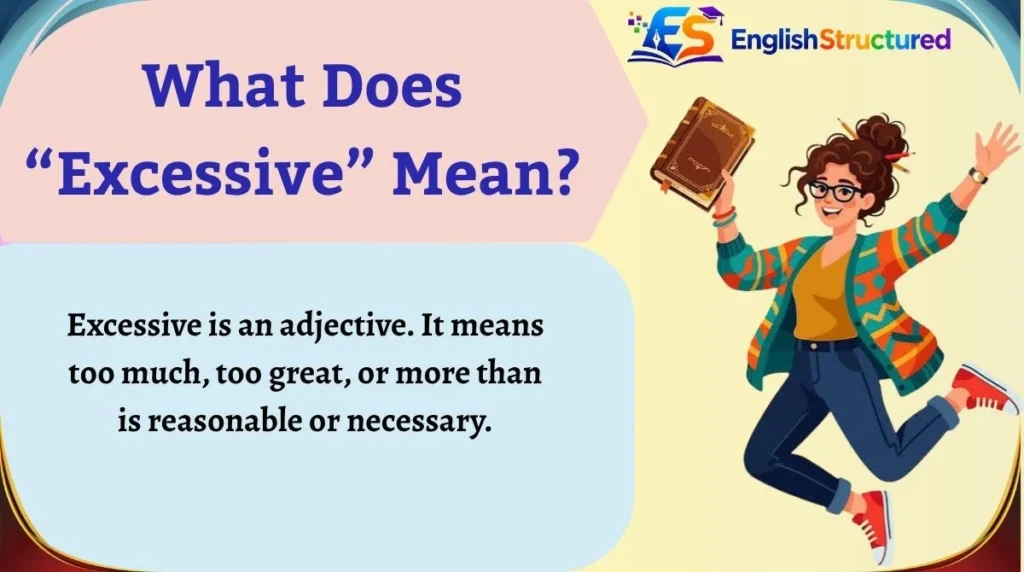
Excessive is an adjective. It means too much, too great, or more than is reasonable or necessary.
Because it is an adjective, it normally describes a noun or comes after a linking verb.
For example:
- The price was excessive.
- They charged an excessive fee.
- He spends an excessive amount of time online.
- Excessive noise can be annoying.
- The teacher gave us an excessive amount of homework.
- She showed excessive concern about the problem.
- The car uses an excessive amount of fuel.
- Excess or Excessive
In each example, excessive describes something as being too much or beyond a reasonable level.
The Grammar Rule for “Excessive”
Because excessive is an adjective, it commonly appears in two structures:
excessive + noun
or
be/seem/become + excessive
Examples:
- excessive noise
- excessive heat
- excessive spending
- Excess or Excessive
- excessive use
- excessive speed
And:
- The noise is excessive.
- The cost seems excessive.
- Excess or Excessive
You can also use excessive with amount, number, or level:
- an excessive amount of money
- an excessive amount of sugar
- an excessive number of questions
- an excessive level of noise
This structure is very common in formal English.
When Should You Use “Excessive”?
Use excessive when you want to say that something is more than is acceptable, reasonable, or necessary.
It often carries a negative meaning because it suggests that something has gone too far.
For example:
The price is high.
This simply says the price is high.
Excess or Excessive
This suggests that the price is unreasonably high.
Another example:
He spends a lot of time playing games.
This gives information about the amount of time.
He spends an excessive amount of time playing games.
This suggests that he spends too much time playing games.
So excessive is stronger than simply saying a lot.
Excessive Does Not Usually Name the Extra Amount
This is one of the easiest ways to separate the two words.
You can say:
Excess or Excessive
But you cannot normally say:
❌ The excessive was removed.
Why? Because excessive is an adjective. It needs a noun to describe.
You could say:
The excessive amount was removed.
Here, excessive describes amount.
Difference Between Excess and Excessive
The biggest difference is grammar.
Excess or Excessive
Their meanings are related, but they do different jobs in a sentence.
| Word | Part of speech | Basic meaning | Example |
|---|---|---|---|
| Excess | Noun | Extra amount | The excess was removed. |
| Excess | Adjective | Extra; more than needed | We sold the excess stock. |
| Excessive | Adjective | Too much; unreasonably high | The cost was excessive. |
Excess Means “The Extra Amount”
When you use excess as a noun, you are talking about the extra part.
The excess was thrown away.
This means the extra amount was thrown away.
Excess or Excessive
This means the company has more products than it needs or can currently use.
Excessive Means “Too Much”
Excessive describes something that has reached a level that is too high or unreasonable.
The company has excessive spending.
This means the spending is too high.
The focus is not simply on the extra amount. The speaker is making a judgment that the amount is too great.
Compare These Sentences
The store has excess stock.
This means the store has extra stock, perhaps more than it currently needs.
Excess or Excessive
This suggests that the amount of stock is unreasonably or unnecessarily high.
Another pair:
We removed the excess water.
The extra water was removed.
Excess or Excessive
The amount of water was unusually or unreasonably large.
The words are close, but the focus changes.
Sentence Structure
With excess, you may see:
the excess
Excess or Excessive
an excess of + noun
Examples:
- The excess was removed.
- Excess baggage costs more.
- There was an excess of food.
With excessive, you may see:
excessive + noun
be + excessive
an excessive amount/number/level of + noun
Examples:
- Excessive noise is annoying.
- The fee is excessive.
- They used an excessive amount of water.
Learning these patterns is more useful than trying to memorize isolated definitions.
Grammar Rules You Must Remember
Rule #1: “Excessive” Is an Adjective
Use excessive to describe something as being too much or too great.
Examples:
- Excess or Excessive
- He received an excessive fine.
- Excessive spending can cause problems.
Do not use excessive as a noun by itself.
❌ The excessive was removed.
✅ The excessive amount was removed.
Rule #2: “Excess” Can Be a Noun
Use excess as a noun when you mean the extra amount.
Examples:
- The excess was donated.
- We sold the excess.
- The factory has an excess of products.
A very useful pattern is:
an excess of + noun
For example:
Excess or Excessive
Rule #3: “Excess” Can Also Come Before a Noun
Excess can describe something that is extra or beyond what is needed.
Examples:
- excess baggage
- excess weight
- excess water
- excess supplies
For example:
The airline charged me for excess baggage.
Here, excess comes directly before baggage.
Rule #4: Use “Excessive” When You Mean “Too Much”
If your main idea is that something is unreasonably high, large, or frequent, excessive is often the better choice.
Compare:
She has excess money.
This means she has extra money.
Excess or Excessive
This means her spending habits are too great or unreasonable.
A quick question can help:
Am I talking about the extra thing itself?
Use excess.
Am I saying that the amount is too much?
Use excessive.
Common Mistakes Students Make
These words are confusing because they come from the same word family. Learners often know that both are connected to “too much,” but they forget that their grammar is different.
Mistake 1: Using “Excessive” as a Noun
❌ The excessive was removed.
This does not work because excessive is an adjective.
✅ The excess was removed.
Or:
Excess or Excessive
The first sentence uses excess as a noun. The second uses excessive to describe amount.
Mistake 2: Assuming “Excess” Always Means “Too Much”
Excess often refers to something extra, but it does not always carry exactly the same judgment as excessive.
Consider:
The warehouse has excess supplies.
This can simply mean there are supplies left over.
The warehouse has excessive supplies.
This suggests that the quantity is too large or unreasonable.
The second sentence sounds more critical.
Mistake 3: Forgetting “of” After “Excess”
When excess is used as a noun before another noun, of is often needed.
For example:
❌ There was an excess sugar in the drink.
Excess or Excessive
However, when excess works as an adjective, no of is needed:
✅ The drink contained excess sugar.
Both structures are possible, but the grammar is different.
Mistake 4: Using “Excessive” Before “Amount” Incorrectly
Some learners avoid the phrase excessive amount because it sounds formal. It is actually a very common and useful structure.
Correct examples include:
- an excessive amount of money
- an excessive amount of food
- an excessive amount of time
- an excessive amount of water
For countable nouns, an excessive number of is usually better:
an excessive number of emails
rather than:
an excessive amount of emails
Mistake 5: Confusing “Excessive” With “Extra”
These words are not always interchangeable.
Extra usually means additional.
Excess or Excessive
For example:
I brought an extra chair.
This simply means I brought one more chair.
I brought an excessive number of chairs.
This suggests I brought far too many chairs.
The emotional meaning is different.
Easy Trick to Remember the Difference
Here is a simple classroom trick:
EXCESS = EXTRA
Think:
Excess = the extra part.
If you can replace the word with extra, excess may be the right choice.
We removed the excess water.
Think:
We removed the extra water.
That works.
EXCESSIVE = TOO MUCH
Think:
Excessive = too much / too great.
Excess or Excessive
Think:
The noise was too much.
That makes sense.
Another helpful trick is to look at the ending.
Excessive ends in -ive, just like many adjectives:
- active
- expensive
- attractive
- effective
- excessive
Excess or Excessive
Excess is more flexible. It can name the extra amount or describe an extra thing.
A Simple Question to Ask Yourself
Before choosing a word, ask:
“Do I mean the extra amount, or do I mean that something is too much?”
If you mean the extra amount, choose excess.
If you mean too much or beyond a reasonable level, choose excessive.
For example:
The excess was removed.
= The extra amount was removed.
The cost was excessive.
= The cost was too high.
That one question can solve many problems.
Daily Life Examples
These words appear in everyday English more often than you may think.
1. At the Airport
“You have excess baggage, so there will be an additional charge.”
Here, excess baggage means baggage above the allowed limit.
2. Talking About Food
Excess or Excessive
Here, excessive means too much.
You could also say:
Excess or Excessive
Here, excess means the extra salt.
3. At Work
“The manager asked us to reduce excessive spending.”
The manager believes the spending is too high.
4. After a Party
“We had an excess of food after the party.”
There was more food than people needed.
5. Talking About Traffic
“Excessive traffic made me late for work.”
The traffic was unusually heavy or too great.
6. Talking About Money
“The company has excess funds that can be used for another project.”
The company has extra funds.
7. Talking About Exercise
“Excessive exercise without enough rest can be harmful.”
The amount of exercise is too great.
8. Talking About Water
“The excess water was pumped out of the basement.”
The extra water was removed.
9. Talking About Noise
“The neighbors complained about excessive noise.”
The noise was too loud or too frequent.
10. Talking About Time
“He spends an excessive amount of time on his phone.”
The speaker thinks he spends too much time on it.
These examples show an important pattern: excess often points to the extra amount, while excessive gives an opinion about the amount being too great.
Practice Section
Excess or Excessive
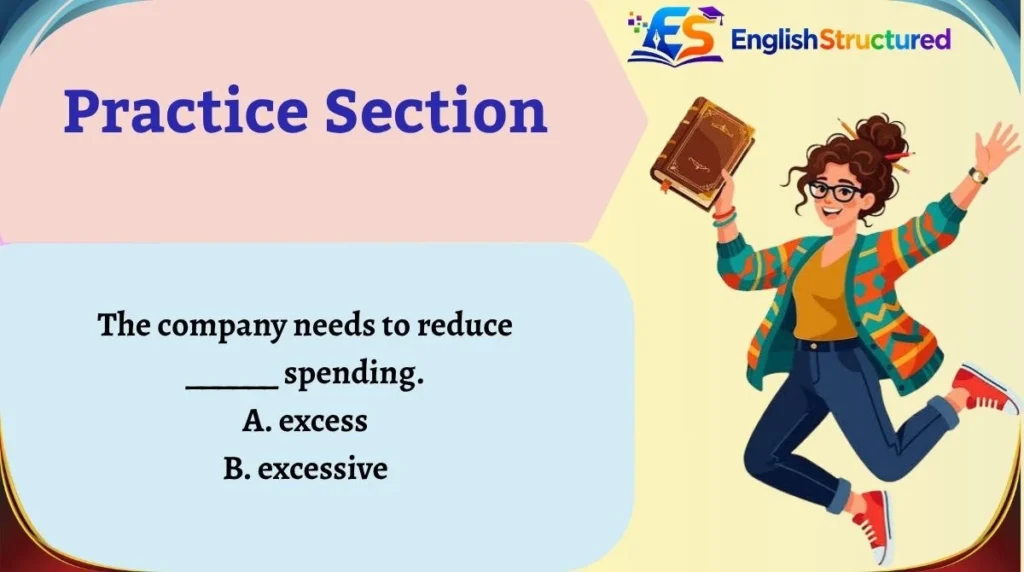
1. The company needs to reduce ______ spending.
A. excess
B. excessive
2. We removed the ______ water from the floor.
A. excess
B. excessive
3. The airline charged me for ______ baggage.
A. excess
B. excessive
4. There was an ______ of food after the event.
A. excess
B. excessive
5. The noise became ______ after midnight.
A. excess
B. excessive
Answers
1. Excessive — Excessive spending means spending that is too high.
2. Excess — Excess water means extra water.
3. Excess — Excess baggage is the standard expression for baggage above the allowed amount.
4. Excess — An excess of food means more food than needed.
5. Excessive — Excessive describes the noise as being too great.
A useful way to check your answer is to replace the word mentally:
- Excess or Excessive
- excessive = too much
If the sentence still makes sense, you have probably chosen correctly.
FAQs
What is the difference between excess and excessive?
Excess usually refers to an extra amount or something beyond what is needed. Excessive is an adjective meaning too much, too great, or unreasonable.
For example, “excess water” means extra water, while “excessive water” emphasizes that the amount is too great.
Is excess a noun or an adjective?
Excess can be both a noun and an adjective.
As a noun, it means an extra amount: “The excess was removed.”
As an adjective, it describes something extra: “We removed the excess water.”
Is excessive an adjective?
Yes. Excessive is an adjective.
It describes something as being too much, too great, or beyond a reasonable level.
For example: “The company faced excessive costs.”
You can also say, “The cost was excessive.”
Can I say “an excess of”?
Yes. “An excess of + noun” is a common and correct structure.
For example:
“An excess of sugar can make the drink too sweet.”
It means there is more sugar than is needed or wanted.
Is “excessive amount” correct?
Yes, “an excessive amount of” is correct and common.
Use it when you want to say that there is too much of something.
For example:
“He spends an excessive amount of money on clothes.”
For countable things, “an excessive number of” is usually more natural.
Is excess formal or informal?
Excess is used in both everyday and formal English. Expressions such as excess baggage, excess weight, and excess water are common.
It is also widely used in business, science, education, and other formal settings.
Can “excess” and “excessive” be used interchangeably?
No, not in every sentence.
They are related, but their grammar and focus are different. Excess can refer to the extra amount, while excessive describes something as being too much or unreasonable.
For example, “The excess was removed” is correct, but “The excessive was removed” is not.
Which is correct: “excess food” or “excessive food”?
Both can be grammatically possible, but they do not communicate exactly the same idea.
Excess food usually means extra or leftover food.
Excessive food suggests an unreasonable or overly large amount of food.
In many everyday situations, excess food is the more natural choice when you mean food that is left over.
Conclusion
Excess and excessive have almost the same basic idea, but they are not the same word. The easiest way to remember the difference is to focus on their job in the sentence.
Excess can mean the extra amount. It can also describe something that is extra, as in excess baggage or excess water.
As a noun, you can say “the excess” or “an excess of something.”
Excessive is an adjective. It means too much, too great, or more than is reasonable.
You can use it before a noun, such as excessive noise, or after a linking verb, such as “The price is excessive.”
When you are unsure, use the simple memory trick:
Excess or Excessive
Excessive = too much.
Once you start noticing these words in real conversations, emails, news stories, and everyday writing, the difference becomes much easier to feel naturally.
A little practice is usually all you need to make the correct choice with confidence.