Makeup or Make Up
The only difference is a space, but that small space changes the meaning and grammar.
This mistake is very common in writing, speaking, school assignments, emails, and even social media posts.
For example, should you write, “She forgot her makeup” or “She forgot her make up”? What about “We need to make up the lost time”?
These questions confuse many beginners because English has many words that can be written as one word or as two separate words.
Understanding the difference is important because using the wrong form can make your writing look incorrect.
Native English speakers usually notice this mistake right away. Learning the correct usage will help you write more clearly and speak with confidence.
The good news is that the rule is not difficult. Once you know how each form works, choosing the right one becomes much easier.
You will also learn several useful expressions that people use in everyday conversations.
By the end of this guide, you will clearly understand when to use “makeup” and when to use “make up.”
You will also see grammar rules, sentence patterns, and many real-life examples that make the difference easy to remember.
What Does “Makeup” Mean?
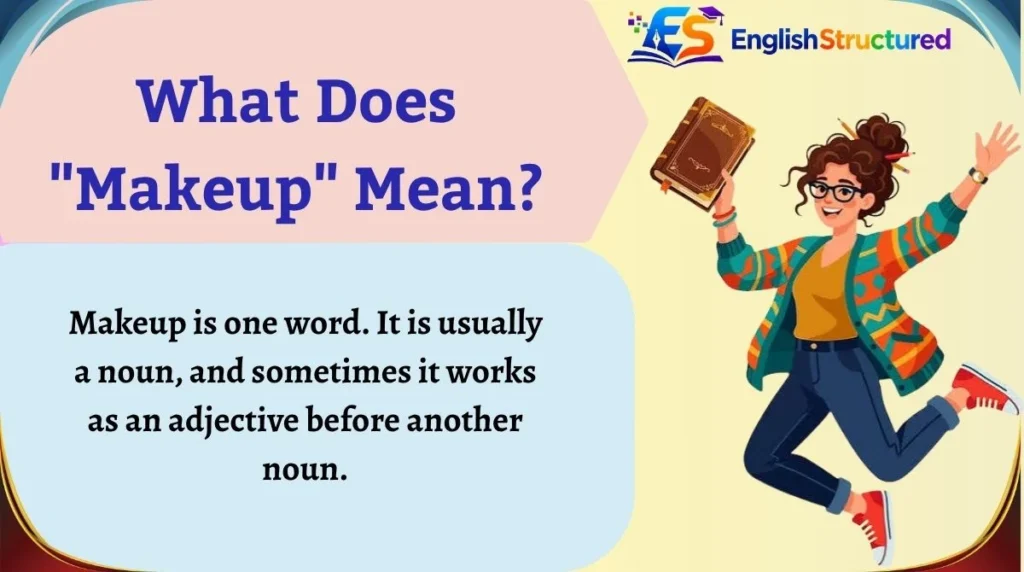
Makeup is one word. It is usually a noun, and sometimes it works as an adjective before another noun.
As a noun, makeup most often means the cosmetics people use to improve or change their appearance. These products include lipstick, foundation, mascara, blush, eyeliner, and many others.
Makeup or Make Up
When to Use “Makeup”
Use makeup when you are talking about:
- Cosmetics or beauty products
- The composition or structure of something
- A characteristic or combination of qualities
- A noun or adjective before another noun
Grammar Rule
Makeup or Make Up
It names a thing, group of products, or composition. It does not describe an action.
Pattern:
- Makeup or Make Up
- Makeup + noun
Meaning 1: Cosmetics
This is the most common meaning.
Examples:
- She bought new makeup for the wedding.
- Makeup or Make Up
- I forgot my makeup at home.
- The actor’s makeup looked very realistic.
- Good makeup can last all day.
- She keeps her makeup in a small bag.
- The store sells high-quality makeup products.
- Makeup or Make Up
Meaning 2: Composition or Structure
Makeup or Make Up
Examples:
- Scientists studied the chemical makeup of the water.
- The team’s makeup changed after the new players arrived.
- The genetic makeup of every person is unique.
- We discussed the social makeup of the city.
- The committee’s makeup includes members from different countries.
- The class has a diverse cultural makeup.
- Makeup or Make Up
- Researchers examined the physical makeup of the material.
“Makeup” as an Adjective
Sometimes makeup comes before another noun to describe its purpose.
Examples:
- makeup bag
- makeup brush
- makeup mirror
- makeup kit
- makeup removMakeup or Make Uper
- makeup sponge
- makeup products
- makeup studio
Example sentences:
- She bought a new makeup bag.
- I need a clean makeup brush.
- Makeup or Make Up
- The makeup kit contains everything you need.
Common Learner Confusion
Many learners write sentences like these:
❌ She bought new make up.
This is incorrect because the sentence talks about cosmetics, which is a noun.
Makeup or Make Up
Another mistake is separating the word when it should stay together.
❌ My make up looks natural.
Makeup or Make Up
Whenever you mean cosmetics or the composition of something, use the single-word form: makeup.
What Does “Make Up” Mean?
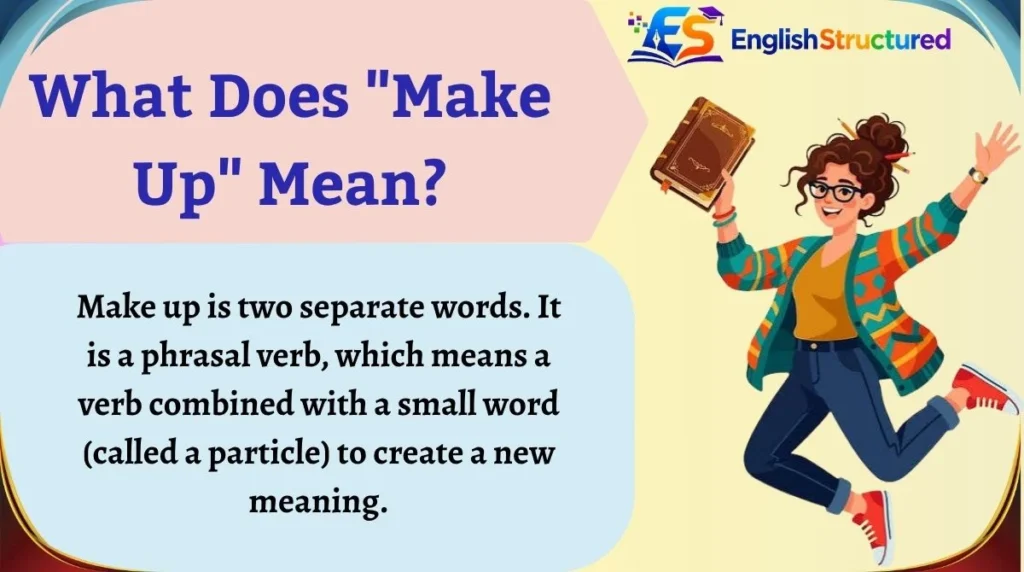
Make up is two separate words. It is a phrasal verb, which means a verb combined with a small word (called a particle) to create a new meaning.
Unlike makeup, make up describes an action.
It has several meanings, and understanding the context helps you choose the correct one.
When to Use “Make Up”
Makeup or Make Up
- Invent something
- Become friends again
- Replace something that was missed
- Form or create something
- Complete missing work
- Compensate for a loss
Grammar Rule
Makeup or Make Up
It always shows an action, not a thing.
Pattern:
- Subject + make up + object
- Subject + make up for + noun
Meaning 1: Invent a Story
Sometimes people make up stories that are not true.
Examples:
- He made up an excuse for being late.
- Don’t make up stories.
- She made up a funny joke.
- The child made up an imaginary friend.
- I think he made up that explanation.
- They made up a story to surprise everyone.
- My brother likes to make up adventures.
- The writer made up interesting characters.
Meaning 2: Become Friends Again
People often make up after an argument.
Examples:
- Tom and Sarah made up yesterday.
- We argued, but we made up later.
- I hope they make up soon.
- The sisters made up after dinner.
- Good friends usually make up quickly.
- They finally made up after several weeks.
- My parents always make up after small disagreements.
- It feels good to make up after a fight.
Meaning 3: Complete Missed Work
If you miss something, you can make it up later.
Examples:
- I will make up the homework tomorrow.
- She stayed late to make up the lost time.
- We must make up the missed class.
- He worked overtime to make up the difference.
- They made up the cancelled lesson.
- Students can make up the exam next week.
- I’ll make up today’s work this evening.
- We need to make up for the delay.
Meaning 4: Form or Create Something
Sometimes make up means to form a whole.
Examples:
- Women make up half of the team.
- Small businesses make up most of the local economy.
- Water makes up a large part of the human body.
- Volunteers make up the entire group.
- These parts make up the machine.
- Children make up most of the audience.
- Several colors make up the design.
- Experience and hard work make up a successful career.
Common Learner Confusion
Students often confuse the noun and the verb.
Incorrect:
- ❌ She likes to makeup every morning.
- ❌ We need more make up for the party.
Correct:
- ✅ She likes to make up her face every morning.
- ✅ We need more makeup for the party.
A simple question can help you choose the right form:
- Is it an action? → make up
- Makeup or Make Up
Difference Between Makeup and Make Up
Although makeup and make up look very similar, they have different meanings and different grammar jobs. The easiest way to tell them apart is to ask yourself one simple question:
Am I talking about a thing or an action?
If you are talking about a thing, use makeup. If you are talking about doing something, use make up.
Learning this simple idea will help you avoid one of the most common English writing mistakes.
Quick Comparison Table
| Feature | Makeup | Make Up |
|---|---|---|
| Part of speech | Noun (sometimes adjective) | Phrasal verb |
| Meaning | Cosmetics, composition, structure | Perform an action, invent, become friends again, replace something, form something |
| Written as | One word | Two words |
| Shows | A thing or idea | An action |
| Example | Her makeup looks beautiful. | They made up after the argument. |
| Can follow “the,” “my,” “your,” or “some” | Yes | No |
| Can be changed into past tense | No | Yes (made up) |
Meaning Comparison
Even though the spellings are almost the same, the meanings are different.
Makeup refers to something that exists. It may be beauty products or the structure of something.
Examples:
- Her makeup is natural.
- The chemical makeup of the rock is unusual.
- Makeup or Make Up
Make up describes an action that someone performs.
Examples:
- Please make up your mind.
- They made up after the fight.
- Makeup or Make Up
Notice how the second group always includes an action.
Grammar Logic
English has many words that can be written together or separately.
When words join together as a noun, they often become a single word.
Examples:
- notebook
- bedroom
- football
- makeup
When the words work together as a verb, they usually stay separate.
Examples:
- make up
- wake up
- sit down
- turn off
This grammar pattern appears in many English phrasal verbs.
Sentence Structure Difference
The sentence pattern also changes.
Structure with Makeup
Subject + Verb + Makeup
Examples:
- Emma wears makeup every day.
- My makeup is waterproof.
- His movie makeup won an award.
- Makeup or Make Up
Since makeup is a noun, it can be the subject or object of a sentence.
Structure with Make Up
Makeup or Make Up
Examples:
- Please make up your bed.
- They made up a story.
- We need to make up the lost time.
- She made up an excuse.
The verb can change tense.
Examples:
- make up
- makes up
- made up
- making up
- will make up
That is another clue that make up is a verb.
Side-by-Side Examples
Look at these sentence pairs.
Example 1
✅ She bought new makeup.
(Beauty products)
✅ She needs to make up her face before the party.
(Action)
Example 2
✅ The scientist studied the chemical makeup of the plant.
(Composition)
✅ Water makes up most of the Earth’s surface.
(Form)
Example 3
✅ Her makeup stayed perfect all day.
(Product)
✅ They made up after their disagreement.
(Action)
Example 4
✅ I forgot my makeup at home.
(Thing)
✅ I will make up the missed homework tonight.
(Action)
Which One Comes After Articles?
Articles like a, an, and the usually come before nouns.
Correct:
- the makeup
- my makeup
- some makeup
- this makeup
Incorrect:
- ❌ the make up (when talking about cosmetics)
However, if “make” is the main verb, articles are not placed between the verb and “up.”
Correct:
- They make up stories.
- We made up yesterday.
Which One Can Be Plural?
Since makeup is a noun, people sometimes wonder if it has a plural form.
Normally, makeup is an uncountable noun when talking about cosmetics.
Correct:
- I bought some makeup.
- She wears a lot of makeup.
Not common:
- ❌ makeups
However, in special situations, writers may use makeups when talking about different theatrical makeup styles or cosmetic collections. This is uncommon in everyday English.
Which One Changes with Tense?
Only verbs change tense.
Because make up is a verb, it changes.
Present:
- make up
Past:
- made up
Present continuous:
- Makeup or Make Up
Future:
- will make up
Examples:
- We make up stories.
- Yesterday we made up.
- We are making up for lost time.
- We will make up the class next week.
The noun makeup never changes because of tense.
Grammar Rules You Must Remember
These simple grammar rules will help you choose the correct form every time.
Rule #1: Use Makeup as a Noun
Makeup or Make Up
Examples:
- Her makeup looks beautiful.
- My makeup bag is full.
- This makeup is expensive.
Makeup or Make Up
Rule #2: Use Make Up as a Verb
If someone is doing an action, use make up.
Examples:
- They made up after the fight.
- I need to make up my homework.
- Don’t make up lies.
The action can happen in any tense.
Rule #3: Check What Comes Before the Word
If words like my, your, his, the, this, or some come before it, you probably need the noun makeup.
Examples:
- my makeup
- Makeup or Make Up
- the makeup
- some makeup
If the word follows helping verbs such as can, will, should, or must, it is probably the verb.
Examples:
- can make up
- should make up
- will make up
- must make up
Rule #4: Ask Yourself One Question
Before writing, ask:
Is it a thing or an action?
If the answer is a thing, write makeup.
If the answer is an action, write make up.
This simple habit prevents most mistakes.
Common Mistakes Students Make
Even advanced learners sometimes confuse these two forms. Most mistakes happen because the words sound exactly the same.
Here are the errors students make most often.
Mistake 1: Splitting the Noun
❌ I forgot my make up.
Makeup or Make Up
Why?
The sentence talks about cosmetics, not an action.
Mistake 2: Joining the Verb
❌ We need to makeup after the fight.
Makeup or Make Up
Why?
The sentence describes an action.
Mistake 3: Using the Wrong Meaning
❌ She bought beautiful make up.
✅ She bought beautiful makeup.
Remember that beauty products are always the noun.
Mistake 4: Forgetting the Space
❌ They will makeup the missed class.
Makeup or Make Up
The verb always stays as two separate words.
Mistake 5: Confusing the Two in One Paragraph
Some students switch between both spellings without noticing.
Incorrect:
Makeup or Make Up
Correct:
She bought new makeup, and later she decided to make up before dinner.
Consistency is important.
Easy Correction Tips
Whenever you proofread your writing, stop at every makeup or make up.
Ask yourself:
- Is this naming something?
- Or is someone doing something?
If it names something, use makeup.
Makeup or Make Up
This quick check takes only a few seconds and helps you avoid grammar mistakes.
Easy Trick to Remember the Difference
Here is a memory trick that many students find helpful.
Remember This Sentence
Things stay together. Actions stay apart.
A thing is written as makeup (one word).
Makeup or Make Up
Think about a makeup bag.
Everything is packed together inside one bag.
So the word stays together:
makeup
Now think about someone fixing a problem or inventing a story.
That person is doing something.
Actions need movement, so the words stay apart:
Makeup or Make Up
Another easy reminder is this:
- Lipstick = makeup
- Apologize and become friends = make up
- Invent a story = make up
- Beauty products = makeup
These simple associations make the correct spelling much easier to remember.
Daily Life Examples of Makeup and Make Up
The best way to master confusing English words is to see them in everyday situations. The following examples show how native speakers naturally use makeup and make up in conversations.
Example 1: Getting Ready for a Party
Emma: Are you almost ready?
Lily: Almost. I’m just putting on my makeup.
Emma: Great! I’ll wait outside.
Example 2: After an Argument
David: Are you still angry with Ben?
Mark: No. We made up this morning.
David: I’m glad to hear that.
Example 3: Missing School
Teacher: You missed yesterday’s lesson.
Student: I know. Can I make up the homework this weekend?
Teacher: Of course.
Example 4: Shopping
Customer: Where can I find makeup?
Shop Assistant: It’s in the beauty section on the second floor.
Example 5: Making an Excuse
Mother: Why were you late?
Son: I didn’t make up an excuse. The bus really broke down.
Example 6: At Work
Manager: We lost two hours because of the meeting.
Employee: We’ll make up the time this afternoon.
Example 7: Science Class
Teacher: Do you know what water is made up of?
Student: Yes. It is made up of hydrogen and oxygen.
Note: The phrase be made up of means “to consist of” or “to be formed from.” It is another common use of make up as part of a verb phrase.
Example 8: Before School
Anna: Where’s my makeup bag?
Sarah: It’s on your desk next to the mirror.
Example 9: Friends Talking
Jake: Did you and Mia finally make up?
Chris: Yes. We talked last night and solved everything.
Example 10: Watching a Movie
Father: The monster looked so real!
Son: The movie’s makeup artists did an amazing job.
Practice Section
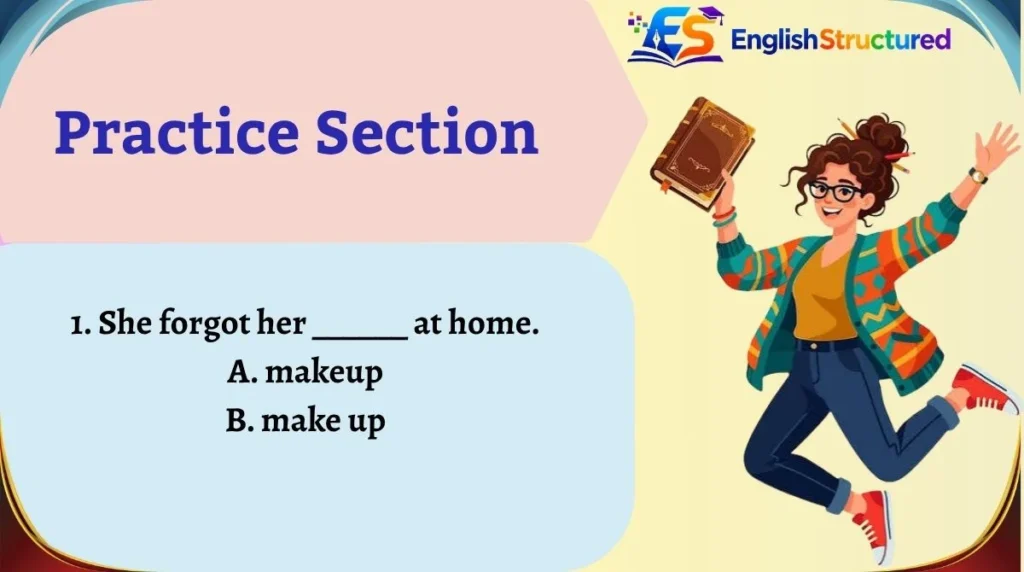
Choose the correct option: makeup or make up.
1. She forgot her ______ at home.
A. makeup
B. make up
2. We need to ______ the lost time.
A. makeup
B. make up
3. Their argument ended because they ______ yesterday.
A. makeup
B. made up
4. The chemical ______ of the soil is different.
A. makeup
B. make up
5. Don’t ______ stories if you don’t know the truth.
A. makeup
B. make up
Answers
- ✅ A. makeup
- ✅ B. make up
- ✅ B. made up
- ✅ A. makeup
- ✅ B. make up
If you answered all five correctly, you have a solid understanding of the difference between these two forms.
FAQs
1. What is the difference between makeup and make up?
Makeup or Make Up. Make up is a phrasal verb that describes an action, such as inventing a story, becoming friends again, replacing something that was missed, or forming a whole. The spelling depends on whether you are talking about a thing or an action.
2. Is makeup one word or two?
When referring to cosmetics or the structure of something, it is written as one word: makeup. When referring to an action, it is written as two words: make up.
Examples:
- She bought new makeup.
- We need to make up the missed lesson.
3. Can make up be used in questions?
Yes. Since make up is a verb, it can appear in statements, questions, and negative sentences.
Examples:
- Did they make up after the argument?
- Can you make up the homework tomorrow?
- Why did you make up that story?
4. Is makeup countable or uncountable?
When talking about cosmetics, makeup is usually an uncountable noun.
Correct examples:
- She wears a little makeup.
- I need some makeup.
In everyday English, people rarely say makeups unless discussing different theatrical looks or cosmetic styles in a specialized context.
5. What does be made up of mean?
The phrase be made up of means to consist of or to be formed from.
Examples:
- The class is made up of twenty students.
- Water is made up of hydrogen and oxygen.
- The committee is made up of experienced teachers.
Although it contains the words made up, this expression has its own meaning and is commonly used in both spoken and written English.
6. How can I remember when to use makeup or make up?
A simple memory trick is:
- Makeup or Make Up
- Action = make up (two words)
If you can touch it, buy it, or describe it as a thing, use makeup. If someone is doing something, use make up.
Conclusion
Makeup or Make Up
Although they sound exactly the same, they have different grammar roles and different meanings.
Remember that makeup is a noun. It usually refers to cosmetics, but it can also describe the composition or structure of something.
On the other hand, make up is a phrasal verb. It describes actions such as inventing a story, becoming friends after an argument, replacing missed work, or forming a whole.
Whenever you are unsure which form to choose, ask yourself one simple question: Am I talking about a thing or an action? If it is a thing, write makeup.
If it is an action, write make up.
The more you read, write, and practice these forms in everyday sentences, the more natural they will become.
With regular practice, you will use both correctly and confidently in conversations, emails, schoolwork, and professional writing.