Not a Problem vs No Problem
You may hear them at home, at school, at work, in shops, or while talking with friends.
They often seem to mean exactly the same thing, so many English learners wonder if they can use either expression in every situation.
The good news is that both expressions are correct. They are also very close in meaning.
Most of the time, both can show that something is okay, acceptable, or not causing difficulty. However, their sentence patterns and common uses are slightly different.
For example, if someone says, “Sorry I’m late,” you can reply, “No problem!” This sounds natural and friendly.
You can also say, “It’s not a problem.” That sentence is correct too, but it has a slightly different structure and can sound a little more deliberate.
There is another important point: “no problem” can stand alone, while “not a problem” usually needs a verb or another part of the sentence.
Understanding this small difference can make your spoken English sound much more natural.
By the end of this guide, you will know when to use each expression, how their grammar works, what mistakes to avoid, and how native speakers use them in real conversations.
What Does “Not a Problem” Mean?
Not a problem means that something is not difficult, not troublesome, or not an issue.
It is often used to reassure someone. When you say, “It’s not a problem,” you are telling the other person that a situation is acceptable and does not cause you trouble.
The basic structure is:
Not a Problem vs No Problem
For example:
- It’s not a problem.
- That’s not a problem.
- Missing one class is not a problem.
- Not a Problem vs No Problem
Here, problem is a singular countable noun. Because it is singular, we normally use the article a.
So:
It is not a problem.
Not:
It is not problem.
The expression can also appear after other subjects.
When Do We Use “Not a Problem”?
We commonly use it when we want to say that something will not cause difficulty.
Imagine your friend asks:
“Can I call you later?”
You might say:
Not a Problem vs No Problem
You are saying that the request is completely acceptable.
It can also be used when discussing plans, mistakes, delays, requests, or small difficulties.
Examples of “Not a Problem”
- Not a Problem vs No Problem
- That’s not a problem. We can change the date.
- It’s not a problem for me to help you.
- Missing one lesson is not a problem.
- Your small mistake is not a problem.
- It’s not a problem if you need more time.
- Changing the order is not a problem.
- There’s no need to worry. It’s not a problem.
Notice that the expression can be part of a complete sentence. It often contains a subject and a verb:
Not a Problem vs No Problem
Here, it’s means it is.
“Not a Problem” as a Reassuring Expression
Sometimes people use “not a problem” without saying the complete sentence.
For example:
“Could you send me the file tomorrow?”
Not a Problem vs No Problem
This is common in conversation. The full idea is:
“That is not a problem.”
So, although “not a problem” can stand alone in casual speech, its underlying grammar is connected to a full sentence such as “It is not a problem.”
Common Learner Confusion
A common mistake is forgetting the article a.
Incorrect:
Not a Problem vs No Problem
Correct:
“It’s not a problem.”
Why? Because problem is a singular countable noun.
Compare:
- It is a problem.
- Not a Problem vs No Problem
- It is a big problem.
- It is not a big problem.
The word a stays because the noun is still singular and countable.
What Does “No Problem” Mean?
No problem is a common expression meaning “That is okay,” “That is fine,” “You are welcome,” or “There is no difficulty.”
It is especially common in spoken English.
For example:
“Sorry for bothering you.”
Not a Problem vs No Problem
Here, no problem means something like:
“That’s okay. You did not cause me any trouble.”
It can also be used after a request:
“Could you help me with this?”
Not a Problem vs No Problem
In this case, it means:
“Sure. I can help.”
When Do We Use “No Problem”?
Not a Problem vs No Problem
- apologizes,
- thanks you,
- asks for a small favor,
- changes a plan,
- explains a small mistake,
- worries that they have caused trouble.
It is very natural in casual conversations.
Examples of “No Problem”
- Not a Problem vs No Problem
- “Can I borrow your pen?” — “No problem.”
- “Thanks for helping me.” — “No problem.”
- “Could you wait five minutes?” — “No problem.”
- “Sorry, I forgot your book.” — “No problem.”
- “Can we meet tomorrow instead?” — “No problem.”
- “I hope I’m not disturbing you.” — “No problem.”
- Not a Problem vs No Problem
- “Can you explain that again?” — “No problem.”
- “Sorry about the delay.” — “No problem.”
The Grammar Behind “No Problem”
The word no means that there is zero amount of something.
For example:
- no money
- no time
- no reason
- no problem
So, literally, “no problem” means “there is no problem.”
However, in everyday conversation, English speakers often shorten expressions. Instead of saying:
“There is no problem.”
they simply say:
Not a Problem vs No Problem
This short form is perfectly normal in casual speech.
“No Problem” After “Thank You”
One especially common use is replying to thank you.
For example:
“Thanks for carrying my bag.”
“No problem.”
This is friendly and natural. Other possible replies include:
- You’re welcome.
- Sure.
- Of course.
- Anytime.
- No worries.
The exact choice depends on the situation and the speaker’s style.
Difference Between “Not a Problem” and “No Problem”
The main difference is grammar and sentence structure, not a completely different meaning.
Both expressions can communicate the idea that something is okay or causes no difficulty.
However, “no problem” is more often used as a short conversational response, while “not a problem” is often used inside a complete sentence.
| Expression | Main meaning | Common use | Example |
|---|---|---|---|
| Not a problem | It is not difficult or troublesome | Statements and reassurance | “It’s not a problem.” |
| No problem | It is okay; there is no difficulty | Short replies and casual speech | “No problem!” |
| Not a problem | Often focuses on a specific situation | Explaining that something is acceptable | “Changing the time is not a problem.” |
| No problem | Often reacts to another person’s words | Replying to apologies, thanks, or requests | “Sorry I’m late.” “No problem.” |
1. “No Problem” Is More Natural as a Short Reply
Suppose someone says:
“Sorry, I forgot to call you.”
A very natural response is:
Not a Problem vs No Problem
You could say:
“It’s not a problem.”
That is also correct. But it sounds slightly more like you are directly describing the situation rather than simply giving a quick friendly response.
2. “Not a Problem” Often Has a Subject
Look at these examples:
Not a Problem vs No Problem
That’s not a problem.
The delay is not a problem.
Changing the date is not a problem.
Not a Problem vs No Problem
With no problem, you can simply respond:
Not a Problem vs No Problem
You do not need to name the subject.
3. Both Can Show Agreement
Someone might ask:
“Can we move the meeting to Friday?”
You could answer:
“No problem.”
Or:
Not a Problem vs No Problem
Both show that you agree to the change.
The first is shorter and more conversational. The second gives a complete statement about the change.
4. The Tone Can Be Slightly Different
No problem usually feels quick, relaxed, and friendly.
Not a problem can feel a little more explicit or reassuring.
Compare:
“Sorry, I made a mistake.”
Not a Problem vs No Problem
This sounds quick and casual.
Now:
“I’m worried that I caused extra work.”
Not a Problem vs No Problem
This can sound more reassuring because you are directly saying that the situation is not an issue.
Neither expression is automatically better. The situation determines which one feels natural.
Grammar Rules You Must Remember
Rule #1: Use “a” with Singular Countable “Problem”
When you use problem as a singular countable noun with not, you normally need a.
Correct:
It’s not a problem.
Incorrect:
Not a Problem vs No Problem
More examples:
That is not a problem.
Not a Problem vs No Problem
Finding another solution is not a problem.
The article a is important because problem is countable.
Rule #2: “No Problem” Does Not Need “A”
With no, you do not say “no a problem.”
Correct:
No problem.
Incorrect:
Not a Problem vs No Problem
The word no already works as a determiner before the noun.
Compare:
a problem
Not a Problem vs No Problem
a reason
no reason
a time
no time
This is a useful grammar pattern to remember.
Rule #3: “No Problem” Can Be a Complete Short Reply
In everyday conversation, no problem can stand by itself.
For example:
“Could you help me?”
Not a Problem vs No Problem
You do not have to say:
“There is no problem.”
The longer version is grammatically complete, but the shorter version is very common in spoken English.
The same thing happens with many conversational expressions:
“Thanks!”
Not a Problem vs No Problem
Short replies are a normal part of natural English.
Rule #4: Use “It’s Not a Problem” for a Specific Situation
When you want to clearly say that a particular thing is acceptable, it’s not a problem is very useful.
For example:
“I need to leave early today.”
“That’s not a problem.”
The phrase that’s points back to the person’s request.
Another example:
“I may need to change the appointment.”
Not a Problem vs No Problem
The expression directly refers to the proposed change.
A useful pattern is:
That/It + is + not a problem.
Common Mistakes Students Make
English learners often confuse these expressions because their meanings overlap. The good news is that most mistakes are easy to fix.
Mistake 1: Saying “It’s Not Problem”
Incorrect:
It’s not problem.
Correct:
Not a Problem vs No Problem
The noun problem is singular and countable, so it needs a in this structure.
Think of the positive form:
It is a problem.
Now add not:
It is not a problem.
The article does not disappear.
Mistake 2: Saying “No a Problem”
Incorrect:
No a problem.
Correct:
Not a Problem vs No Problem
The word no already comes directly before the noun.
You can say:
no problem
but not:
no a problem
Mistake 3: Thinking “No Problem” Is Always More Correct
Some learners believe that because native speakers often say no problem, it must be the only natural choice.
That is not true.
Both are correct:
No problem.
It’s not a problem.
The important thing is to understand the sentence structure and context.
Mistake 4: Using “No Problem” in Every Situation
Although no problem is very common, repeating it after every request, apology, or thank-you can make your speech sound limited.
You can also use:
- Sure.
- Of course.
- That’s okay.
- You’re welcome.
- No worries.
- That’s fine.
For example:
“Can you help me?”
“Sure.”
“Thanks!”
“You’re welcome.”
Having several natural responses makes your English more flexible.
Mistake 5: Confusing “No Problem” With “No Problems”
Both problem and problems can appear in English, but “no problem” is the standard fixed expression when you mean “that’s okay.”
For example:
“Can I use your phone?”
“No problem.”
You may hear “no problems” in some varieties or situations, but learners should not assume it is interchangeable with the common conversational expression.
For everyday English, “No problem” is the safest choice.
Easy Trick to Remember the Difference
Here is a simple trick:
NO PROBLEM = short answer.
NOT A PROBLEM = part of a sentence.
Think of it this way:
Someone talks → “No problem!”
If someone apologizes, thanks you, or asks for a small favor, no problem is often an easy response.
“Sorry!”
Not a Problem vs No Problem
You explain a situation → “It’s not a problem.”
If you are talking about a particular situation, use a complete sentence.
“The meeting has to start at 10 instead of 9.”
“That’s not a problem.”
Another easy way to remember it is:
NO answers quickly.
NOT A describes something.
This is not an absolute grammar rule, because “not a problem” can also be used as a short reply. However, it is a very useful guide for beginners.
Daily Life Examples
Here are some natural conversations showing how people use these expressions.
Example 1: Being Late
Ali: Sorry, I’m ten minutes late.
Sara: No problem. I just arrived too.
Not a Problem vs No Problem
Example 2: Changing Plans
Tom: Can we meet on Saturday instead?
Mia: Sure. That’s not a problem.
Here, that’s not a problem clearly refers to changing the meeting day.
Example 3: Asking for Help
Student: Could you help me with this question?
Teacher: No problem. Show me what you have done.
The short expression sounds friendly and natural.
Example 4: Thanking Someone
James: Thanks for bringing my notebook.
Ben: No problem.
Not a Problem vs No Problem
Example 5: A Small Mistake
Lena: I sent you the wrong file. I’m sorry.
David: No problem. Just send the correct one when you can.
The expression reassures the other person.
Example 6: Work Situation
Manager: Can you finish this tomorrow?
Employee: Yes. That’s not a problem.
The speaker is saying that the task can be completed without difficulty.
Example 7: Asking for More Time
Student: I need another day to finish my homework.
Teacher: That’s not a problem. Just submit it tomorrow.
The phrase directly describes the request as acceptable.
Example 8: Interrupting Someone
A: Sorry to interrupt you.
B: No problem. What do you need?
This is a common conversational use.
Example 9: Changing an Order
Customer: Could I change my order?
Server: Of course. That’s not a problem.
Here, that’s not a problem sounds reassuring and polite.
Example 10: Missing a Call
A: Sorry, I missed your call.
B: No problem. I’ll call you again later.
The short expression fits naturally into casual conversation.
Practice Section
Choose no problem or not a problem for each sentence.
1. “Sorry I forgot to bring your book.”
“__________. You can bring it tomorrow.”
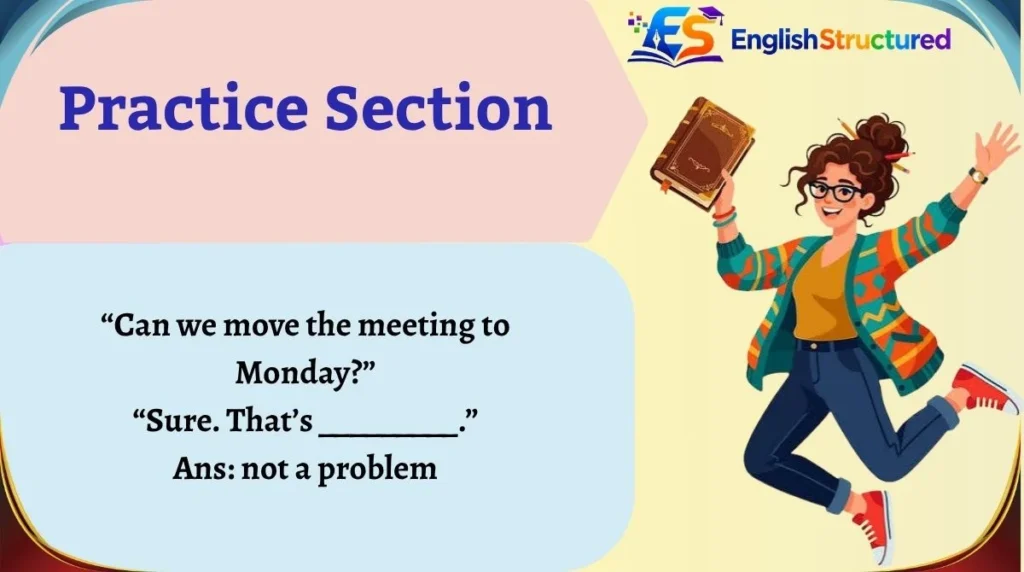
2. “Can we move the meeting to Monday?”
“Sure. That’s _________.”
3. “Thanks for helping me.”
“__________!”
4. “It’s __________ if you need to leave early.”
5. “Could you explain that one more time?”
“__________.”
Answers
1. No problem
“No problem. You can bring it tomorrow.”
This is a short response to an apology.
2. not a problem
“Sure. That’s not a problem.”
The expression refers to the proposed change.
3. No problem
“No problem!”
This is a common casual reply to “thanks.”
4. not a problem
“It’s not a problem if you need to leave early.”
The sentence needs the structure it’s not a problem.
5. No problem
Not a Problem vs No Problem
This is a short response to a request.
FAQs
1. What is the difference between “not a problem” and “no problem”?
Both expressions can mean that something is okay or does not cause difficulty. No problem is especially common as a short conversational reply. Not a problem is often used in a complete sentence, such as “That’s not a problem.”
2. Can I say “no problem” in response to an apology?
Yes. No problem is a very common response to an apology, especially in casual English. For example, if someone says, “Sorry I’m late,” you can simply say, “No problem.”
3. Is “no problem” formal or informal?
No problem is mainly conversational and informal to neutral. It is perfectly normal in everyday speech and many workplace situations. In very formal writing, a phrase such as “That is acceptable” or “There is no issue” may be more suitable.
4. Is “not a problem” more polite than “no problem”?
Neither expression is automatically more polite. No problem often sounds warm and casual, while that’s not a problem can sound slightly more deliberate and reassuring. Your tone of voice and the situation matter more than the phrase itself.
5. Can I use “not a problem” as a reply?
Yes. You can say “Not a problem” as a short reply. It is common in spoken English and means something like “That’s okay” or “I’m happy to do that.” The complete form would be “That’s not a problem.”
6. Should I say “no problem” or “no problems”?
For the common conversational expression, use “No problem.” It is the standard phrase for responding to a request, apology, or thanks. The singular form is the one learners should remember as the fixed expression.
Conclusion
Not a Problem vs No Problem
Use “no problem” when you want a quick, friendly response. It works especially well after someone apologizes, thanks you, or asks for a small favor.
Use “not a problem” when you want to say that a particular situation, request, change, or task is not difficult or troublesome.
The common pattern is “It’s not a problem” or “That’s not a problem.”
Remember the simple trick: “No problem” is often the short answer, while “not a problem” often describes a situation.
Once you hear these expressions in real conversations, the difference becomes much easier to feel.
Do not worry about choosing perfectly every time. Both phrases are natural and widely understood.
Listen to how people use them, practice a few everyday examples, and soon they will become an easy part of your spoken English.