Personal vs Personnel
This small spelling difference can cause big confusion, especially for English learners.
The two words sound different, too, but when you see them quickly in a sentence, it is easy to mix them up.
The word personal usually means something connected with a particular person.
We use it when talking about someone’s private life, feelings, belongings, opinions, or individual choices. For example, you might say, “That is my personal opinion.”
The word personnel, on the other hand, means the people who work for an organization, company, military unit, or other group. For example, “All hospital personnel must wear identification badges.”
The difference matters because using the wrong word can change the meaning of your sentence completely.
If you say “personal department” when you mean the employees of a company, you have used the wrong word.
There is a simple way to remember them. Personal is about a person’s private or individual matters. Personnel is about people who work somewhere.
By the end of this guide, you will know exactly when to use each word, how they work in sentences, and how to avoid this common English mistake.
What Does “Personal” Mean?
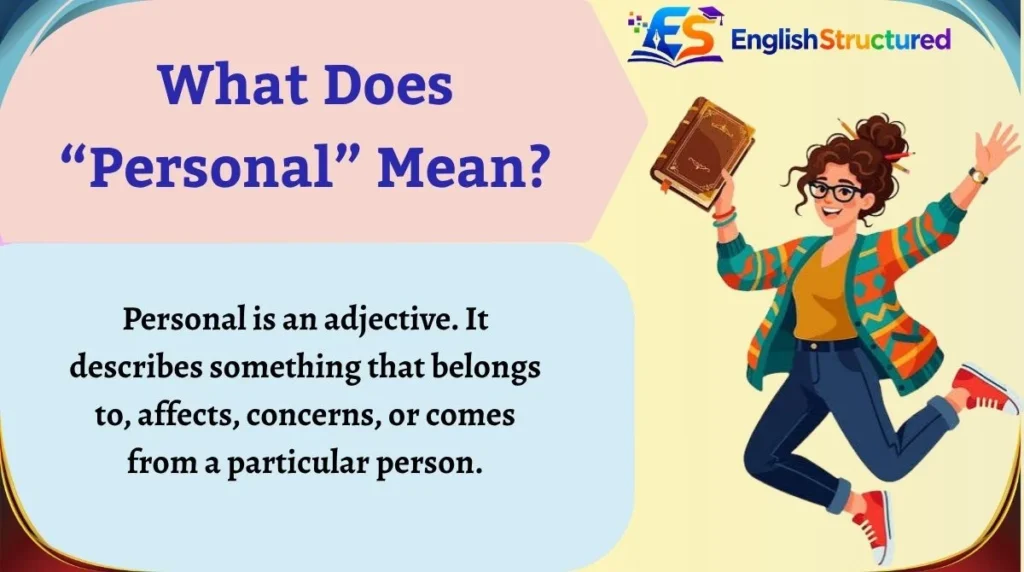
Personal is an adjective. It describes something that belongs to, affects, concerns, or comes from a particular person.
Personal vs Personnel
It can describe someone’s private life, feelings, opinion, information, belongings, choices, or experiences. The word is very common in everyday English.
For example:
I don’t want to discuss my personal problems at work.
Here, personal means problems connected to the speaker’s private life.
You can also use personal when something is your own opinion rather than an official or general opinion.
Personal vs Personnel
This means the opinion belongs to the speaker. It does not necessarily represent a group or organization.
When should you use “personal”?
Use personal when you are talking about something connected with an individual person.
Common expressions include:
- personal information
- personal opinion
- personal experience
- personal life
- personal belongings
- personal choice
- personal space
- personal problem
- personal goal
- personal relationship
- personal responsibility
- personal decision
The word can also describe something designed for individual use.
For example:
Personal vs Personnel
The files are hers and are connected to her private affairs.
Grammar rule for “personal”
Because personal is an adjective, it normally comes before a noun.
personal + noun
Examples:
- personal information
- personal choice
- Personal vs Personnel
- personal opinion
It can also appear after linking verbs such as be, especially when describing someone’s nature or connection to something.
Personal vs Personnel
This matter is personal.
Remember that personal does not normally mean “employees.” It describes something related to an individual person.
Examples of “personal”
- Personal vs Personnel
- I have a personal question for you.The question concerns the person’s private life or situation.
- She gave me her personal opinion.Her opinion is her own rather than an official opinion.
- He keeps his personal belongings in his locker.The belongings belong to him.
- This is a personal decision.The decision is based on an individual’s own situation or choice.
- I learned a lot from my personal experience.The experience happened to the speaker.
- Everyone needs some personal space.Personal space means physical or emotional space that a person wants for themselves.
- Personal vs Personnel
A common confusion with “personal”
Personal vs Personnel
Personal is connected to an individual person.
It does not mean a group of workers.
For example:
Personal vs Personnel
This sentence is incorrect if you mean new employees.
The correct sentence is:
Personal vs Personnel
That difference is worth remembering because personnel is the word used for employees or staff.
What Does “Personnel” Mean?
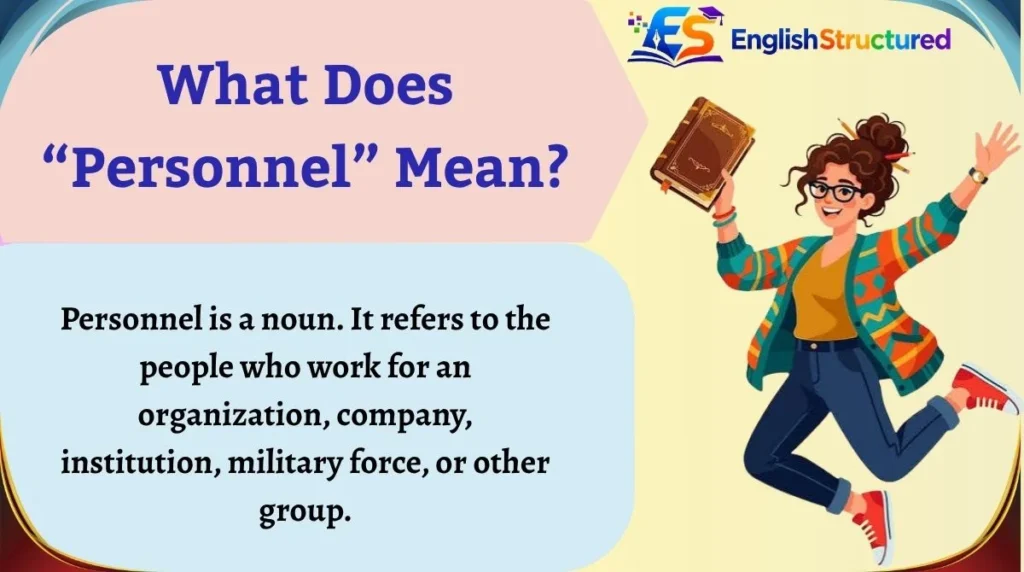
Personnel is a noun. It refers to the people who work for an organization, company, institution, military force, or other group.
Personal vs Personnel
For example:
All hospital personnel must follow safety rules.
Here, personnel means the people who work at the hospital.
You may see this word in workplaces, government offices, hospitals, schools, airports, military settings, and large organizations.
When should you use “personnel”?
Use personnel when you are talking about workers or staff as a group.
For example:
Personal vs Personnel
This means the hotel has experienced workers.
You can also use it when referring to employees who perform a particular job.
Personal vs Personnel
This means the security workers checked the bags.
Common expressions include:
- military personnel
- hospital personnel
- security personnel
- airport personnel
- medical personnel
- Personal vs Personnel
- trained personnel
- qualified personnel
- emergency personnel
- support personnel
- technical personnel
- Personal vs Personnel
Grammar rule for “personnel”
Personal vs Personnel
It normally refers to people who work for an organization or group.
One important point is that personnel is usually treated as a collective noun, so we normally do not say “personnels” when talking about employees.
For example:
The company needs more personnel. ✅
Not:
The company needs more personnels. ❌
You can use words such as members, employees, or workers when you need to talk about individual people.
Personal vs Personnel
However, in many situations, simply using personnel is enough.
Examples of “personnel”
- Hospital personnel responded quickly to the emergency.Personnel means the hospital workers.
- Only authorized personnel may enter this room.This means only approved workers or staff can enter.
- The company is looking for qualified personnel.Qualified personnel means workers with the required skills.
- Security personnel are standing near the entrance.Security personnel means security workers.
- Personal vs Personnel
- Airport personnel helped us find our luggage.Airport personnel means airport workers.
- Emergency personnel arrived at the scene.This means trained emergency workers arrived.
- The manager spoke with the office personnel.Here, personnel means the people working in the office.
A common confusion with “personnel”
The biggest mistake is confusing personnel with personal.
Remember:
Personal vs Personnel
Personal = related to an individual person
Compare these two sentences:
I need to update my personal information.
This means private information about me.
Personal vs Personnel
This means the manager needs more workers.
The spelling is similar, but the meanings are completely different.
Difference Between Personal and Personnel
The easiest way to understand the difference is to focus on the type of word and its meaning.
| Word | Part of speech | Basic meaning | Example |
|---|---|---|---|
| Personal | Adjective | Related to one person | This is my personal opinion. |
| Personnel | Noun | Employees or workers | The company needs more personnel. |
The two words have different jobs in a sentence.
Personal describes a noun.
Personal vs Personnel
personal experience
personal choice
Personnel is itself a noun.
The personnel arrived early.
Personal vs Personnel
This is one of the most useful grammar clues.
Meaning difference
Think about personal as something connected to one person.
Think about personnel as a group of working people.
For example:
She keeps her personal documents at home.
The documents belong to her or concern her.
But:
Personal vs Personnel
The personnel are the employees who work in the office.
Sentence structure difference
Because personal is an adjective, it often comes directly before a noun.
personal + noun
Examples:
personal information
Personal vs Personnel
personal goal
personal experience
Personal vs Personnel
The personnel arrived.
We trained the personnel.
The manager spoke to the personnel.
Personal vs Personnel
A quick side-by-side comparison
My personal computer is broken.
Here, personal describes the computer. It means the computer belongs to or is for my individual use.
Personal vs Personnel
Here, personnel means the company’s employees.
Another example:
Please keep your personal belongings with you.
Your belongings are private possessions.
Airport personnel will help passengers.
Airport personnel are airport workers.
The context makes the difference clear once you know what each word means.
Grammar Rules You Must Remember
Rule #1: Personal is an adjective
Personal vs Personnel
This is my personal choice.
He shared his personal experience.
Do not use personal as a noun when you mean employees.
The company needs more personal. ❌
Personal vs Personnel
Rule #2: Personnel means workers or staff
Use personnel when talking about people employed by an organization.
Hospital personnel worked throughout the night.
Personal vs Personnel
A simple replacement test can help. If you can replace the word with staff or employees, personnel is probably correct.
Personal vs Personnel
The hotel needs more staff.
The meaning is almost the same.
Rule #3: Personal usually comes before a noun
Because personal is an adjective, it commonly describes a noun.
personal information
Personal vs Personnel
personal opinion
personal decision
If you see a noun immediately after the blank, personal may be the correct choice.
For example:
Please protect your ______ information.
The answer is personal.
Please protect your personal information.
Rule #4: Personnel is usually not pluralized
When personnel means employees or staff, it is generally used as a collective noun.
We need additional personnel. ✅
We need additional personnels. ❌
If you want to talk about separate people, use another noun such as employees, workers, or staff members.
Five employees joined the meeting.
This is often clearer when you are talking about a specific number of people.
Common Mistakes Students Make
These words are easy to confuse because they share many of the same letters. Their pronunciation and meanings, however, are different.
Mistake 1: Using “personal” to mean employees
Incorrect:
The company is hiring more personal.
Correct:
The company is hiring more personnel.
Why? The sentence is talking about workers, so personnel is needed.
Correction tip: If you mean staff, think personnel.
Mistake 2: Using “personnel” before a noun
Incorrect:
I gave him my personnel opinion.
Correct:
I gave him my personal opinion.
Why? The speaker is describing an opinion that belongs to them. Personal is an adjective and describes “opinion.”
Mistake 3: Saying “personnels”
Incorrect:
The company has many skilled personnels.
Better:
The company has many skilled personnel.
Or:
The company has many skilled employees.
When personnel means staff, it is normally treated as a collective noun and does not need an -s ending.
Mistake 4: Confusing “personal information” with “personnel information”
These phrases can have very different meanings.
Personal information means private information about an individual.
Do not give your personal information to strangers.
Personnel information can refer to information or records related to employees in an organization.
The manager keeps personnel information in a secure system.
So, changing one letter can change the meaning.
Mistake 5: Choosing by spelling instead of meaning
Some students try to remember the answer only by looking at the spelling. That can be difficult.
Instead, ask yourself:
Am I talking about one person’s private or individual matter?
Use personal.
Am I talking about workers or employees?
Use personnel.
That simple question will solve most problems.
Easy Trick to Remember the Difference
Here is a quick memory trick:
Personal = person
The word personal is closely connected with an individual person.
Think:
Personal vs Personnel
For example:
personal opinion
personal phone
personal problem
Now remember:
Personnel = people at work
Think:
Personal vs Personnel
For example:
hospital personnel
security personnel
military personnel
You can also remember the extra “nel” in personnel as a reminder that it is the longer word for a group of workers.
Another useful trick is to replace the word in your head.
If private, individual, or my own makes sense, try personal.
my own opinion → my personal opinion
If staff, employees, or workers makes sense, try personnel.
security workers → security personnel
This method is much easier than trying to memorize a complicated grammar rule.
Daily Life Examples
Here are some natural examples you might hear at home, at school, or at work.
1. Personal information
A: Why are you filling out this form?
B: It asks for my personal information.
Here, personal means information about the individual.
2. Security personnel
A: Why can’t we enter that area?
B: Security personnel are checking the building.
Here, personnel means security workers.
3. Personal opinion
A: Do you think this plan will work?
B: That’s just my personal opinion, but I think it will.
The speaker is giving an individual opinion.
4. Hospital personnel
A: Who helped the patient?
Personal vs Personnel
Personnel means hospital workers.
5. Personal belongings
A: Where should I put my bag?
B: Keep your personal belongings with you.
Personal describes the belongings that belong to you.
6. Qualified personnel
A: Can anyone repair this machine?
B: No. We need qualified personnel.
Qualified personnel means workers with the right training or skills.
7. Personal decision
A: Why did she leave the job?
B: It was a personal decision.
The decision was hers and concerned her individual situation.
8. Emergency personnel
A: What happened outside?
B: Emergency personnel arrived a few minutes ago.
Emergency personnel means trained emergency workers.
9. Personal space
A: Why did he move back?
B: I think he wanted some personal space.
Personal space means the physical or emotional space a person wants around them.
10. Office personnel
A: Who should I speak to about this form?
B: Ask the office personnel at the front desk.
Here, personnel means the office workers.
Practice Section
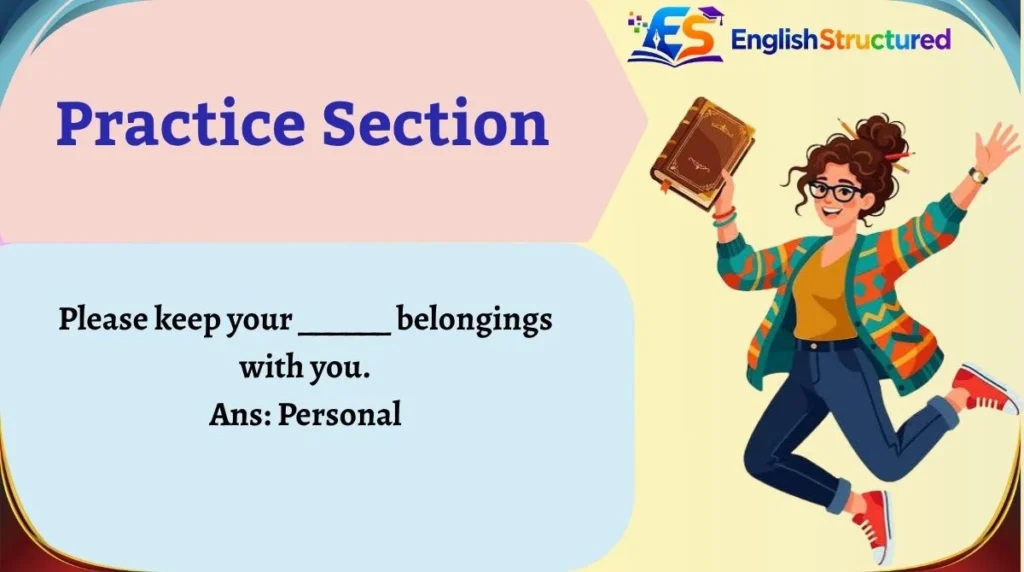
Choose personal or personnel to complete each sentence.
- Please keep your ______ belongings with you.
- The hospital needs more trained ______.
- That is my ______ opinion.
- Security ______ stopped the visitor.
- Do not share your ______ information online.
Answers
1. Personal
“Personal belongings” means things that belong to an individual.
2. Personnel
The sentence is talking about trained workers, so personnel is correct.
3. Personal
An individual’s own opinion is a personal opinion.
4. Personnel
Security personnel are security workers.
5. Personal
Private information about an individual is called personal information.
A useful exercise is to make your own sentences with both words. Try writing three sentences with personal and three with personnel. This helps the difference become automatic.
FAQs
What is the difference between personal and personnel?
Personal is an adjective meaning related to an individual person. Personnel is a noun meaning employees, staff, or workers in an organization.
For example, “personal information” means private information, while “company personnel” means company employees.
Can “personnel” be used in questions?
Yes. Personnel can be used in questions just like other nouns.
For example:
Where can I find the medical personnel?
Personal vs Personnel
The word still means workers or staff.
Is “personal” an adjective?
Yes. Personal is an adjective.
It describes nouns such as information, opinion, experience, choice, problem, belongings, and decision.
For example:
She shared her personal experience.
Is “personnel” singular or plural?
Personnel is usually treated as a collective noun when it means staff or employees. It can refer to a group of people without adding -s.
Instead of saying “personnels,” use personnel, employees, or staff members, depending on the sentence.
Does personnel mean employees?
Yes. In many situations, personnel means the people who work for an organization.
For example:
All company personnel must attend the meeting.
This means all company employees or staff must attend.
What is the difference between personal information and personnel information?
Personal information means private or identifying information about a person.
Personnel information refers to information connected with employees or staff, especially in an organization.
For example, a company’s personnel records may contain information about its employees.
Conclusion
Personal vs Personnel
Use personal when something relates to one person, especially their private life, feelings, belongings, choices, opinions, or experiences.
It is an adjective, so it commonly comes before a noun: personal opinion, personal information, and personal experience.
Use personnel when you mean employees, staff, or workers. It is a noun, and you will often see it in phrases such as security personnel, hospital personnel, and military personnel.
The easiest memory trick is simple: personal = related to a person, while personnel = people who work.
When you see either word, stop for a second and ask what you mean.
Are you describing something belonging to an individual, or are you talking about workers? That quick check will help you choose the right word every time.