Apportion vs Portion vs Proportion
All three words are connected with the idea of parts or dividing something, but they do not work in the same way.
For example, you can apportion money among several people. You can eat a portion of food. You can talk about the proportion of students who passed an exam.
The small differences matter because these words have different meanings, grammar roles, and uses.
Using the wrong one can make a sentence sound strange, even when the general idea is clear.
The good news is that the difference is easier than it first seems. Think of them as three different ways of talking about a part.
Apportion is mainly about the action of dividing or assigning something. Portion usually means a part or amount of something.
Proportion is about the relationship between parts, especially when we compare amounts.
Once you understand this basic idea, the three words become much easier to remember.
This guide explains their meanings, grammar rules, common mistakes, everyday uses, and simple examples.
By the end, you should be able to choose the right word with confidence.
What Does “Apportion” Mean?
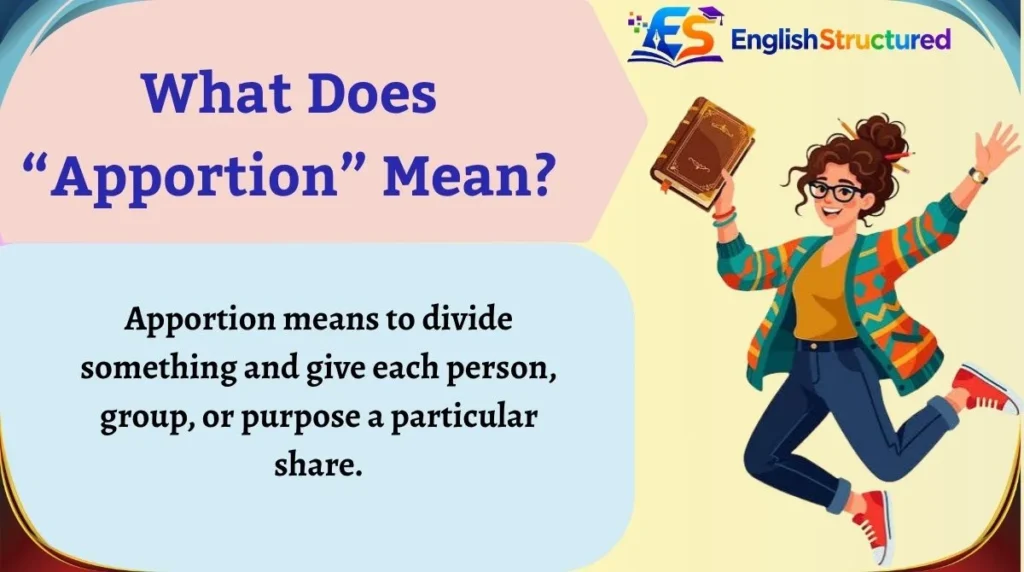
Apportion means to divide something and give each person, group, or purpose a particular share.
It is usually used when something needs to be divided fairly or according to a particular rule. The thing being divided may be money, time, responsibility, resources, work, costs, or property.
Apportion vs Portion vs Proportion
Simple meaning
Apportion = to divide and distribute something among people or groups
For example:
- The manager apportioned the work among the employees.
- Apportion vs Portion vs Proportion
In both sentences, something is being divided and assigned.
When should you use “apportion”?
Use apportion when you are talking about the action of dividing something into shares.
It often appears when there are several people, groups, departments, or purposes involved.
You might use it when discussing:
- Money
- Work
- Costs
- Responsibilities
- Resources
- Land
- Time
- Benefits
- Taxes
- Duties
The word is somewhat formal. In casual conversation, people often use simpler expressions such as divide, share, or split.
For example:
Apportion vs Portion vs Proportion
This is correct, but in everyday speech, you could simply say:
We need to split the cost among the four families.
Grammar rule for “apportion”
Apportion vs Portion vs Proportion
Common patterns include:
apportion + something + among/between + people or groups
Examples:
- The teacher apportioned the tasks among the students.
- The company apportioned the budget among its departments.
- The judge apportioned the costs between the two parties.
You can also use:
Apportion vs Portion vs Proportion
Example:
The funds were apportioned according to the needs of each department.
8 examples of “apportion”
- Apportion vs Portion vs Proportion
- The company apportioned the expenses among its branches.
- The government apportioned money to local schools.
- We need to apportion the work fairly.
- The committee apportioned responsibility among its members.
- The land was apportioned between the two families.
- The manager apportioned each employee a share of the project.
- Apportion vs Portion vs Proportion
A common learner confusion
A common mistake is using portion when the sentence actually needs a verb.
For example:
Apportion vs Portion vs Proportion
This sentence can be grammatically possible in some contexts, but apportion is usually the better word when you mean formally dividing and assigning shares.
Compare:
Apportion vs Portion vs Proportion
Here, the focus is on the act of dividing and assigning the budget.
Remember:
Apportion = the action of dividing something into shares.
What Does “Portion” Mean?
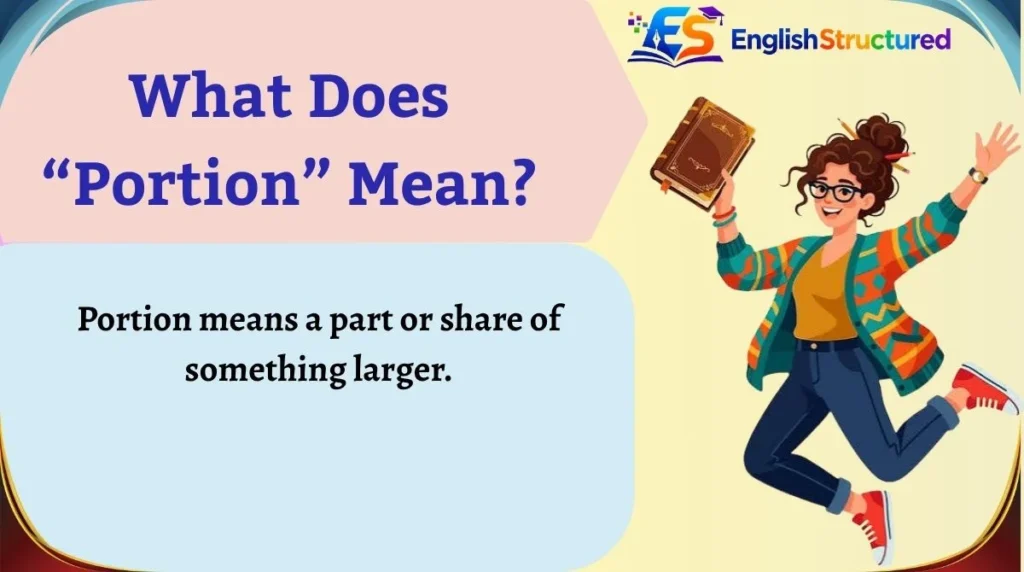
Portion means a part or share of something larger.
It can refer to food, money, land, work, time, or almost anything that can be viewed as a part of a whole.
Apportion vs Portion vs Proportion
Simple meaning
Portion = a part or amount of something
For example:
Apportion vs Portion vs Proportion
Here, “portion” means a part of the whole cake.
Another example:
Each student received an equal portion of the prize money.
Here, it means each student’s share.
When should you use “portion”?
Apportion vs Portion vs Proportion
It is especially common when talking about:
- Food
- Money
- Land
- Time
- A book or text
- A task
- A group
- A larger object
One of its most common everyday uses is for food.
For example:
Can I have a smaller portion of rice?
The restaurant serves large portions.
She ordered a portion of fries.
“Portion” as a noun
Apportion vs Portion vs Proportion
Examples:
- a large portion of food
- a small portion of the budget
- a portion of the population
- a portion of the building
- a portion of the land
The word can be followed by of.
Apportion vs Portion vs Proportion
Examples:
A large portion of the money was spent on education.
Only a small portion of the cake remained.
“Portion” as a verb
Portion can also be a verb.
Apportion vs Portion vs Proportion
For example:
Apportion vs Portion vs Proportion
Here, the chef divided the soup into five amounts.
Apportion vs Portion vs Proportion
Apportion vs Portion vs Proportion
8 examples of “portion”
- I ordered a small portion of rice.
- Apportion vs Portion vs Proportion
- Each child received an equal portion of the money.
- Only a small portion of the land is used for farming.
- A large portion of the budget goes to education.
- Please give me a smaller portion.
- Apportion vs Portion vs Proportion
- The chef portioned the food into separate containers.
A common learner confusion
Learners sometimes think portion and apportion are interchangeable because they look almost the same.
They are related, but their grammar is different.
Compare:
Apportion vs Portion vs Proportion
Apportion vs Portion vs Proportion
Now compare:
Each worker received a portion of the money.
Here, portion is a noun describing the share that each worker received.
A simple way to remember this is:
Apportion vs Portion vs Proportion
Portion = the part or share.
What Does “Proportion” Mean?
Proportion means the relationship between one part and another part, or between a part and the whole.
It is often used when comparing amounts.
For example:
Apportion vs Portion vs Proportion
This does not simply mean “a large part.” It focuses on the relationship between the students who passed and the total number of students.
Simple meaning
Apportion vs Portion vs Proportion
The word is commonly used in:
- Mathematics
- Statistics
- Science
- Reports
- Business
- Surveys
- Everyday comparisons
Proportion in simple English
Imagine a box containing 100 apples.
Apportion vs Portion vs Proportion
You are not only saying that green apples are a part of the box. You are showing how that part compares with the total.
That is the key idea behind proportion.
Grammar rule for “proportion”
Proportion is a noun.
A very common structure is:
Apportion vs Portion vs Proportion
Examples:
A large proportion of students use smartphones.
A small proportion of workers work from home.
Another common structure is:
Apportion vs Portion vs Proportion
Example:
The proportion of students who passed the exam increased.
8 examples of “proportion”
- Apportion vs Portion vs Proportion
- Only a small proportion of the population lives in that area.
- The proportion of women in the workforce has increased.
- A high proportion of customers prefer online shopping.
- The survey shows a similar proportion of young people using the service.
- The proportion of successful applicants was very low.
- Apportion vs Portion vs Proportion
- The two ingredients should be mixed in the correct proportion.
Proportion vs percentage
These words are related, but they are not always identical.
A percentage gives an amount out of 100.
A proportion describes the relationship between parts and the whole.
For example:
40% of students passed.
This gives a specific percentage.
You could also say:
Apportion vs Portion vs Proportion
This gives a general idea about the relationship without giving an exact number.
Difference Between Apportion, Portion, and Proportion
The easiest way to understand the three words is to focus on what each one does.
| Word | Main meaning | Grammar | Main idea | Example |
|---|---|---|---|---|
| Apportion | Divide and assign shares | Verb | The action of dividing | We apportioned the money among the teams. |
| Portion | A part or share | Noun / Verb | One part of a whole | She received a portion of the money. |
| Proportion | Relationship between parts or amounts | Noun | Comparing parts with the whole | A large proportion of students passed. |
1. Apportion focuses on dividing
Apportion vs Portion vs Proportion
The manager apportioned the work among the staff.
The important action is dividing and assigning.
2. Portion focuses on a part
When you talk about a portion, you are talking about one part or share.
I received my portion of the money.
The focus is on the share itself.
3. Proportion focuses on comparison
Apportion vs Portion vs Proportion
A large proportion of the students passed.
The focus is on the relationship between the students who passed and the entire group.
Compare these three sentences
Consider a company with a budget of $100,000.
The director apportioned the budget among five departments.
This means the director divided and assigned the money.
Apportion vs Portion vs Proportion
This means each department received a share.
A large proportion of the budget went to research.
This tells us about the relationship between the research spending and the total budget.
The words are connected, but their jobs are different.
Grammar Rules You Must Remember
Rule #1: Use “apportion” for the act of dividing
Apportion vs Portion vs Proportion
Use it when someone divides something and assigns shares.
The manager apportioned the work among the employees.
Do not use apportion as a simple noun meaning “a part.”
Wrong:
I received an apportion of the money.
Correct:
I received a portion of the money.
Rule #2: Use “portion” for a part or share
Portion commonly works as a noun.
She ate a small portion of the meal.
He received his portion of the prize.
The word tells us about a part of something larger.
A useful pattern is:
a portion of + noun
Examples:
a portion of the food
a portion of the money
a portion of the land
a portion of the population
Rule #3: Use “proportion” when comparing amounts
Use proportion when the relationship between parts is important.
A large proportion of the students passed.
Only a small proportion of the money was spent.
The word is especially useful when discussing statistics, surveys, research, and numbers.
Rule #4: Remember that “portion” and “proportion” are not the same
Both words can describe a part, but proportion adds the idea of comparison or relationship.
Compare:
A large portion of the cake was eaten.
This simply describes a large part of the cake.
Now:
A large proportion of the students passed.
This focuses on the number of students who passed compared with the total number of students.
That small difference is very important.
Common Mistakes Students Make
These three words are easy to confuse because they share similar letters and meanings. Here are some mistakes to watch for.
Mistake 1: Using “portion” instead of “apportion”
Incorrect:
The manager portioned the tasks among the employees.
Although “portion” can be used as a verb, it does not always carry the same formal sense of assigning shares.
Better:
The manager apportioned the tasks among the employees.
Use apportion when the main idea is formal division and assignment.
Mistake 2: Using “apportion” as a noun
Incorrect:
Everyone received an apportion of the money.
Correct:
Everyone received a portion of the money.
Apportion is a verb.
Portion is the noun you usually need here.
Mistake 3: Confusing “portion” with “proportion”
Incorrect:
A large portion of students passed the exam.
Apportion vs Portion vs Proportion
Better:
A large proportion of students passed the exam.
However, “portion” is perfectly natural when you simply mean a part:
A large portion of the class left early.
Mistake 4: Forgetting “of”
Learners often leave out of after portion or proportion.
Incorrect:
A large portion the money was spent.
Correct:
A large portion of the money was spent.
Incorrect:
A small proportion students failed.
Correct:
A small proportion of students failed.
The pattern is usually:
portion/proportion + of + noun
Mistake 5: Using “proportion” when you only mean a physical part
Suppose you cut a cake and give someone one piece.
Natural:
She ate a portion of the cake.
You do not need “proportion” unless you are talking about the relationship or size of that part compared with something else.
A good correction tip is to ask:
“Am I talking about a part, or am I comparing amounts?”
If it is simply a part, portion may be right.
Apportion vs Portion vs Proportion
Easy Trick to Remember the Difference
Here is a simple three-word memory trick:
Apportion = Assign
Both ideas involve giving someone a share.
The manager apportioned the work.
Think: Who gets what?
Portion = Part
A portion is simply a part of something.
I ate a portion of the pizza.
Think: What part?
Proportion = Compare
Proportion helps you think about how one part relates to the whole or another part.
A large proportion of the class passed.
Think: How much compared with the whole?
So remember:
APPORTION → ASSIGN
PORTION → PART
PROPORTION → COMPARE
That one trick can help you choose the correct word quickly.
Daily Life Examples
These examples show how the three words can appear in normal conversations.
Example 1: Sharing a bill
Ali: How should we divide the restaurant bill?
Sara: We can apportion it equally among the four of us.
Here, apportion means to divide and assign the costs.
Example 2: Talking about food
Ali: Is that a full meal?
Sara: No, it’s only a small portion.
Here, portion means an amount of food.
Example 3: Talking about students
Teacher: How many students passed?
Student: A large proportion of the class passed.
Here, proportion describes the number of successful students compared with the whole class.
Example 4: Sharing work
Manager: We have a lot to finish today.
Employee: We should apportion the work among the team.
The speaker is talking about dividing responsibilities.
Example 5: Talking about money
Each family received an equal portion of the money.
The focus is on each family’s share.
Example 6: Talking about a budget
A large proportion of our budget goes toward rent.
The speaker is comparing rent with the entire budget.
Example 7: Talking about land
The farmer apportioned the land among his children.
The land was divided and assigned.
Example 8: Talking about food again
Please give me a smaller portion of rice.
This is a normal everyday use of portion.
Example 9: Talking about survey results
A high proportion of customers said they were satisfied.
The speaker is talking about the relationship between satisfied customers and all customers surveyed.
Example 10: Talking about responsibilities
The team leader apportioned responsibilities among the members.
The leader divided and assigned different duties.
Practice Section
Apportion vs Portion vs Proportion
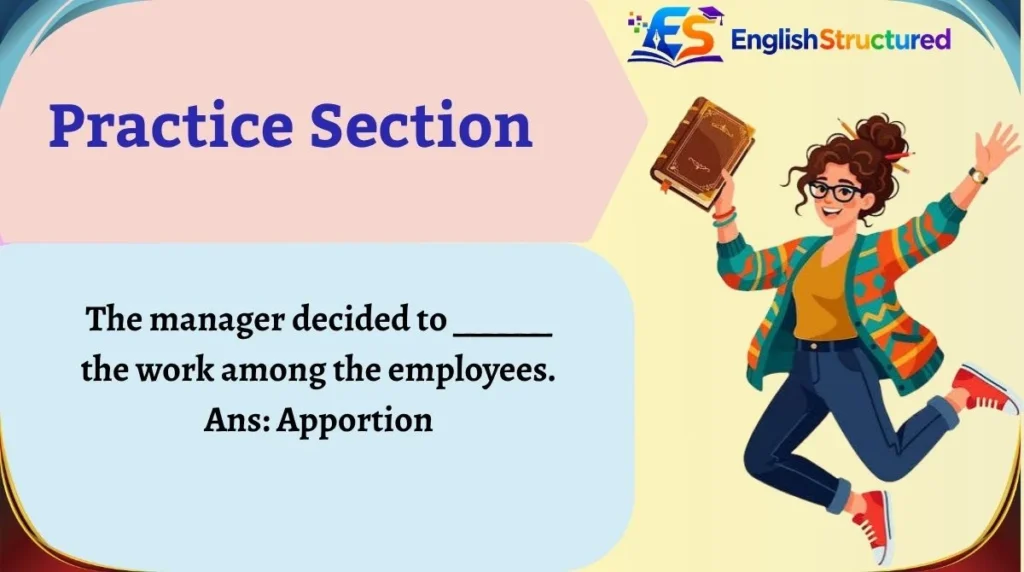
1. The manager decided to ______ the work among the employees.
2. I could not finish my ______ of the meal.
3. A large ______ of the students passed the exam.
4. The money was ______ among the different departments.
5. Each child received an equal ______ of the prize.
Answers
1. apportion
The manager decided to apportion the work among the employees.
The manager is dividing and assigning the work.
2. portion
I could not finish my portion of the meal.
A portion is a part or amount of something.
3. proportion
A large proportion of the students passed the exam.
This refers to the relationship between students who passed and the whole group.
4. apportioned
The money was apportioned among the different departments.
The money was divided and assigned.
5. portion
Each child received an equal portion of the prize.
Each child received a share.
FAQs
What is the difference between apportion and portion?
Apportion is mainly a verb meaning to divide and assign something among people or groups. Portion usually means a part or share of something. For example, a manager can apportion money, while each worker receives a portion of it.
What is the difference between portion and proportion?
A portion is simply a part or share of something. A proportion describes the relationship between one part and the whole or between different amounts. “A portion of the cake” means a part of the cake, while “a large proportion of students” focuses on the number compared with the whole group.
Is “apportion” a verb or noun?
Apportion is a verb. It means to divide something and give different shares to people, groups, or purposes. For example: “The company apportioned the budget among its departments.”
Can “portion” be used as a verb?
Yes. Portion can be both a noun and a verb. As a noun, it means a part or amount. As a verb, it means to divide something into portions. For example: “The chef portioned the food into five containers.”
Is “proportion” formal or informal?
Proportion is common in both general and formal English, although it is especially common in academic, business, scientific, and statistical writing. In everyday speech, people may sometimes use simpler expressions such as “part,” “amount,” or “share.”
Can “portion” and “proportion” be used interchangeably?
Not always. They can both refer to a part, but proportion usually adds the idea of a relationship or comparison. Use “portion” for a part or share and “proportion” when the size of that part in relation to the whole is important.
Conclusion
Apportion vs Portion vs Proportion
Apportion is a verb. It means to divide and assign something among people, groups, or purposes. Think about dividing work, money, land, or responsibility.
Portion usually means a part or share of something. It is especially common when talking about food, money, land, time, or a section of something.
Proportion means the relationship between parts or amounts.
It is common when comparing one part with the whole, especially in statistics, reports, and everyday discussions about numbers.
Keep this simple memory trick in mind:
Apportion = assign.
Portion = part.
Proportion = compare.
Once you start noticing these words in real sentences, the difference will feel much more natural. Try making a few sentences of your own, and you will soon stop mixing them up.