Any Information or Some Information
Both can talk about an amount that is not exact, so it may seem that they can be used in the same way. However, they are not always interchangeable.
The phrases any information and some information are especially common in everyday English.
You may hear them at school, at work, in emails, on websites, or during simple conversations. For example, someone may ask, “Do you have any information about the meeting?”
Another person might say, “I have some information about the new schedule.”
Both sentences are correct, but they do not communicate exactly the same idea.
The main difference is often connected to the type of sentence and the speaker’s meaning.
We commonly use any information in questions and negative sentences when the amount or existence of information is uncertain.
We often use some information in positive sentences when the speaker knows that information exists or wants to refer to an unspecified amount.
There are also situations where some can be used in questions, especially when the speaker expects a “yes” answer or is making an offer or request.
By the end, you will understand when to use any information, when to use some information, how the two phrases differ, and how native speakers use them in real conversations.
What Does “Any Information” Mean?
Any information means information of any amount or type, without specifying exactly what information is meant.
The word any is often used when we do not know whether something exists, or when the exact amount is not important.
For example:
Any Information or Some Information
The speaker does not know whether the other person has information. The answer could be yes or no.
We commonly use any with uncountable nouns such as:
- information
- advice
- money
- water
- help
- time
- news
- work
Because information is an uncountable noun, we say any information, not any informations.
When Do We Use “Any Information”?
The most common use is in questions.
For example:
Any Information or Some Information
The speaker is simply asking whether information is available.
Any Information or Some Information
I don’t have any information about the accident.
Here, the speaker says that there is no information available to them.
Another common use appears in sentences with words such as without, hardly, or never.
Any Information or Some Information
The phrase means that he gave us no information.
Grammar Rule for “Any Information”
A simple rule is:
Use “any” when talking about an unspecified amount, especially in questions and negative sentences.
The basic patterns are:
Question:
Any Information or Some Information
Negative:
Subject + do/does not + have + any information.
Here are some examples:
- Any Information or Some Information
- Did she give you any information about the interview?
- I don’t have any information about the problem.
- We haven’t received any information yet.
- Does the website provide any information about prices?
- He didn’t give me any information about the meeting.
- Any Information or Some Information
- They left without giving us any information.
Notice that any information works naturally in all these examples because the speaker is asking about, denying, or emphasizing the absence of information.
A Common Learner Confusion
Any Information or Some Information
That is not always true.
In the question:
Any Information or Some Information
Any means something like “even a little information” or “information of any kind.”
The speaker is not asking for every possible piece of information. They simply want to know whether information is available.
What Does “Some Information” Mean?
Some information means an unspecified amount of information.
The speaker usually believes that the information exists. They may have a small amount, a certain amount, or simply an amount that they do not want to describe exactly.
For example:
Any Information or Some Information
This tells us that the speaker has information. We do not know exactly how much information they have.
Any Information or Some Information
She gave me some information about the course.
The speaker knows that information was given.
When Do We Use “Some Information”?
The most common use of some information is in positive sentences.
For example:
Any Information or Some Information
The speaker found information. The exact amount is not stated.
We can also use some information when we want to offer information.
Would you like some information about our services?
This is a question, but some is natural because the speaker is making an offer.
We can also use it when making a polite request.
Could you give me some information about the course?
Here, the speaker expects or hopes that the listener can provide information.
Grammar Rule for “Some Information”
A useful basic rule is:
Use “some” when you are referring to an unspecified amount that exists or is expected to exist.
The most common pattern is:
Any Information or Some Information
Examples:
- Any Information or Some Information
- She gave me some information about the school.
- We received some information this morning.
- He found some information about the train schedule.
- They shared some information with us.
- I need some information about the application process.
- The teacher gave us some information about the test.
- Any Information or Some Information
In each example, the speaker refers to information that exists or is expected to be provided.
Can “Some Information” Be Used in Questions?
Yes.
This is an important point for learners.
Any Information or Some Information
Compare:
Any Information or Some Information
This is a neutral question. The speaker does not know whether the listener has information.
Now consider:
Could you give me some information about the event?
This is a polite request. The speaker expects the person may provide information.
Another example is:
Any Information or Some Information
This is an offer.
So, some is not forbidden in questions. The choice depends on the speaker’s purpose and expectation.
Difference Between “Any Information” and “Some Information”
The easiest way to understand the difference is to look at what the speaker knows or expects.
| Phrase | Common use | Main idea | Example |
|---|---|---|---|
| any information | Questions and negatives | Information may or may not exist | Do you have any information? |
| some information | Positive statements | Information exists or is expected | I have some information. |
| any information | Negative statements | No information | I don’t have any information. |
| some information | Offers | An amount is being offered | Would you like some information? |
| some information | Requests | The speaker wants information | Could you give me some information? |
“Any Information” in a Neutral Question
Suppose you meet your friend after school.
You ask:
Any Information or Some Information
You genuinely do not know whether your friend knows anything.
The answer might be:
Any Information or Some Information
Or:
No, I don’t have any information.
This gives us a useful pattern:
Question: Do you have any information?
Positive answer: Yes, I have some information.
Negative answer: No, I don’t have any information.
This is one of the easiest ways to remember the difference.
“Some Information” Shows Existence
When someone says:
Any Information or Some Information
They are telling you that information exists and that they have it.
The amount is not clear, but its existence is clear.
The sentence does not mean that they have every piece of information. It simply means they have an unspecified amount.
“Any Information” Can Suggest Uncertainty
When someone asks:
Any Information or Some Information
They do not know whether information exists.
They are checking.
The answer could be:
Any Information or Some Information
Or:
No, there isn’t any information available.
This contrast is very useful:
Any Information or Some Information
any = checking whether an amount exists
This is not an absolute rule for every sentence, but it works very well for everyday English.
Grammar Logic Behind “Some” and “Any”
Both words are called determiners when they come before nouns.
They help us talk about an amount without giving an exact number.
With countable nouns, we might say:
some books
any books
But information is uncountable, so we say:
Any Information or Some Information
any information
We do not normally say:
Any Information or Some Information
or:
any informations
Instead, if we need to count pieces of information, we can say:
a piece of information
two pieces of information
several pieces of information
For example:
Any Information or Some Information
Or:
She gave me three pieces of information.
Both are grammatically correct, but the second sentence gives a specific number.
Grammar Rules You Must Remember
Rule #1: Use “Any Information” in Many Questions
When you are simply checking whether information exists, any information is usually the natural choice.
Example:
Do you have any information about the meeting?
You do not know whether the person has information.
Another example:
Has the company released any information about the new product?
The speaker is asking whether the company has released information.
Rule #2: Use “Any Information” in Negative Sentences
After a negative verb such as don’t, doesn’t, didn’t, haven’t, or hasn’t, we commonly use any information.
Examples:
I don’t have any information.
She didn’t give me any information.
We haven’t received any information yet.
A common mistake is to use some after a normal negative verb:
I don’t have some information. ❌
For the usual meaning of “I have no information,” say:
I don’t have any information. ✅
Rule #3: Use “Some Information” in Positive Statements
When you say that information exists, some information is often the natural choice.
Example:
I have some information about your application.
This means the speaker has information, but the exact amount is not given.
Another example:
The teacher gave us some information about the exam.
The information definitely exists.
Rule #4: “Some Information” Can Be Used for Offers and Requests
Do not think that some can never appear in a question.
We often use it when making an offer or a polite request.
Offer:
Would you like some information about the course?
Request:
Could you give me some information about the course?
The speaker expects the information to be available.
That is why some sounds natural.
Common Mistakes Students Make
Mistake 1: Thinking “Any” Is Always Wrong in Positive Sentences
Some learners learn the simple rule “some for positive, any for negative” and then use it too strictly.
In many cases, that rule is helpful, but it is not the whole story.
For example:
You can contact me if you need any information.
This is a positive sentence, but any information is completely natural.
Here, any means information of whatever kind may be needed.
So remember: grammar rules are useful guides, but meaning and context also matter.
Mistake 2: Saying “Informations”
This is a very common mistake.
Any Information or Some Information
I have some information. ✅
Information is normally uncountable in English.
If you want to count it, use pieces of information.
I have three pieces of information for you.
Not:
I have three informations. ❌
Mistake 3: Using “Some” in a Normal Negative Sentence
A learner might say:
I don’t have some information about it. ❌
If the intended meaning is “I have no information,” use any.
I don’t have any information about it. ✅
The same pattern works with many other uncountable nouns:
I don’t have any money.
She doesn’t need any advice.
We don’t have any time.
Mistake 4: Believing Every Question Needs “Any”
This is another oversimplification.
Compare:
Any Information or Some Information
and:
Could you give me some information about the school?
Both are questions.
The first is a neutral question about whether information exists.
The second is a request for information.
So ask yourself:
Am I checking whether something exists, or am I asking/offering something that I expect to be available?
That question can help you choose the right word.
Easy Trick to Remember the Difference
Here is a simple classroom trick:
Think of “Any” as a Question Mark
When you are checking whether something exists, think any.
Any Information or Some Information
You are checking.
Is there any information available?
You are checking.
Did they give you any information?
You are checking.
Think of “Some” as Something You Have
When information is already known to exist, think some.
I have some information.
She gave me some information.
We received some information.
There is another easy pair to memorize:
Any Information or Some Information
Yes, I have some information.
No, I don’t have any information.
If you remember these three sentences, you will understand a large part of the difference.
Daily Life Examples
The phrases appear in many normal conversations.
Example 1: At School
Student: Do you have any information about tomorrow’s exam?
Friend: Yes, I have some information from the teacher.
Example 2: At Work
Employee: Has the manager given you any information about the meeting?
Coworker: No, I haven’t received any information yet.
Example 3: Asking for Help
Customer: Could you give me some information about this course?
Staff member: Of course. The course starts next Monday.
Example 4: Offering Help
Receptionist: Would you like some information about our services?
Visitor: Yes, please.
Example 5: Talking About a Website
A: Did you find any information about the hotel?
B: Yes. I found some information about the rooms and prices.
Example 6: Talking About News
A: Do you have any information about what happened?
B: No. Nobody has given me any information.
Example 7: A Job Application
Applicant: Is there any information about the interview?
Assistant: Yes. We sent some information to your email.
Example 8: A Doctor’s Office
Patient: Could you give me some information about the appointment?
Receptionist: Sure. Your appointment is at 10 a.m.
Example 9: A Travel Question
Traveler: Do you have any information about the train schedule?
Station worker: Yes, I can give you some information about today’s trains.
Example 10: A General Conversation
A: Have you heard anything about the new project?
B: I have some information, but I don’t know all the details yet.
These examples show how naturally the two words can work together in the same conversation.
Practice Section
Any Information or Some Information
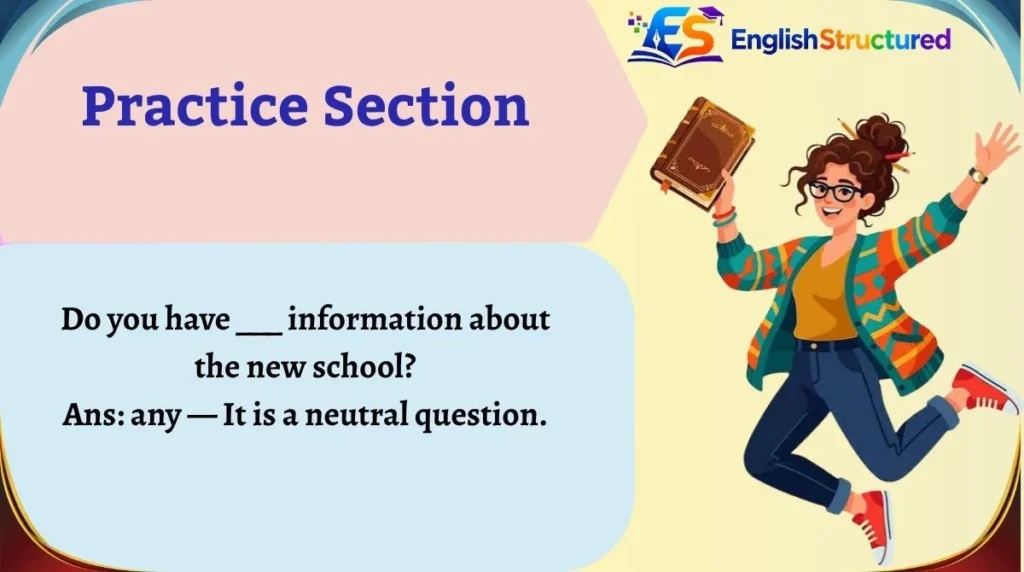
1. Do you have ___ information about the new school?
2. I have ___ information that may help you.
3. We don’t have ___ information about the accident.
4. Could you give me ___ information about the course?
5. Did she give you ___ information about the meeting?
Answers
1. any — It is a neutral question.
Any Information or Some Information
2. some — The speaker says that information exists.
I have some information that may help you.
3. any — The sentence is negative.
We don’t have any information about the accident.
4. some — This is a polite request.
Any Information or Some Information
5. any — The speaker is checking whether information was given.
Did she give you any information about the meeting?
FAQs
1. What is the difference between “any information” and “some information”?
Any information commonly refers to information whose existence is uncertain, especially in questions and negative sentences.
Some information usually refers to an unspecified amount that exists or is expected to exist.
For example, “Do you have any information?” checks whether information is available, while “I have some information” says that information is available.
2. Can we use “any information” in a positive sentence?
Yes.
Although any is very common in questions and negative sentences, it can appear in positive sentences with meanings such as “information of any kind.”
For example:
You can contact me if you need any information.
Here, any means whatever information you may need.
3. Can we use “some information” in a question?
Yes.
We commonly use some information in polite requests and offers.
For example:
Could you give me some information?
Or:
Would you like some information?
The use of some suggests that the speaker expects or wants information to be provided.
4. Is “any information” correct?
Yes. Any information is completely correct.
It is especially common in questions and negative sentences:
Do you have any information?
I don’t have any information.
It is also common in expressions such as:
If you need any information, please contact me.
5. Is “some information” grammatically correct?
Any Information or Some Information
Use it when referring to an unspecified amount of information, especially in positive statements.
For example:
She gave me some information about the job.
Remember that information is uncountable, so “some informations” is incorrect.
6. Should I say “any information” or “some information” in an email?
It depends on what you mean.
For a neutral question, any information is usually natural:
Do you have any information about the application?
Any Information or Some Information
Could you please provide some information about the application?
Both can be correct when the context changes.
Conclusion
Any Information or Some Information
Use any information when you are often checking whether information exists, especially in questions and negative sentences. For example, “Do you have any information?” and “I don’t have any information.”
Use some information when you are talking about an unspecified amount that exists or is expected. For example, “I have some information” or “She gave me some information.”
Remember that some can appear in questions, especially in polite requests and offers. “Could you give me some information?” is perfectly natural.
Also, never forget that information is uncountable. Say “some information,” “any information,” or “a piece of information,” not “informations.”
The best way to learn this difference is to notice it in everyday conversations and practice making your own sentences.
Once you understand the idea of checking with any and referring to existing information with some, choosing the right phrase becomes much easier.