Cite vs Site vs Sight
However, their meanings, spellings, and uses are completely different.
That is why even good English learners sometimes mix them up.
You may know what you want to say, but choosing the correct spelling can still be tricky. For example, you might want to talk about a location, but accidentally write sight instead of site.
These words appear often in everyday English, schoolwork, business writing, websites, books, news reports, and conversations.
Knowing the difference can help you write more clearly and avoid small spelling mistakes that change the meaning of a sentence.
The good news is that the difference is actually quite easy once you connect each word with its main idea.
Cite is connected with mentioning a source. Site is connected with a place or location. Sight is connected with seeing.
Think of three simple ideas:
- Cite = mention a source
- Site = a place
- Sight = seeing
Once these three meanings become familiar, you will have much less trouble choosing the right word.
You will also learn how each word works in a sentence, which mistakes to avoid, and a few simple memory tricks that can help you remember them for years.
What Does “Cite” Mean?
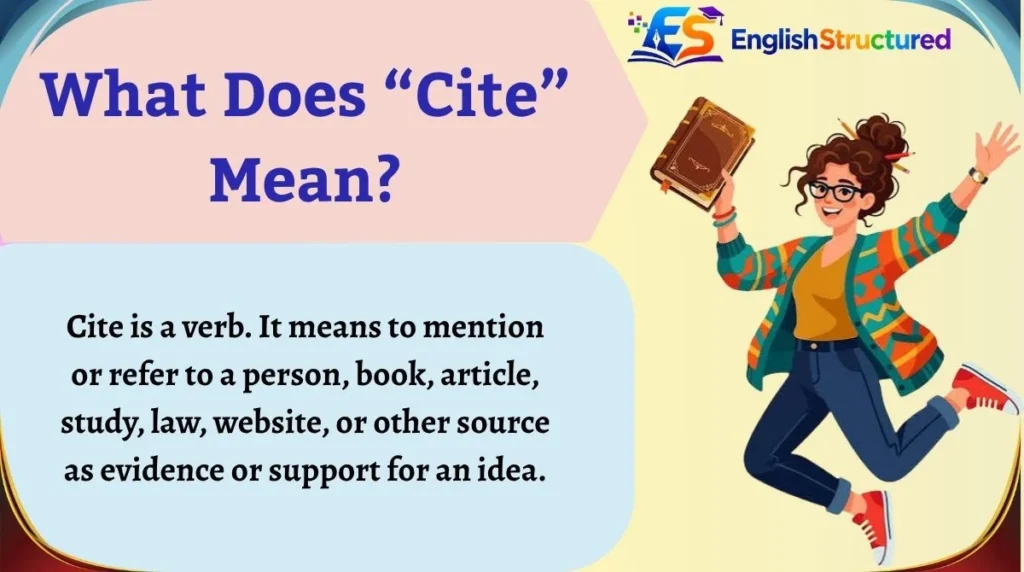
Cite is a verb. It means to mention or refer to a person, book, article, study, law, website, or other source as evidence or support for an idea.
You often see this word in academic writing. Students may cite books and research papers when writing assignments. Writers may cite sources when they give information that comes from another person or publication.
For example:
Cite vs Site vs Sight
Here, cited means that the student mentioned the books as sources.
The word cite can also mean to officially mention someone for an achievement or to praise someone for a reason. In legal or formal English, it can also mean to refer to a law, rule, or case.
When Should You Use “Cite”?
Use cite when you are talking about giving credit to a source or referring to something as evidence.
You may use it when discussing:
- Books
- Articles
- Research papers
- Studies
- Websites
- Reports
- Laws
- Court cases
- Speeches
- Statements from experts
Grammar Rule for “Cite”
Cite is a verb, so it normally describes an action.
Common forms include:
- Cite vs Site vs Sight
- cites
- cited
- citing
Examples:
I need to cite this study.
She cites several experts in her essay.
Cite vs Site vs Sight
We are citing the original source.
The noun related to this idea is citation.
A citation is the actual reference or credit given to a source.
The paper contains ten citations.
Examples of “Cite”
- Please cite your sources at the end of the assignment.
- Cite vs Site vs Sight
- You should cite the book before using its information.
- The professor asked students to cite reliable sources.
- The article cites several experts in the field.
- He cited the law during the discussion.
- She cited a famous author as an example.
- Cite vs Site vs Sight
Notice that every example involves mentioning or referring to a source, authority, or supporting information.
A Common Confusion With “Cite”
Many learners hear cite and immediately think about a website or physical place because it sounds like site. But cite has nothing to do with a location.
Compare these two sentences:
The company built a new site.
Cite vs Site vs Sight
The first sentence talks about a place. The second talks about mentioning a source.
A useful question is:
“Am I mentioning a source?”
If the answer is yes, you probably need cite.
What Does “Site” Mean?
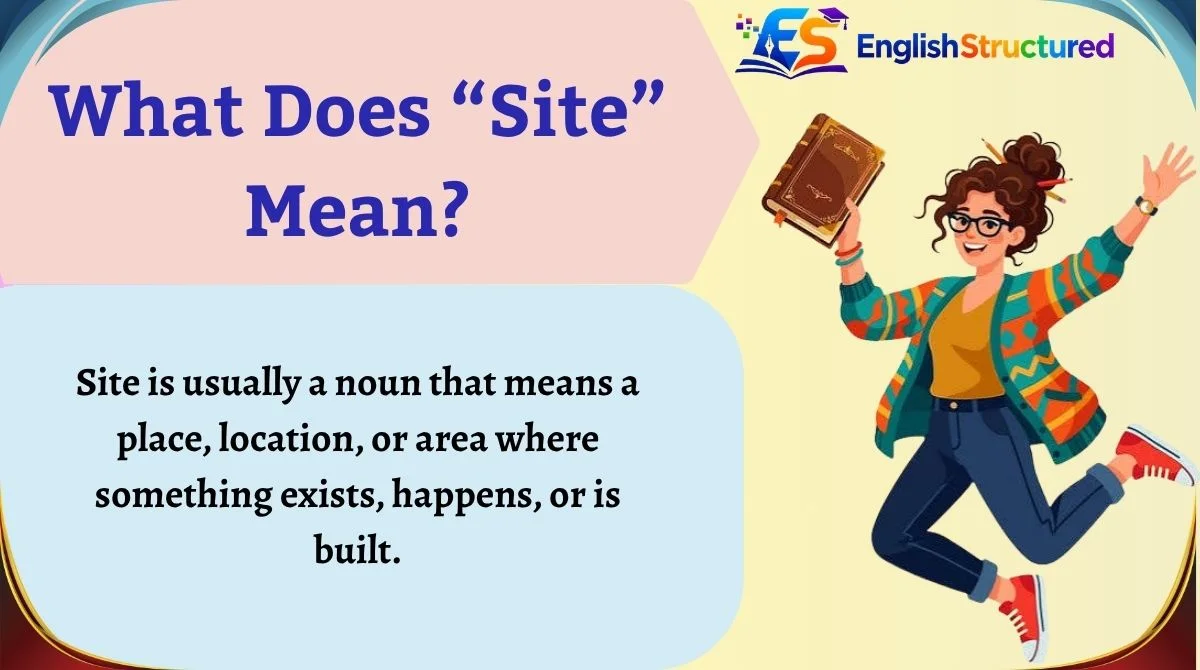
Site is usually a noun that means a place, location, or area where something exists, happens, or is built.
You can use site for physical places as well as some locations on the internet.
For example:
The workers arrived at the construction site.
The site is the place where construction is happening.
You may also hear phrases such as:
- Cite vs Site vs Sight
- building site
- historical site
- camping site
- website
- job site
- accident site
- Cite vs Site vs Sight
When Should You Use “Site”?
Use site when you are talking about a place or location.
It can describe a physical place:
The school was built on an old factory site.
It can also describe an online location:
I found the information on a government website.
In website, the word site refers to an online place where information or services are available.
Grammar Rule for “Site”
Cite vs Site vs Sight
As a noun, it can refer to a particular location:
This is the site of the new hospital.
As a verb, site can mean to choose a location for something:
The company plans to site the factory near the highway.
For everyday English, however, learners will most often meet site as a noun.
Examples of “Site”
- The workers cleaned the construction site.
- The hotel is located on a beautiful seaside site.
- We visited an ancient historical site.
- The accident site was closed for several hours.
- Cite vs Site vs Sight
- The camping site is near the lake.
- I found the information on a government website.
- The company moved its production site last year.
These examples all connect site with the idea of a place or location.
“Site” in Online English
One especially common use of site is website.
A website is an online place where people can read information, shop, communicate, learn, or use services.
For example:
I visited the university website.
Cite vs Site vs Sight
Please check the official site for more information.
So if you are talking about an online place, site is the correct spelling.
A Common Confusion With “Site”
Learners sometimes write:
Cite vs Site vs Sight
That spelling is incorrect if they mean an online location.
The correct sentence is:
I found this information on the official site.
Remember: a website is a site, not a sight.
What Does “Sight” Mean?
Sight is connected with seeing. It is usually a noun and can refer to the ability to see, something that you see, or a view that attracts attention.
For example:
My grandmother’s sight is getting weaker.
Here, sight means the ability to see.
It can also describe something interesting or impressive that you see:
Cite vs Site vs Sight
In that sentence, sight means something visible that is worth seeing.
When Should You Use “Sight”?
Use sight when you are talking about:
- Seeing
- The ability to see
- Something you can see
- A beautiful or unusual view
- A person or thing that becomes visible
You may also see sight in common expressions such as:
- Cite vs Site vs Sight
- out of sight
- in sight
- catch sight of
- lose sight of
- within sight
Grammar Rule for “Sight”
Sight is usually a noun.
It can describe the physical ability to see:
His sight became weaker with age.
It can also describe something seen:
Cite vs Site vs Sight
The word is strongly connected with the sense of vision.
Examples of “Sight”
- The doctor tested my sight.
- The sunset was a beautiful sight.
- The children cheered at the sight of the clown.
- The ship disappeared from sight.
- We caught sight of a deer in the forest.
- She fell in love with him at first sight.
- The mountains were finally in sight.
- Cite vs Site vs Sight
In every example, the meaning connects to seeing or something seen.
Common Expressions With “Sight”
At first sight means when you see someone or something for the first time.
They liked each other at first sight.
Cite vs Site vs Sight
The boat disappeared out of sight.
In sight means something can be seen or is visible.
The finish line is finally in sight.
Catch sight of means to see something, often briefly.
I caught sight of my friend across the street.
These expressions make sight easier to recognize because they all relate to vision.
Difference Between Cite, Site, and Sight
Although cite, site, and sight have the same pronunciation, their meanings are very different.
| Word | Part of Speech | Main Meaning | Simple Memory |
|---|---|---|---|
| Cite | Verb | Mention or refer to a source | Cite a source |
| Site | Usually noun | A place or location | Site = place |
| Sight | Usually noun | Seeing or something seen | Sight = see |
The most important difference is their meaning, not their pronunciation.
Cite = Mention a Source
Use cite when you refer to information from another source.
Cite vs Site vs Sight
Ask yourself:
“Am I giving credit to a source?”
If yes, use cite.
Site = Place
Use site when you mean a location.
The builders inspected the site.
Ask yourself:
“Am I talking about a place?”
Cite vs Site vs Sight
Sight = Seeing
Use sight when the sentence involves seeing, vision, or something visible.
The waterfall was an amazing sight.
Ask yourself:
“Am I talking about seeing?”
If yes, use sight.
Compare These Sentences
The writer cited a famous study.
The writer mentioned a study as a source.
Cite vs Site vs Sight
The researchers went to a location.
Cite vs Site vs Sight
The waterfall was something beautiful to see.
The pronunciation stays almost the same, but the meaning changes completely.
Grammar Rules You Must Remember
Rule #1: Use “Cite” for Sources
When you mention a source to support information, use cite.
Correct: The student cited two books.
Cite vs Site vs Sight
The student is not talking about places. The student is referring to books as sources.
A helpful related word is citation.
Add a citation after the quotation.
Rule #2: Use “Site” for a Place
When you mean a location, use site.
Correct: The workers arrived at the building site.
Incorrect: The workers arrived at the building sight.
The workers are at a physical location, so site is correct.
This rule also applies to online locations.
Visit our website for more information.
Here, site is part of the word website.
Rule #3: Use “Sight” for Seeing
When your meaning involves vision or something seen, use sight.
The rainbow was a beautiful sight.
You are describing something you saw, so sight is correct.
Another example:
My sight is not as good as it used to be.
Cite vs Site vs Sight
Rule #4: Do Not Choose the Word by Sound
This is perhaps the most important rule.
Cite, site, and sight sound alike, but sound does not tell you which spelling to use.
Instead, think about the meaning.
Source → cite
Place → site
Seeing → sight
This simple three-word connection can prevent most mistakes.
Common Mistakes Students Make
These mistakes happen because English contains many homophones. When two or more words have the same pronunciation, learners may choose a spelling based on sound rather than meaning.
Mistake 1: Using “Sight” for a Website
Wrong:
Check our official sight for details.
Correct:
Check our official site for details.
Why? Because a website is an online place.
Correction tip: If you can replace the word with website or location, use site.
Mistake 2: Using “Site” Instead of “Cite”
Wrong:
Please site your sources.
Correct:
Please cite your sources.
Why? You are asking someone to mention their sources, not to locate them.
Correction tip: If the sentence contains sources, references, studies, books, or evidence, check whether cite is needed.
Mistake 3: Using “Cite” for a Location
Wrong:
Cite vs Site vs Sight
Correct:
The building was constructed on this site.
The sentence is about a location.
Mistake 4: Using “Site” for Something Seen
Wrong:
The sunset was a wonderful site.
Correct:
The sunset was a wonderful sight.
The sunset is something you see, so the correct word is sight.
Mistake 5: Confusing “Sight” With “Site” in Expressions
Students sometimes write:
Cite vs Site vs Sight
The correct phrase is:
The car disappeared out of sight.
The phrase out of sight means that the car can no longer be seen.
A good way to learn these expressions is to memorize them as complete phrases instead of learning the words separately.
Easy Trick to Remember the Difference
Here is a very simple memory trick:
Cite = Credit
Both cite and citation are connected with giving credit to a source.
Think:
Cite vs Site vs Sight
If you mention where information came from, cite it.
Site = Spot
A site is a spot or place.
Think:
Site = Spot
A construction site is a construction spot. A historical site is a historical place. A website is an online place.
Sight = See
The word sight contains the idea of seeing.
Think:
Sight = See
If something is beautiful, visible, or related to your ability to see, sight is probably the word you need.
So remember:
Cite → Credit
Site → Spot
Sight → See
That is much easier than trying to memorize complicated grammar definitions.
Daily Life Examples
These examples show how the three words appear in normal conversations and everyday writing.
Example 1: School
Student: Did you finish your research paper?
Friend: Almost. I still need to cite my sources.
The student needs to give credit to the sources used in the paper.
Example 2: Construction
Worker: Where is the new office going to be?
Manager: They selected a site near the main road.
Here, site means a location.
Example 3: Travel
Friend: How was your trip?
Traveler: Amazing! The mountains were an incredible sight.
The mountains were something beautiful to see.
Example 4: Online Shopping
Customer: Where can I see the full product list?
Employee: Check our official site.
The website is an online location.
Example 5: Research
Teacher: Where did you get that information?
Student: I cited a scientific study.
The student referred to a source.
Example 6: Health
Doctor: How is your sight?
Patient: It has become a little blurry recently.
Here, sight means the ability to see.
Example 7: History
Tourist: What are we visiting today?
Guide: An ancient historical site.
The group is visiting a historical place.
Example 8: Nature
Child: Look at that rainbow!
Mother: What a beautiful sight!
The rainbow is something the mother can see.
Example 9: Academic Writing
Teacher: Your argument is strong, but you need to cite more evidence.
The teacher wants references to supporting sources.
Example 10: Travel and Location
Friend: Can you still see the hotel?
Traveler: No. It is out of sight now.
The hotel cannot be seen anymore.
Practice Section
Choose the correct word: cite, site, or sight.
1. Please ___ your sources in your essay.
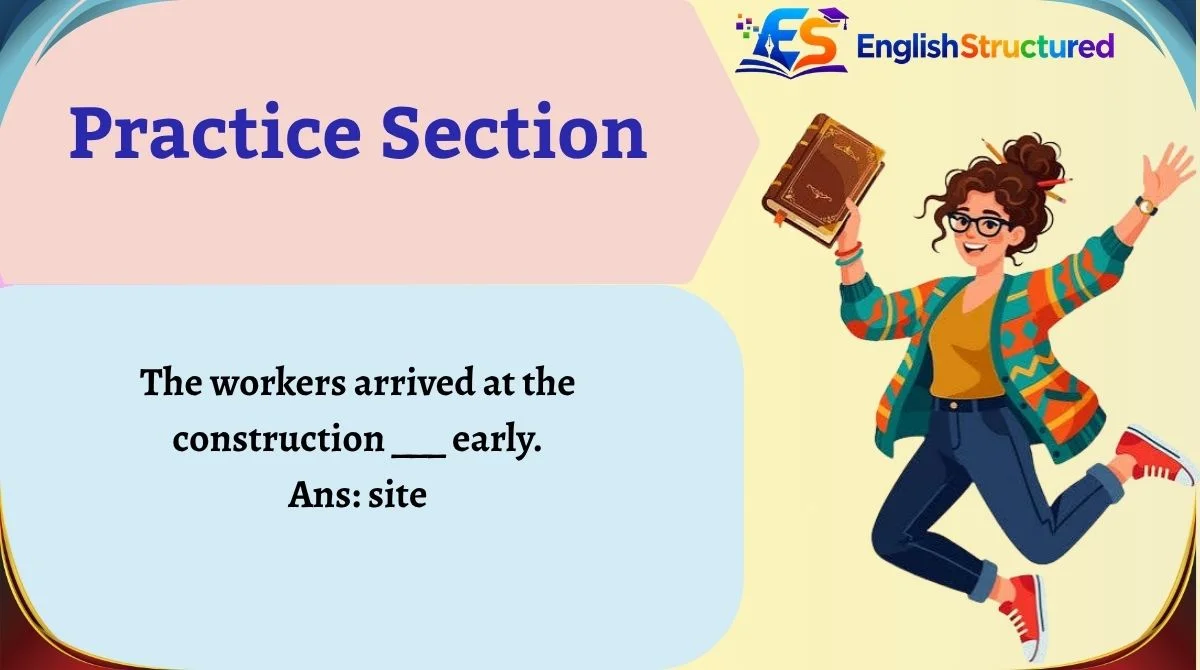
2. The workers arrived at the construction ___ early.
3. The waterfall was an amazing ___.
4. You can find more information on our official ___.
5. She has excellent ___ and can read small letters easily.
Answers
1. cite
Please cite your sources in your essay.
You are mentioning sources.
2. site
The workers arrived at the construction site early.
A construction site is a place.
3. sight
Cite vs Site vs Sight
The waterfall is something you can see.
4. site
You can find more information on our official site.
A website is an online place.
5. sight
She has excellent sight and can read small letters easily.
Here, sight means the ability to see.
FAQs
What is the difference between cite, site, and sight?
Cite means to mention or give credit to a source. Site means a place or location. Sight relates to seeing or something that is seen.
They sound alike but have different meanings and spellings.
Is “cite” a noun or a verb?
Cite is mainly a verb. It describes the action of referring to a source, law, study, book, or other authority.
For example: Students should cite their sources.
Cite vs Site vs Sight
Is “site” the same as “website”?
A website is a type of site, especially an online site.
For example, you can say website or sometimes simply site when the context is clear: Visit our site for more information.
Does “sight” mean the ability to see?
Yes. Sight can mean the ability to see.
For example: His sight became weaker as he got older.
It can also mean something that you see, such as The waterfall was a beautiful sight.
Which is correct: “cite a source” or “site a source”?
Cite vs Site vs Sight
Cite means to mention or give credit to a source. Site refers to a location, so site a source is normally incorrect when you mean academic referencing.
Which is correct: “historical site” or “historical sight”?
Usually, the correct phrase is historical site when you mean a place with historical importance.
For example: We visited a famous historical site.
However, you could use historical sight in a different context if you mean something historical that was seen. The meaning of the sentence decides the spelling.
Conclusion
Cite, site, and sight may sound exactly alike, but their meanings are easy to separate once you connect each word with a simple idea.
Cite is about sources and references. You cite a book, study, article, law, or other source. Site is about a place or location, including a physical location or an online website.
Cite vs Site vs Sight
When you are unsure, stop and ask yourself one quick question: What do I mean here?
If you mean credit or mention a source, choose cite. If you mean a place, choose site. If you mean seeing or something seen, choose sight.
The easiest memory trick is:
Cite = Credit
Site = Spot
Sight = See
These three words become much easier with practice. Try noticing them when you read websites, school assignments, books, news stories, or everyday messages.
The more you see them in real sentences, the more naturally you will choose the correct spelling.