Adopted vs Adoptive
The biggest difference is simple: adopted usually describes a person or animal that has been taken into a new family through adoption.
Adoptive describes a person, parent, family, or relationship connected with adoption.
For example, you can say, “She is an adopted child.” Here, adopted tells us what happened to the child. The child was legally taken into another family.
Now consider this sentence: “She lives with her adoptive parents.” Here, adoptive tells us what kind of parents they are. They became her parents through adoption.
This small difference matters because these words often appear in family conversations, school writing, news stories, books, legal documents, and everyday English.
Learners sometimes use one word when they need the other. That can make a sentence sound confusing or change its meaning.
The good news is that the difference is not difficult once you understand what each word focuses on.
After learning the examples and simple rules below, you should be able to choose the right word with much more confidence.
What Does “Adopted” Mean?
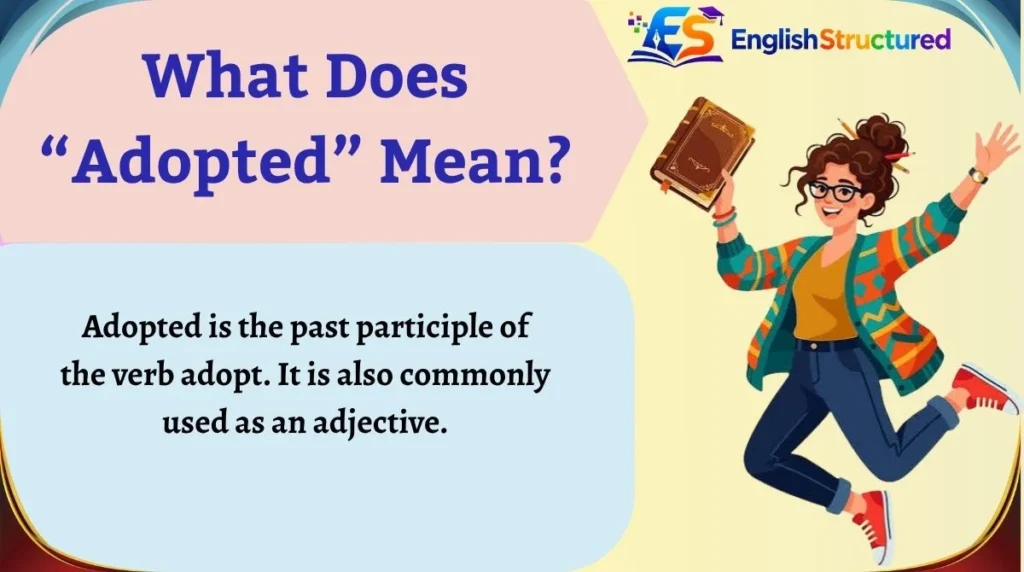
Adopted is the past participle of the verb adopt. It is also commonly used as an adjective.
When we talk about a person who has been legally accepted into a family that is not their birth family, we can use adopted.
For example:
Adopted vs Adoptive
This means Daniel was taken into a family through the legal process of adoption.
The word can describe what happened to someone. The focus is often on the person who was adopted.
Simple definition of adopted
Adopted means legally taken into a family as a son, daughter, or other family member.
It can also have other meanings outside family relationships. For example, a country can adopt a new law, or a company can adopt a new policy. In those cases, adopted means accepted or officially chosen.
However, when comparing adopted with adoptive, we are usually talking about adoption and family relationships.
Grammar rule for “adopted”
In family contexts, adopted commonly comes before a noun or after a linking verb.
Pattern 1:
Adopted vs Adoptive
- an adopted child
- an adopted son
- Adopted vs Adoptive
- an adopted baby
Pattern 2:
subject + be + adopted
- He was adopted.
- She is adopted.
- They were adopted as children.
Examples of “adopted”
- Mia was adopted when she was a baby.
- My adopted brother lives in Canada.
- The couple adopted a little girl last year.
- He recently learned that he was adopted.
- Their adopted son loves playing football.
- The adopted child grew up in a loving home.
- She has two adopted children.
- The family adopted a rescue dog from a local shelter.
Notice that adopted focuses on the person or animal that was taken into a new home or family.
Adopted does not always mean “born into the family”
This is an important point for English learners.
If someone says:
Adopted vs Adoptive
They mean that she became their daughter through adoption, not through biological birth.
Similarly:
“He is my adopted son.”
means he became their son through adoption.
The word adopted tells us about the way the family relationship was formed.
Another meaning of “adopted”
The verb adopt has a broader meaning, too.
For example:
- Adopted vs Adoptive
- The government adopted a new policy.
- She adopted a healthier lifestyle.
Here, adopted does not involve children or families. It means accepted, started using, or officially chose something.
So always look at the context.
What Does “Adoptive” Mean?
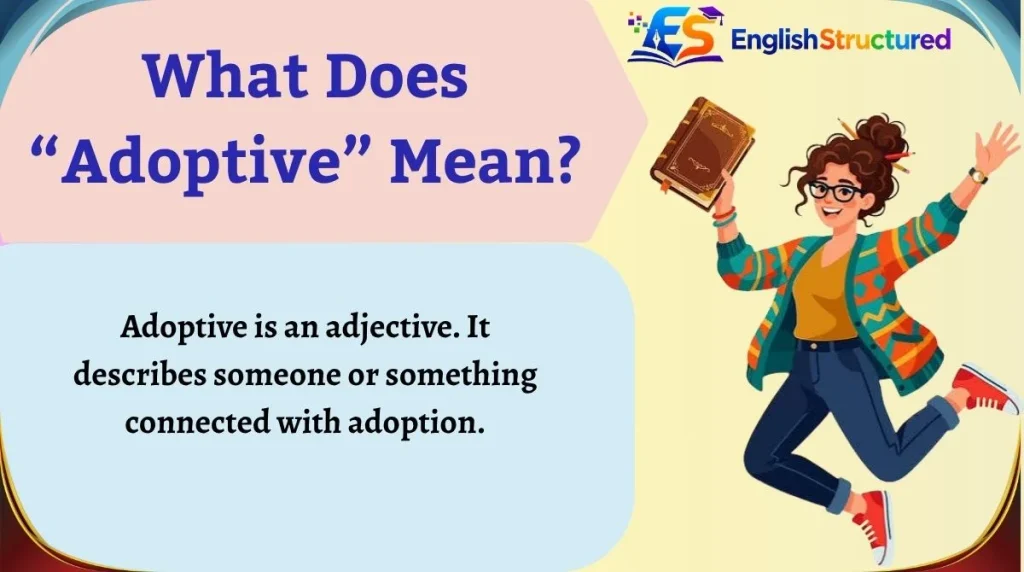
Adoptive is an adjective. It describes someone or something connected with adoption.
In family English, it is often used for a parent, family, relationship, or relative that exists because of adoption.
For example:
“My adoptive parents live in London.”
This means the parents became the speaker’s parents through adoption.
The word adoptive focuses on the relationship or role created through adoption, rather than simply saying that a person was adopted.
Simple definition of adoptive
Adoptive means connected with adoption, especially describing a parent or family relationship created through adoption.
Common expressions include:
- Adopted vs Adoptive
- adoptive mother
- adoptive father
- adoptive family
- adoptive child
- adoptive home
The most common use is probably adoptive parents.
Grammar rule for “adoptive”
Because adoptive is an adjective, it normally describes a noun.
Pattern:
Adopted vs Adoptive
For example:
- adoptive parents
- adoptive mother
- adoptive father
- Adopted vs Adoptive
You can also use it after certain linking verbs when it describes the subject:
“They are her adoptive parents.”
Examples of “adoptive”
- Her adoptive parents raised her with great care.
- He stayed in contact with his adoptive family.
- My adoptive mother taught me how to cook.
- The child moved to a new home with his adoptive parents.
- She is very close to her adoptive father.
- The adoptive family welcomed the child warmly.
- His adoptive parents supported his education.
- They invited their daughter’s adoptive family to the celebration.
In these examples, adoptive describes the type of parent or family relationship.
Adoptive vs biological
You will often see adoptive used alongside words such as biological or birth.
For example:
“She wanted to learn more about her biological parents while staying close to her adoptive parents.”
Here, biological parents means the parents related to her by birth, while adoptive parents means the parents who became her legal parents through adoption.
These terms describe different relationships.
Difference Between Adopted and Adoptive
The easiest way to understand the difference is to ask:
Who or what does the word describe?
Adopted vs Adoptive
Adoptive usually describes the parent, family, or relationship connected with adoption.
| Word | Main idea | Usually describes | Example |
|---|---|---|---|
| Adopted | Someone was taken into a family through adoption | Child, son, daughter, person, animal | She is an adopted child. |
| Adoptive | Connected with adoption | Parent, family, mother, father, relationship | They are her adoptive parents. |
| Adopted | Result of an adoption | The person or animal adopted | He was adopted as a baby. |
| Adoptive | Role created through adoption | The family or parent | His adoptive mother helped him. |
The basic difference
Compare these two sentences:
Tom is an adopted child.
Tom lives with his adoptive parents.
The first sentence describes Tom.
The second sentence describes Tom’s parents.
That is the key distinction.
Think about the direction
You can think of adoption as creating a relationship between two sides.
The child is adopted.
Adopted vs Adoptive
So:
adopted child → the child was adopted
adoptive parents → the parents adopted the child
This simple connection can help you choose the right adjective quickly.
Sentence structure
Adopted can be used with forms of be:
- She was adopted.
- He is adopted.
- Adopted vs Adoptive
It can also directly describe a noun:
- an adopted child
- an adopted daughter
- an adopted son
Adoptive usually comes directly before a noun:
- adoptive parents
- adoptive mother
- adoptive father
- adoptive family
So the grammar is different even though the words are related.
Compare these pairs
Correct:
Adopted vs Adoptive
Correct:
She lives with her adoptive parents.
The first tells us about the daughter.
The second tells us about the parents.
Another pair:
He was adopted at the age of two.
Adopted vs Adoptive
Again, adopted describes him, while adoptive describes his father.
Grammar Rules You Must Remember
Rule #1: Use “adopted” for the person or animal that was taken into a family
When the subject is the person who became part of a family through adoption, adopted is usually the right choice.
Example:
“Lena was adopted when she was six months old.”
Lena is the person who was adopted.
Another example:
Adopted vs Adoptive
The son is the person who was adopted.
Rule #2: Use “adoptive” for parents and family relationships connected with adoption
When you are describing the parents who adopted someone, use adoptive.
Example:
“Her adoptive parents live nearby.”
The parents are not the people who were adopted. They are the people who became parents through adoption.
You can also say:
Adopted vs Adoptive
Here, adoptive describes the mother’s relationship with him.
Rule #3: “Adopted” can describe more than family members
Remember that adopt has several meanings.
For example:
“The company adopted a new safety policy.”
Here, adopted means accepted or officially started using.
You could also say:
Adopted vs Adoptive
There is no family relationship in these sentences.
The surrounding words tell you which meaning is intended.
Rule #4: “Adoptive” is an adjective connected specifically with adoption
Adoptive is normally used to show that something is related to an adoption relationship.
Examples:
“She met her adoptive family.”
“He spoke about his adoptive mother.”
“The child stayed with an adoptive family.”
A useful grammar clue is that adoptive usually needs a noun to describe.
So when you see parents, mother, father, or family, adoptive is often the natural choice.
Common Mistakes Students Make
Many mistakes happen because the two words come from the same verb, adopt. Learners remember the general idea but forget which side of the relationship each adjective describes.
Mistake 1: Using “adoptive child” when “adopted child” is intended
A learner might write:
❌ “She is an adoptive child.”
A more natural choice is:
Adopted vs Adoptive
The child is the person who was adopted, so adopted is the usual word.
Easy tip: Ask, “Was this person adopted?” If the answer is yes, adopted is likely correct.
Mistake 2: Calling parents “adopted parents”
Another common mistake is:
❌ “He lives with his adopted parents.”
In standard family terminology, the clearer expression is:
Adopted vs Adoptive
The parents are adoptive because they became parents through adoption.
Mistake 3: Thinking “adoptive” means “the person who was adopted”
This is not the normal meaning.
If you say:
Adopted vs Adoptive
you are describing her status.
If you say:
“She has adoptive parents.”
you are describing her parents’ relationship to her.
Do not switch the two just because they look similar.
Mistake 4: Thinking “adopted” always relates to children
It does not.
You can say:
“The committee adopted the proposal.”
This means the committee accepted the proposal.
You can also say:
Adopted vs Adoptive
Here, adopted describes an action involving an animal.
So context matters.
Mistake 5: Assuming “adoptive” and “adopted” are interchangeable
They are related, but they are not normally interchangeable.
Compare:
“She met her adopted daughter.”
This describes the daughter.
Adopted vs Adoptive
This wording can occur in some contexts, but it is much less direct than adopted daughter when you simply mean a daughter who was adopted.
The safest everyday choice is:
adopted child/son/daughter
and
adoptive parent/mother/father/family.
Easy Trick to Remember the Difference
Here is a quick memory trick:
“Adopted = received”
Think of the person who received a new family relationship.
Adopted vs Adoptive
“Adoptive = adopter side”
Think of the parent or family that adopted the child.
The parents are adoptive.
You can remember this little pair:
Adopted child.
Adoptive parents.
That two-word combination covers the most common use.
Another helpful trick is to imagine a simple question:
Who was adopted?
The answer gets adopted.
What kind of parents are they?
The answer is adoptive parents.
For example:
Who was adopted? — Emma.
What kind of parents does Emma have? — Adoptive parents.
This works because the two words describe different sides of the same family relationship.
Daily Life Examples
Here are some natural examples you may hear in real conversations.
Example 1
A: “Is that your brother?”
B: “Yes. He is my adopted brother.”
The speaker is explaining that the brother became part of the family through adoption.
Example 2
A: “Who are those people?”
B: “They are her adoptive parents.”
Here, adoptive parents tells us that they became her parents through adoption.
Example 3
A: “When was your daughter adopted?”
B: “She was adopted when she was a baby.”
The daughter is the person who was adopted.
Example 4
A: “Does he still talk to his adoptive family?”
B: “Yes. They are very close.”
The family is described as adoptive because the relationship was formed through adoption.
Example 5
A: “Is your son adopted?”
B: “Yes, we adopted him when he was two.”
Both forms are natural here. Adopted describes the son, while adopted in “we adopted him” is the past tense of the verb.
Example 6
A: “Who raised her?”
B: “Her adoptive parents raised her.”
The adjective adoptive describes the parents.
Example 7
A: “Did the family adopt a dog?”
B: “Yes. Their adopted dog is very friendly.”
Here, adopted is used for an animal that was taken into the home.
Example 8
A: “What happened after the baby was adopted?”
B: “The baby moved into a new home.”
The baby is the person affected by the adoption.
Example 9
A: “Are you still in touch with your adoptive mother?”
B: “Yes. We speak every weekend.”
The mother is described as adoptive because she became the speaker’s mother through adoption.
Example 10
A: “Why did the school change its rules?”
B: “The school adopted a new policy.”
This example shows the other meaning of adopted. It has nothing to do with family adoption. It means the school officially accepted or started using a new policy.
Practice Section
Choose adopted or adoptive in each sentence.
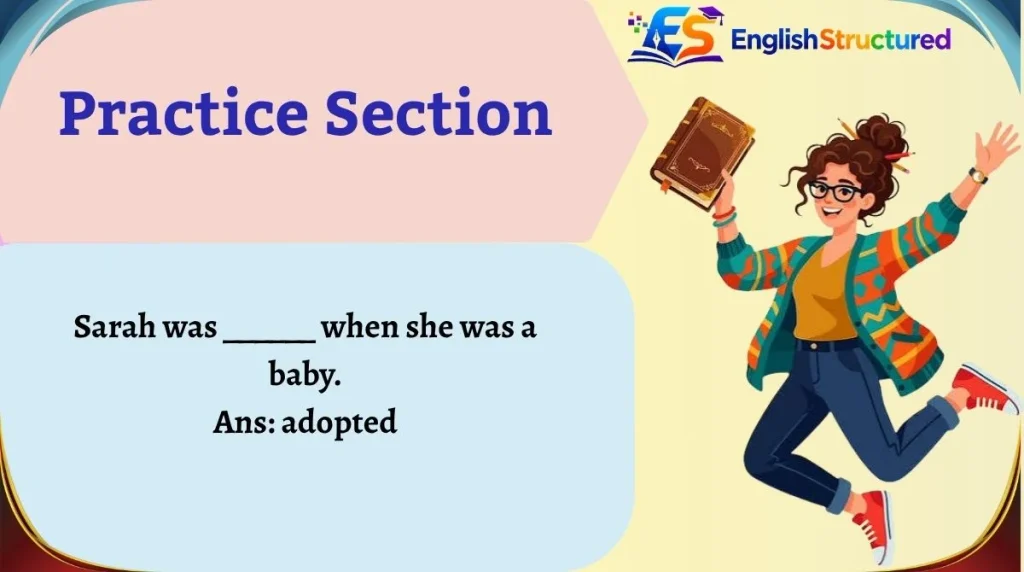
1. Sarah was ______ when she was a baby.
2. Her ______ parents live in Manchester.
3. He has an ______ sister.
4. The child met his ______ mother for the first time.
5. The company ______ a new working policy.
Answers
1. adopted
Sarah is the person who was taken into the family through adoption.
2. adoptive
The parents became parents through adoption, so they are her adoptive parents.
3. adopted
An adopted sister is a sister who joined the family through adoption.
4. adoptive
The mother is described by her relationship to the adopted child, so adoptive mother is appropriate.
5. adopted
Here, adopted means officially accepted or started using a policy.
FAQs
What is the difference between adopted and adoptive?
Adopted usually describes the person or animal that was taken into a family through adoption.
Adoptive describes a parent, family, or relationship connected with adoption.
For example, “an adopted child” and “adoptive parents” are both natural expressions.
Is it correct to say “adopted parents”?
In everyday standard English, adoptive parents is the clearer and more usual expression when you mean parents who became parents through adoption.
For example:
“She lives with her adoptive parents.”
Use adopted for the person who was adopted.
Is “adopted child” correct?
Yes. Adopted child is a common and correct expression.
It means a child who became part of a family through adoption.
For example:
“The adopted child grew up with three brothers.”
The word adopted describes the child.
Can “adopted” be used for animals?
Yes. Animals can also be adopted.
For example:
Adopted vs Adoptive
You can also describe the animal as an adopted pet.
The word still means that the animal was taken into a new home through an adoption process.
Is “adoptive” formal or informal?
Adoptive is a normal standard English word. It is not limited to very formal writing.
You can use it in everyday speech, school writing, books, news reports, and professional contexts.
Adopted vs Adoptive
Can I use “adopted” and “adoptive” in the same sentence?
Absolutely.
For example:
“The adopted child lives happily with her adoptive parents.”
This is a very useful sentence because it shows the difference clearly.
Adopted vs Adoptive
Conclusion
Adopted vs Adoptive
Use adopted when you are talking about the person or animal that was taken into a family through adoption.
You can say an adopted child, an adopted son, or she was adopted as a baby.
Use adoptive when you are describing parents, a family, or a relationship connected with adoption.
Common expressions include adoptive parents, adoptive mother, adoptive father, and adoptive family.
The easiest pair to remember is:
Adopted vs Adoptive
adoptive parents → the parents adopted the child
Also remember that adopted has a wider meaning. A government can adopt a law, a school can adopt a policy, and a person can adopt a new habit.
Once you focus on who was adopted and who became a parent through adoption, the difference becomes much easier.
Keep these two words in a few simple sentences, and soon the correct choice will feel natural.