Alter vs Altar
This can be frustrating, especially when you are learning English by listening and speaking. Two good examples are alter and altar.
These words are pronounced very similarly. In many accents, they can sound almost identical. However, their meanings are not related at all.
Alter is usually a verb that means to change something. Altar is a noun that refers to a special table or raised place used in religious ceremonies.
For example, you might say, “We need to alter the design before printing it.” Here, alter means change. But you could also say, “The couple stood near the altar.”
In this sentence, altar refers to a special place in a church or another place of worship.
The spelling difference is only one letter, so it is easy to make a mistake. A student may know the meaning of both words but still choose the wrong spelling while writing.
The good news is that the difference is quite simple once you connect each word with its meaning.
By the end of this guide, you will know when to use alter, when to use altar, how they work in sentences, common mistakes to avoid, and an easy trick to remember them.
What Does “Alter” Mean?
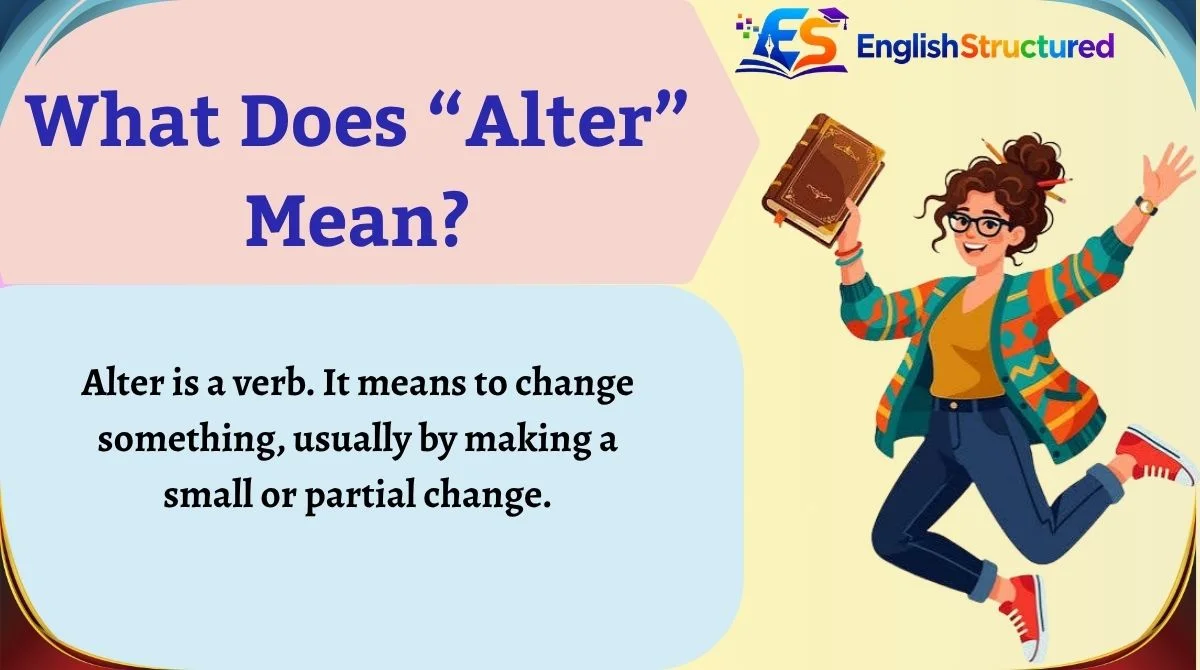
Alter is a verb. It means to change something, usually by making a small or partial change.
When you alter something, you do not always replace it completely. You make a change to improve it, adjust it, or make it suitable for a new situation.
For example:
Alter vs Altar
The dress is not being replaced. A small change will be made to its length.
The word alter can be used for clothes, plans, designs, schedules, buildings, opinions, behavior, and many other things.
When Should You Use “Alter”?
Use alter when you are talking about changing something.
It is commonly used when:
- A plan needs a change.
- A piece of clothing needs adjustment.
- A design needs modification.
- A schedule needs to be changed.
- Someone changes their behavior or opinion.
- The condition or appearance of something is changed.
Grammar Rule for “Alter”
Alter vs Altar
A common sentence pattern is:
Subject + alter + object
For example:
We need to alter the plan.
Here, “we” is the subject, “alter” is the verb, and “the plan” is the object.
You can also use different verb forms:
- alter
- alters
- altered
- altering
Examples of “Alter”
- Alter vs Altar
- The tailor will alter the jacket to make it smaller.
- We had to alter our plans because of the rain.
- She decided to alter her study routine.
- The company may alter the design of the product.
- Alter vs Altar
- His experience altered his opinion about the problem.
- The builder had to alter the original plan.
Notice that alter always carries the idea of change or adjustment in these examples.
Alter Does Not Usually Mean “Destroy”
A useful point for learners is that alter usually suggests changing something that already exists.
For example:
Alter vs Altar
This means we changed something about the room.
It does not necessarily mean that we destroyed the room or built a completely new one.
You could alter the furniture, wall color, layout, lighting, or another part of it.
Alter in Everyday English
You may hear alter in both everyday and formal English.
For example:
Alter vs Altar
This is natural when speaking to a tailor.
You might also hear:
“The meeting time was altered.”
This sounds slightly more formal than:
“The meeting time was changed.”
So, alter and change are often close in meaning, but alter can sound a little more formal.
What Does “Altar” Mean?
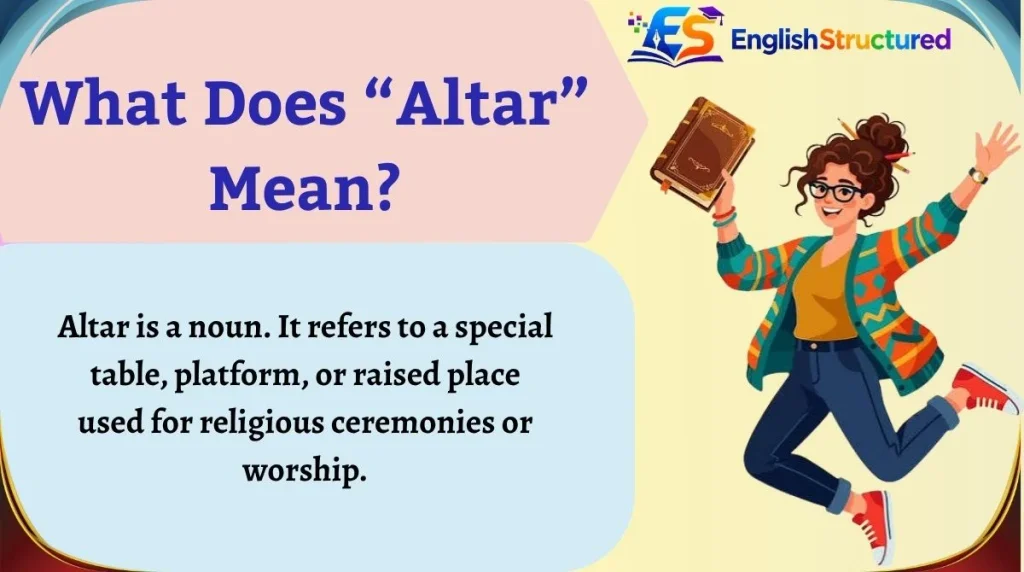
Altar is a noun. It refers to a special table, platform, or raised place used for religious ceremonies or worship.
An altar can be found in churches, temples, and other places of worship, depending on the religion and tradition.
For example:
Alter vs Altar
Here, altar is the name of a physical or sacred place used during religious activities.
When Should You Use “Altar”?
Use altar when talking about a religious or ceremonial place.
It is often associated with:
- Churches
- Religious ceremonies
- Worship
- Weddings
- Prayers
- Offerings
- Sacred objects
- Traditional ceremonies
The exact appearance and purpose of an altar can differ between religions and cultures.
Grammar Rule for “Altar”
Altar is a noun, so it names a person, place, thing, or idea.
A common sentence pattern is:
Alter vs Altar
For example:
The priest walked toward the altar.
You can also use altar after prepositions:
The flowers were placed on the altar.
She stood near the altar.
Examples of “Altar”
- The flowers were placed on the altar.
- The priest stood beside the altar.
- Alter vs Altar
- The couple stood near the altar during the wedding ceremony.
- Candles were burning on the altar.
- The painting behind the altar was very old.
- The family gathered around the altar for the ceremony.
- Alter vs Altar
In every example, altar refers to a special religious or ceremonial place.
“Altar” in Wedding English
Many English learners first encounter altar when reading or hearing about weddings.
You may hear:
Alter vs Altar
The aisle is the passage that people walk along, while the altar is the place at the front where a religious wedding ceremony may take place.
This is one reason the word appears often in stories, movies, books, and conversations about marriage.
However, remember that not every wedding takes place at an altar. The word is most appropriate when the ceremony actually involves an altar.
Difference Between Alter and Altar
The easiest way to understand the difference is this:
Alter vs Altar
Altar = a religious or ceremonial place.
They may sound alike, but they belong to different parts of speech and have different meanings.
Comparison Table
| Word | Part of Speech | Meaning | Example |
|---|---|---|---|
| alter | Verb | To change or adjust something | We need to alter the plan. |
| altar | Noun | A sacred table or place used in worship | The flowers are on the altar. |
The spelling can cause confusion, but the grammar gives you a strong clue.
If the word describes an action, you probably need alter.
If the word names a place or object used for worship, you need altar.
Meaning Comparison
Consider these two sentences:
We need to alter the room.
Alter vs Altar
In the first sentence, alter tells us what action is happening. Something about the room will be changed.
In the second sentence, altar names a place or object.
The meanings are completely different.
Grammar Comparison
Alter is a verb:
Alter vs Altar
You can change its tense:
She alters the dress.
She altered the dress.
Alter vs Altar
Altar is a noun:
The altar is beautiful.
You can use an article before it:
Alter vs Altar
the altar
You can also make it plural:
altars
For example:
The museum contains several old altars.
Sentence Structure Difference
Look at these structures:
Alter:
Alter vs Altar
Altar:
They + stood + near + the altar.
The first word performs an action. The second word names a thing or place.
That small grammar difference can help you choose the correct spelling even when you are unsure.
Grammar Rules You Must Remember
Rule #1: Use “Alter” for Change
When you mean change, adjust, or modify, use alter.
Alter vs Altar
Here, the design will be changed.
Another example:
The teacher altered the lesson plan.
The lesson plan was changed.
A quick question can help: “Am I talking about changing something?”
If the answer is yes, alter is probably the correct word.
Rule #2: Use “Altar” for a Religious Place or Object
When you are talking about a sacred table, platform, or place used in worship, use altar.
Alter vs Altar
The word names the place where the candles were placed.
Another example:
The priest walked toward the altar.
You are not talking about an action of changing something. You are talking about a religious place.
Rule #3: “Alter” Is a Verb, While “Altar” Is a Noun
This grammar rule is extremely useful.
If the word needs to describe an action, use alter.
Alter vs Altar
If the word needs to name a thing or place, use altar.
The altar was decorated with flowers.
Try looking at the words around it. This often makes the correct choice obvious.
Rule #4: “Alter” Can Change Form, but “Altar” Names a Thing
Because alter is a verb, it can appear in different forms.
She alters the clothes.
Alter vs Altar
She is altering the clothes.
Altar, however, remains a noun.
The altar is old.
Alter vs Altar
The altars were cleaned.
The verb changes according to tense and subject, while the noun changes mainly between singular and plural.
Common Mistakes Students Make
The main reason students confuse these words is sound.
In many accents, alter and altar sound very similar. If you learn mainly through listening, you may know what a speaker means but still be unsure how to spell the word.
Another problem is that both words contain the letters alt. Their spellings are close enough to create confusion.
Mistake 1: Using “Altar” for “Change”
Incorrect:
Alter vs Altar
Correct:
We need to alter the schedule.
Why?
Because the sentence is talking about changing the schedule.
A schedule is not a religious place, so altar cannot be correct.
Mistake 2: Using “Alter” for a Religious Place
Incorrect:
Alter vs Altar
Correct:
The flowers were placed on the altar.
Why?
The sentence refers to a religious object or place. Therefore, the noun altar is needed.
Mistake 3: Thinking They Are Different Spellings of the Same Word
They are not.
Some learners assume that altar is simply another spelling of alter. It is not.
They are two separate English words with different meanings.
Think of them as two completely different words that happen to sound similar.
Mistake 4: Choosing by Sound Alone
If you only listen to the pronunciation, it may be difficult to tell the words apart.
Instead, look at the meaning of the sentence.
Ask:
Is something being changed?
Alter vs Altar
Ask:
Is this a religious or ceremonial place?
Use altar.
Meaning is more reliable than sound.
Easy Trick to Remember the Difference
Here is a simple memory trick:
Alter = Adjust
Both alter and adjust start with the letter A.
Think:
Alter vs Altar
For example:
I need to alter my shirt.
You are adjusting the shirt.
Altar = A Religious Place
Think of altar as a special place found in a religious setting.
You can picture:
Altar → candles → church → ceremony
This mental picture makes the spelling easier to remember.
Another quick trick is to focus on the final letters:
altER → changER
This is not a grammar rule, but it can serve as a personal memory aid.
For altar, remember:
altar = religious table/place
You do not need a complicated trick. Just connect each spelling with one strong idea.
Alter = change.
Altar = worship.
That is enough.
Daily Life Examples
These examples show how the two words may appear in natural conversations.
Example 1: Talking About Clothes
Mia: Are you going to wear that dress tonight?
Sara: I might. But I need to alter it first.
Here, alter means make a change to the dress.
Example 2: Talking About a Plan
Tom: Are we still leaving at six?
Ali: No. We had to alter our plans.
Again, alter means change.
Example 3: Talking About a Church
John: Where should I put these flowers?
Mary: Please put them near the altar.
Here, altar is a religious place or structure.
Example 4: Talking About a Wedding
Emma: Where did the ceremony take place?
Lucy: It was held near the altar.
The word names the ceremonial place.
Example 5: Changing a Schedule
Teacher: The exam starts at nine tomorrow.
Student: Will the time change?
Teacher: No, we do not plan to alter the schedule.
The verb means change.
Example 6: Describing a Religious Building
Visitor: What is that large table at the front?
Guide: That is the altar.
The noun identifies the object.
Example 7: Changing a Design
Designer: Do you like this logo?
Manager: Yes, but we should alter the size slightly.
The manager wants to change the logo.
Example 8: Describing Decorations
Anna: The church looks beautiful today.
Ben: Yes. I especially like the flowers around the altar.
The word refers to the religious setting.
Example 9: Changing Clothes Before an Event
Customer: Can you make these trousers shorter?
Tailor: Certainly. I can alter them for you.
Here, alter means adjust the clothing.
Example 10: Talking About a Ceremony
David: Where should we stand during the ceremony?
Sarah: We can stand near the altar.
The word refers to the ceremonial area.
Practice Section
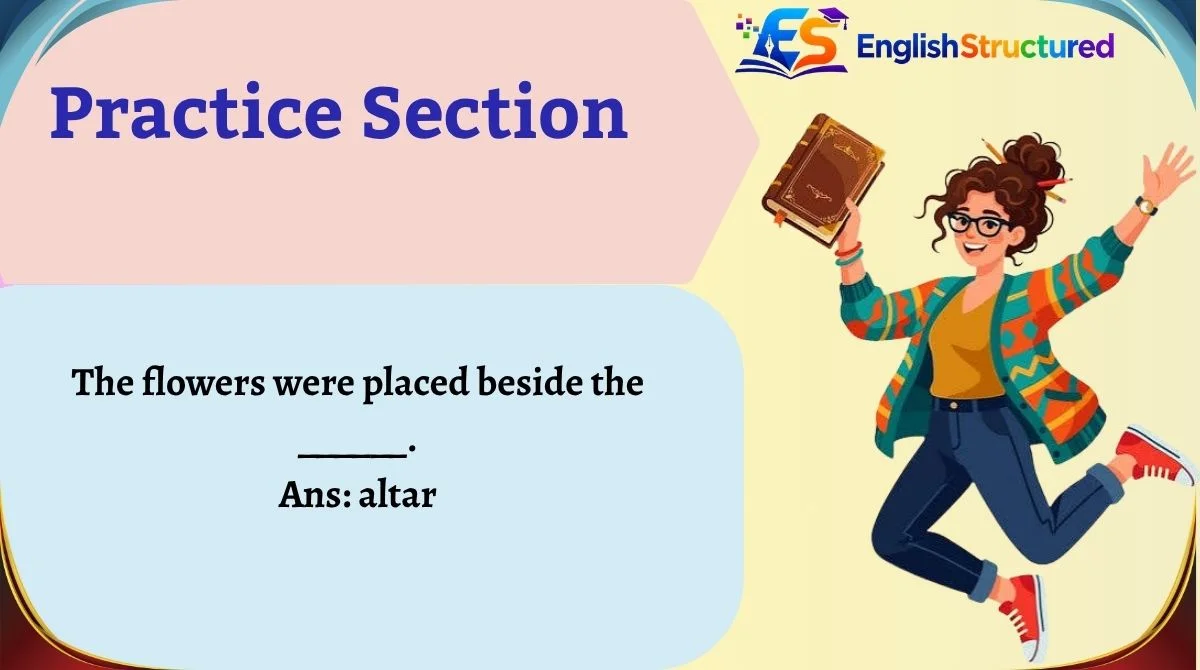
Choose alter or altar in each sentence.
1. The tailor will ______ my jacket.
2. The flowers were placed beside the ______.
3. We may need to ______ our travel plans.
4. The priest stood near the ______.
5. Can you ______ the length of these trousers?
Take a moment before checking the answers.
Answers
1. alter
The tailor will alter the jacket because the jacket needs to be changed or adjusted.
2. altar
The flowers were placed beside the altar, which is a religious or ceremonial place.
3. alter
Travel plans can be altered when they need to be changed.
4. altar
A priest may stand near the altar during a religious ceremony.
5. alter
Alter vs Altar
A useful final check is:
Change = alter
Religious place = altar
FAQs
What is the difference between alter and altar?
Alter is a verb that means to change, adjust, or modify something. Altar is a noun that refers to a special table, platform, or place used for religious worship or ceremonies. They sound similar but have different meanings and spellings.
Is “alter” a verb or a noun?
Alter is normally a verb. It describes the action of changing something. For example, “We need to alter the schedule” means that we need to change the schedule. Its forms include alters, altered, and altering.
Is “altar” a verb or a noun?
Altar is a noun. It names a religious or ceremonial table, platform, or place. For example, “The candles were placed on the altar.” The plural form is altars.
Do alter and altar sound the same?
In many English accents, alter and altar sound very similar or nearly identical. This is why they are easy to confuse when listening. The meaning and spelling tell you which word is correct.
Can I use “alter” to talk about changing clothes?
Yes. Alter is commonly used for clothes that need to be adjusted. For example, “The tailor will alter my dress.” It can mean making clothing shorter, longer, tighter, looser, or otherwise different.
Is “altar” only used in churches?
Not necessarily. An altar can be found in different religious and cultural traditions. Its exact form and purpose can vary. The important idea is that it is connected with worship, religious practice, or a sacred ceremony.
Is “alter” the same as “change”?
They can have very similar meanings. Alter often means to make a change or adjustment to something that already exists. “Change” is a more common and general word, while “alter” can sound somewhat more formal.
How can I remember alter vs altar?
Keep one simple pair in your mind: alter = change and altar = worship. If you are talking about changing something, choose alter. If you are talking about a religious or ceremonial place, choose altar.
Conclusion
The difference between alter and altar is much easier once you stop focusing only on their pronunciation.
Remember the two key meanings:
Alter vs Altar
Altar = a religious or ceremonial place or structure.
Alter is a verb, so it describes an action. You can alter a dress, plan, schedule, design, or opinion. Altar is a noun, so it names a thing or place, often connected with worship or a religious ceremony.
Because these words can sound alike, spelling mistakes are common. The best way to avoid them is to think about the meaning before choosing the spelling.
If you are talking about change, write alter.
If you are talking about worship, write altar.
A little practice will make the difference automatic. The next time you hear one of these words, pause for a second and ask what the speaker means.
That simple habit can help you choose the correct word when you write.