Awaiting vs Waiting
That sounds simple, but these two words are often confusing for English learners.
You may see a sentence like “I am waiting for your reply” and wonder if “I am awaiting your reply” means the same thing.
The good news is that the basic idea is very similar. Both words can show that something has not happened yet, and you expect it to happen later.
The main difference is in the grammar and the style of English they create.
Waiting is much more common in everyday English. We use it when talking with friends, family, coworkers, and people we meet in daily life.
Awaiting is more formal and is often used in official letters, business writing, notices, and formal statements.
There is also an important grammar difference. We normally say wait for something or someone, but we usually say await something or someone without “for.”
For example:
- I am waiting for the bus.
- I am awaiting the bus.
Both can be correct, but the second sentence sounds much more formal and is less common in normal conversation.
By the end of this guide, you will know exactly when to use awaiting and waiting, how their sentence structures differ, and how to avoid common mistakes.
What Does “Awaiting” Mean?
Awaiting is the -ing form of the verb “await.” It means staying ready or expecting something to happen, arrive, or be received.
In simple English, awaiting means waiting for something to happen or arrive.
For example:
Awaiting vs Waiting
This means:
We are waiting for your response.
The meaning is almost the same, but the first sentence sounds more formal and professional.
The verb await is usually used when the thing being expected comes directly after the verb. We normally do not put for after await.
The basic structure is:
Subject + await/awaiting + object
Examples:
- Awaiting vs Waiting
- She is awaiting the results.
- They are awaiting a decision.
- The patient is awaiting treatment.
Notice that there is no for after “awaiting.”
When Do We Use “Awaiting”?
We often use awaiting in formal or written English. It is common in business emails, official documents, legal writing, announcements, reports, and formal notices.
For example:
Awaiting vs Waiting
This sounds like something you might see on an official website.
In everyday speech, a person would more naturally say:
Your application is waiting for approval.
However, even that sentence can sometimes be improved depending on the meaning. More naturally, a person might say:
We are waiting for your application to be approved.
So, awaiting is especially useful when you want your writing to sound formal, direct, or professional.
Grammar Rule for “Awaiting”
“Awaiting” is normally followed directly by a noun or noun phrase.
Correct:
Awaiting vs Waiting
Correct:
The company is awaiting the final report.
Correct:
We are awaiting further instructions.
Incorrect:
Awaiting vs Waiting
The last sentence is a common learner mistake. Await already contains the idea of “wait for,” so “for” is not normally used after it.
Examples of “Awaiting”
- I am awaiting your response.
- The students are awaiting the results of the exam.
- We are awaiting further instructions.
- The company is awaiting approval from the manager.
- She is awaiting a decision from the university.
- The team is awaiting confirmation of the meeting.
- Thousands of people are awaiting the announcement.
- The patient is awaiting treatment at the hospital.
In all of these examples, “awaiting” has a formal tone. It tells us that someone is expecting something.
Common Confusion About “Awaiting”
Many learners think that awaiting and waiting can always replace each other without changing the sentence structure.
That is not quite true.
Compare:
I am waiting for John.
and:
Awaiting vs Waiting
Both are grammatically possible, but the second one sounds unusually formal in normal conversation.
The bigger grammar point is this:
Wait usually needs “for” before the person or thing. Await normally does not.
That small difference is very important.
What Does “Waiting” Mean?
Waiting is the -ing form of the verb “wait.” It means staying in one place, staying ready, or doing nothing until someone or something arrives or happens.
In simple words, waiting means expecting something and staying until it happens.
It is one of the most common verbs in everyday English.
You can use “waiting” when talking about buses, people, food, phone calls, messages, appointments, results, and many other things.
For example:
Awaiting vs Waiting
This is completely natural in everyday English.
You can also say:
She is waiting for her friend.
The word for is normally used when you identify the person or thing you are expecting.
When Do We Use “Waiting”?
We use waiting in both spoken and written English. It is normal, natural, and very common.
You can use it with friends:
I’m waiting for you outside.
You can use it at work:
Awaiting vs Waiting
You can use it in an email:
I’m waiting for your reply.
You can also use it when talking about future events:
We’re waiting for the results.
Unlike “awaiting,” the word “waiting” does not usually make your sentence sound formal.
Grammar Rule for “Waiting”
When wait is followed by the person or thing you are expecting, we normally use for.
The common structure is:
Subject + wait/waiting + for + person/thing
Examples:
Awaiting vs Waiting
She is waiting for the doctor.
They are waiting for the bus.
We are waiting for an answer.
You can also use “wait” without “for” when the meaning is already clear.
For example:
Awaiting vs Waiting
Wait here.
I waited for two hours.
The important point is that when you name the expected person or thing after “wait,” for is normally needed.
Examples of “Waiting”
- I am waiting for my friend.
- She is waiting for the bus.
- We are waiting for your call.
- They are waiting for the food.
- Awaiting vs Waiting
- I am waiting for an answer.
- The children are waiting for their teacher.
- Awaiting vs Waiting
These sentences sound natural in everyday English.
Common Confusion About “Waiting”
One common mistake is forgetting for.
A learner may say:
I am waiting my friend.
This is incorrect when “wait” means expecting someone.
The natural sentence is:
Awaiting vs Waiting
Another mistake is using “for” after “await.”
For example:
I am awaiting for your reply.
This is normally incorrect.
The better sentence is:
I am awaiting your reply.
So, remember that wait and await follow different grammar patterns.
Difference Between Awaiting and Waiting
The easiest way to understand the difference is to remember two things:
Waiting is common and natural. Awaiting is formal and more direct in grammar.
Both words can describe expecting something to happen, arrive, or be received. The main difference is their grammar, style, and frequency.
Comparison Table
| Point | Waiting | Awaiting |
|---|---|---|
| Basic meaning | Expecting someone or something | Expecting someone or something |
| Common in speech | Very common | Less common |
| Formality | Neutral | Formal |
| Common structure | Wait for + noun | Await + noun |
| Example | I am waiting for your reply. | I am awaiting your reply. |
| “For” after the verb | Usually needed | Usually not used |
| Business writing | Very common | Common in formal writing |
| Casual conversation | Natural | Can sound formal |
| Main verb | Wait | Await |
The meaning is often very close, but the feeling of the sentence can be different.
Usage Difference
Consider these two sentences:
I am waiting for your answer.
Awaiting vs Waiting
Both tell the reader that you expect an answer.
The first one sounds normal and conversational.
The second one sounds more formal and professional.
If you are talking to a friend, “waiting” is usually the better choice.
I’m waiting for you.
If you are writing a formal business message, “awaiting” may fit better.
We are awaiting your confirmation.
Still, “waiting for” is not wrong in formal writing. In fact, it is often clearer and more natural.
Grammar Logic
The biggest grammar difference is the word for.
The verb wait normally uses “for” when you say what or whom you are expecting.
Wait for + object
We are waiting for the train.
The verb await normally takes the object directly.
Await + object
We are awaiting the train.
The word “await” already carries the meaning of expecting something, so adding “for” is unnecessary.
Sentence Structure Difference
Here is a simple pattern:
WAIT
Subject + wait/waiting + for + object
Example:
Awaiting vs Waiting
AWAIT
Subject + await/awaiting + object
Example:
Sarah is awaiting the teacher.
The second sentence is grammatically possible, but it sounds much more formal and less natural in everyday conversation.
Another example:
We are waiting for a decision.
Awaiting vs Waiting
Both are correct.
The first sounds neutral. The second sounds more official.
Meaning Comparison
In most cases, there is no major difference in the basic meaning.
Both can express expectation.
However, “wait” can have a wider everyday use.
For example:
Wait here.
Wait a minute.
Awaiting vs Waiting
Wait until tomorrow.
You cannot simply replace every use of “wait” with “await.”
For example:
Wait a minute!
is natural.
Await a minute!
does not sound natural.
So, “await” is not simply a formal version of every use of “wait.” It is mainly used when you are expecting or anticipating a person, thing, decision, result, response, or event.
Grammar Rules You Must Remember
Rule #1: Use “for” after “wait” when naming what you expect
This is the most important rule.
I am waiting for my sister.
Awaiting vs Waiting
She is waiting for a reply.
Do not normally say:
I am waiting my sister.
The correct structure is wait for + person/thing.
Rule #2: Do not normally use “for” after “await”
“Await” takes the object directly.
Awaiting vs Waiting
They are awaiting the results.
She is awaiting a decision.
Avoid:
We are awaiting for your response.
A simple memory trick is:
Wait FOR something. Await something.
Rule #3: “Waiting” is usually better for everyday conversation
If you are speaking with a friend, family member, or coworker, waiting is usually the natural choice.
Awaiting vs Waiting
Are you waiting for the bus?
Awaiting vs Waiting
These sound friendly and normal.
“Awaiting” is not wrong, but it can sound stiff in casual speech.
I am awaiting Tom.
This sounds much more formal than most people would need.
Rule #4: “Awaiting” is common in formal or official writing
You may see “awaiting” in business, government, legal, academic, or official contexts.
Examples:
Awaiting vs Waiting
The project is awaiting final authorization.
We are awaiting further information.
Awaiting vs Waiting
This does not mean that “awaiting” is always better. Use it when its formal tone fits the situation.
Common Mistakes Students Make
Learners often confuse these words because their meanings are so close. The problem becomes easier when you focus on grammar and style, not just meaning.
Mistake #1: “Waiting” Without “For”
Wrong:
I am waiting my friend.
Correct:
I am waiting for my friend.
When “wait” is followed by the person or thing you expect, use for.
Mistake #2: Adding “For” After “Awaiting”
Wrong:
We are awaiting for your answer.
Correct:
Awaiting vs Waiting
This is probably the most common grammar mistake with “await.”
Think of “await” as a verb that can take the object directly.
Mistake #3: Using “Awaiting” in Every Situation
Some learners learn that “await” means “wait” and then use it everywhere.
For example:
Await here.
This is not natural.
Say:
Awaiting vs Waiting
Or:
Please wait here.
“Await” is not normally used for simple instructions like “wait here” or “wait a minute.”
Mistake #4: Thinking “Awaiting” Is Always More Correct
Formal does not mean better.
Compare:
I am waiting for your reply.
Awaiting vs Waiting
Both can be correct.
If you are sending a simple message to a friend, the first sentence is much more natural.
The best word depends on the situation and tone.
Mistake #5: Confusing “Awaiting” With a Different Tense
“Awaiting” is not a tense by itself.
It is the present participle / -ing form of “await.”
You can use it with different helping verbs:
Awaiting vs Waiting
We were awaiting the results.
They have been awaiting approval.
The tense comes from the helping verb and sentence structure, not from “awaiting” alone.
Easy Trick to Remember the Difference
Here is a very simple trick:
WAIT = WAIT FOR
AWAIT = AWAIT IT
When you use wait, think of the word for.
Awaiting vs Waiting
Wait for me.
Wait for your turn.
When you use await, remove “for.”
Await the bus.
Awaiting vs Waiting
Await your turn.
The second group sounds formal, but the grammar is easy to remember.
There is another useful trick.
Think about conversation versus formal writing.
If you are talking to someone in normal daily English, waiting is usually your safe choice.
If you are writing an official message and want a more formal tone, awaiting may fit.
For example:
Casual:
I’m waiting for your message.
Formal:
I am awaiting your response.
Both communicate the same basic idea.
One more thing: do not force yourself to use “awaiting” just because it sounds advanced. Good English is not about choosing the biggest or most formal word. It is about choosing the right word for the situation.
Daily Life Examples
Here are some simple examples showing how these words work in real conversations and situations.
Example 1: At a Bus Stop
Ali: Are you waiting for the bus?
Sara: Yes. It should be here soon.
“Waiting for” sounds completely natural here. “Awaiting” would sound too formal for this casual conversation.
Example 2: Waiting for a Friend
John: Where are you?
Mike: I’m waiting for you outside the café.
This is a normal everyday use of “waiting.”
Example 3: A Business Email
We are awaiting your confirmation before we continue with the order.
This sounds formal and professional.
You could also say:
We are waiting for your confirmation before we continue with the order.
That version is also correct, but the first has a more official tone.
Example 4: Exam Results
The students are waiting for their exam results.
This is natural and easy.
A formal school notice might say:
Students are awaiting their examination results.
Both sentences have the same basic meaning.
Example 5: At a Restaurant
Emma: Why haven’t you ordered?
Lucy: I’m waiting for my friend.
This is much more natural than “I am awaiting my friend” in normal conversation.
Example 6: Customer Service
We are awaiting further information from the customer.
This sounds appropriate in a formal report or workplace message.
Example 7: Waiting for a Phone Call
A: Has Sarah called you?
B: Not yet. I’m waiting for her call.
Again, “waiting for” is the natural spoken choice.
Example 8: An Official Application
Your application is currently awaiting approval.
This type of wording is common in formal notices and application systems.
Example 9: Waiting for Food
Dad: Why are you still sitting there?
Son: I’m waiting for my food.
“Waiting for” is the clear choice in casual speech.
Example 10: A Formal Announcement
The organization is awaiting a final decision from the board.
The word “awaiting” works well because the sentence has an official and professional tone.
Practice: Choose the Correct Option
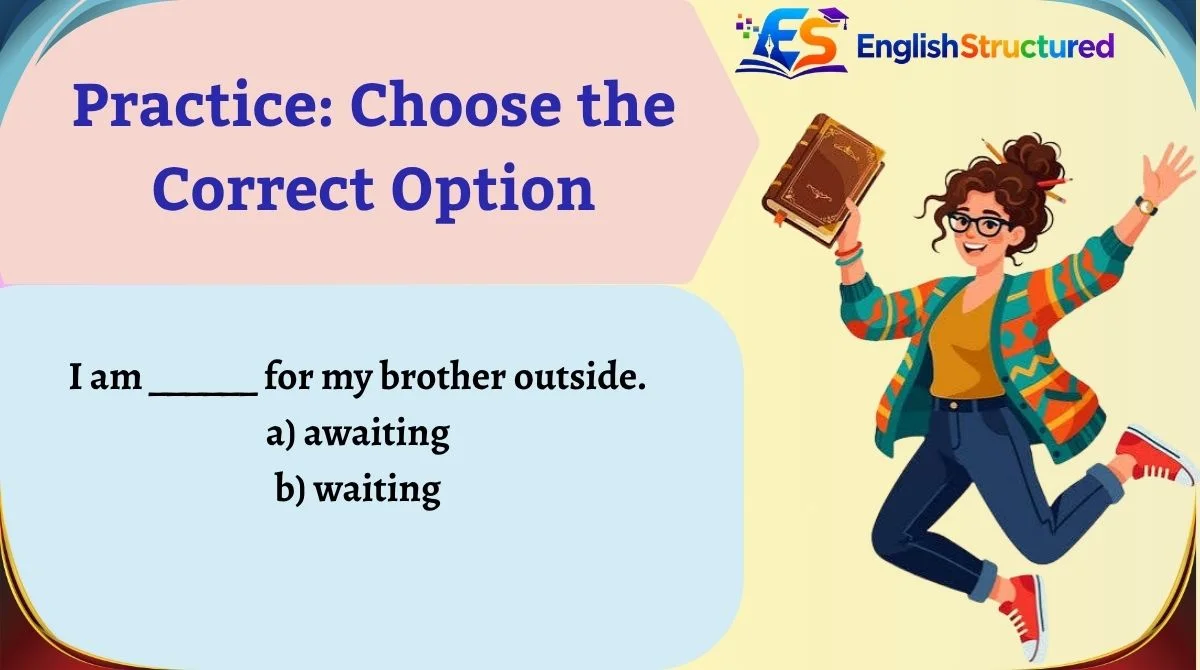
Choose waiting or awaiting to complete each sentence. Pay attention to both meaning and grammar.
1. I am ______ for my brother outside.
a) awaiting
b) waiting
2. We are ______ your confirmation before making the change.
a) awaiting
b) waiting
3. She is ______ for the doctor.
a) waiting
b) awaiting for
4. The company is ______ the final report.
a) waiting for
b) awaiting for
5. They are ______ the results of the investigation.
a) waiting for
b) awaiting
Answers
1. waiting
I am waiting for my brother outside.
This is normal everyday English.
2. awaiting
We are awaiting your confirmation before making the change.
“Awaiting” works well in this formal context.
3. waiting
She is waiting for the doctor.
Remember that “wait” normally needs for before the person or thing.
4. awaiting
The company is awaiting the final report.
Do not add “for” after “awaiting.”
5. Both can work
They are waiting for the results.
They are awaiting the results.
The first is more natural in everyday English. The second sounds more formal.
FAQs
What is the difference between awaiting and waiting?
Both words can mean expecting someone or something to arrive or happen. Waiting is more common in everyday English, while awaiting sounds more formal. The grammar is also different: we usually say wait for something, but await something without “for.”
Can we use “awaiting” in questions?
Yes, but it is less common in normal conversation. For example, you can say, “What are you awaiting?” However, most people would naturally say, “What are you waiting for?” The second question is much more common in everyday spoken English.
Is “awaiting” formal or informal?
Awaiting is generally formal. You may see it in business emails, official notices, reports, applications, and other formal writing. In casual conversation, “waiting” is usually the better choice.
Is “waiting for” correct?
Yes. Waiting for is completely correct and very common. For example, “I am waiting for the bus” and “She is waiting for her friend” are natural sentences. When you use “wait” before a person or thing you expect, “for” is normally needed.
Is “awaiting for” correct?
No, “awaiting for” is normally incorrect when “await” is being used in its usual sense. Say “I am awaiting your reply,” not “I am awaiting for your reply.” Remember: wait for, but await something.
Can awaiting and waiting be used interchangeably?
Sometimes they can express almost the same idea, but they are not interchangeable in every sentence. “Waiting” has more everyday uses, such as “Wait here” and “Wait a minute.” “Awaiting” is more limited and usually refers to expecting a person, thing, result, decision, response, or event.
Conclusion
Awaiting vs Waiting
The easiest rule to remember is:
Wait for something. Await something.
For example:
I am waiting for your reply.
I am awaiting your reply.
Both sentences can be correct. The first sounds more natural in everyday English, while the second sounds more formal.
Use waiting when you are speaking naturally with friends, family, coworkers, or other people in daily situations.
Use awaiting when a formal or professional tone is suitable, especially in official writing.
Also remember that “awaiting” should not normally be followed by for. Saying “awaiting for” is a common mistake.
The best way to learn this difference is to notice these words in real sentences and practice making your own examples.
Once you remember the simple pattern “wait for” but “await,” this confusing pair becomes much easier.