Learning English can sometimes feel confusing because many words look almost the same but have different jobs in a sentence.
Convenient or Convenience
However, they cannot. One is an adjective, while the other is a noun.
This small difference causes many mistakes in speaking and writing.
You may hear someone say, “This store is convenience,” or write, “Please choose a convenient time for your convenience.”
These sentences may sound close to correct, but they do not follow standard English grammar.
Understanding the difference is important because these words appear in daily conversations, emails, schoolwork, business communication, travel, shopping, and social media.
Native speakers use them often, so knowing when to use each one will make your English sound more natural and confident.
The good news is that the rule is simple once you understand the role each word plays.
After reading this guide, you will know what each word means, when to use it, why learners confuse them, and how to avoid common mistakes.
You will also see many real-life examples that make the difference easy to remember.
What Does “Convenient” Mean?
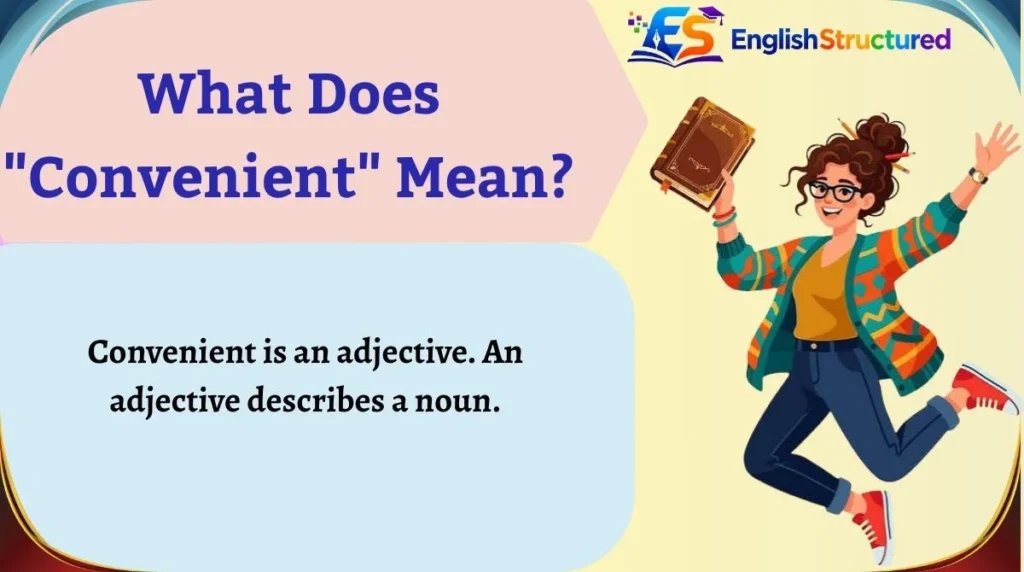
Convenient is an adjective. An adjective describes a noun. It tells us that something is easy to use, easy to reach, or suitable for a particular purpose or time.
If something saves you time, effort, or trouble, it is usually convenient.
Simple Definition
Convenient or Convenience:
- Easy to use
- Easy to reach
- Suitable for your needs
- Happening at a good time
- Saving time or effort
When to Use “Convenient”
Use convenient when you are describing a person, place, thing, time, or situation.
It often appears before a noun or after linking verbs such as is, are, was, were, seems, becomes, and feels.
Examples:
- a convenient location
- Convenient or Convenience
- a convenient time
- The hotel is convenient.
- Online shopping is convenient.
Grammar Rule
Convenient = Adjective
Sentence Pattern
- Convenient + noun
- Subject + be + convenient
Examples:
- This app is convenient.
- We found a convenient restaurant.
- The meeting time is convenient for everyone.
Convenient or Convenience
Example Sentences
Here are some everyday examples.
- Convenient or Convenience
- Is tomorrow afternoon convenient for you?
- We chose a convenient hotel near the airport.
- Online banking is convenient for busy people.
- The new bus stop is very convenient.
- She found a convenient place to park her car.
- Convenient or Convenience
- The office is in a convenient location.
Common Learner Confusion
Many learners use convenience when they should use convenient.
Convenient or Convenience
✅ This shop is convenient.
The sentence needs an adjective after the verb is, so convenient is the correct choice.
Another common mistake is using very convenience.
❌ The app is very convenience.
✅ The app is very convenient.
Words like very, quite, really, and extremely usually describe adjectives, so convenient fits naturally.
Common Collocations with “Convenient”
Native speakers often use these combinations:
- convenient location
- convenient time
- convenient place
- convenient way
- Convenient or Convenience
- convenient service
- convenient solution
- convenient method
- convenient access
- Convenient or Convenience
Examples:
- The library is in a convenient location.
- Can we meet at a convenient time?
- This is the most convenient way to travel.
- Convenient or Convenience
Synonyms of “Convenient”
Depending on the context, convenient can mean:
- suitable
- practical
- easy
- useful
- accessible
- handy
- well-placed
- time-saving
Each synonym has a slightly different meaning, but they all suggest something that makes life easier.
What Does “Convenience” Mean?
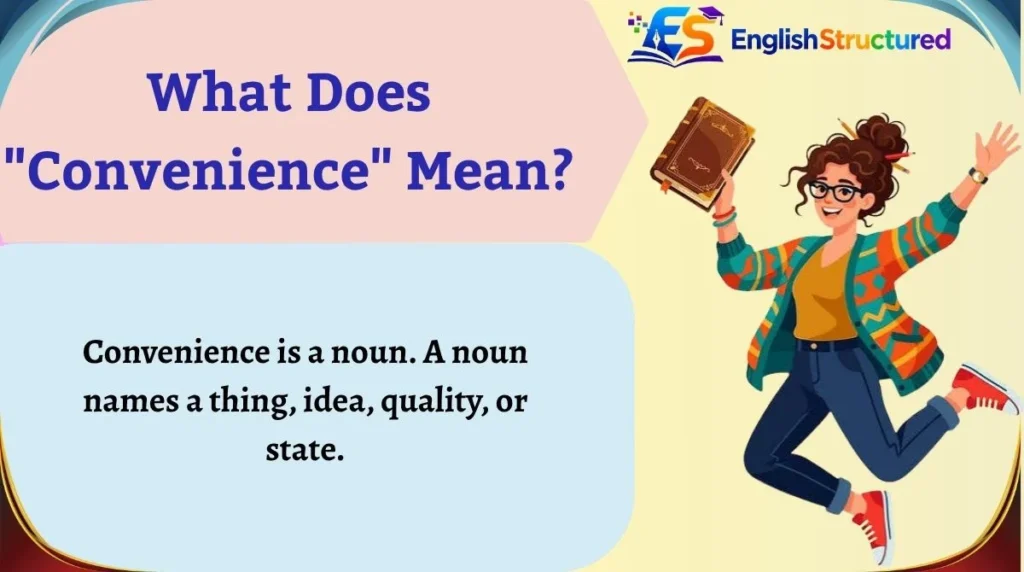
Convenience is a noun. A noun names a thing, idea, quality, or state.
Instead of describing something, convenience refers to the quality of being convenient or the ease that something provides.
Simple Definition
Convenience means:
- Ease
- Comfort
- The quality of making life easier
- Freedom from difficulty
- Something that saves time or effort
When to Use “Convenience”
Convenient or Convenience
It is often used after articles such as a, the, or with phrases like for your convenience, at your convenience, and for convenience.
Grammar Rule
Convenience = Noun
Common sentence patterns:
- the convenience of + noun
- for your convenience
- at your convenience
- convenience is important
- a convenience
Examples:
- The convenience of online shopping attracts many customers.
- Convenient or Convenience
- We moved for the convenience of our children.
Unlike convenient, this word is the name of an idea, not a description.
Example Sentences
- The convenience of mobile banking saves people a lot of time.
- We chose the apartment for its convenience.
- Please call me at your convenience.
- The store stays open late for customers’ convenience.
- Convenient or Convenience
- Online ticket booking provides extra convenience.
- The hotel was selected because of its convenience.
- Convenient or Convenience
Common Learner Confusion
Students sometimes use convenient where they actually need a noun.
❌ We like the convenient of online classes.
Convenient or Convenience
After the, English normally expects a noun, not an adjective.
Another common mistake is saying:
❌ Thank you for your convenient.
✅ Thank you for your convenience.
Convenient or Convenience
Common Collocations with “Convenience”
These combinations are very common in everyday English.
- for your convenience
- at your convenience
- convenience store
- convenience fee
- convenience of
- Convenient or Convenience
- added convenience
- customer convenience
- Convenient or Convenience
- everyday convenience
Examples:
- Please use the side entrance for your convenience.
- Answer the email at your convenience.
- We stopped at a convenience store on the way home.
- Technology adds convenience to our daily lives.
Synonyms of “Convenience”
Depending on the situation, convenience may mean:
- ease
- comfort
- usefulness
- practicality
- accessibility
- efficiency
- advantage
- simplicity
Convenient or Convenience
Difference Between Convenient and Convenience
Even though convenient and convenience come from the same word family, they have different grammar jobs. Knowing this difference will help you build correct English sentences every time.
The easiest way to remember them is this:
- Convenient describes something.
- Convenient or Convenience
Think of these examples:
- Convenient or Convenience
- The convenience of this bus saves me time. (The ease of using the bus saves time.)
Both sentences talk about the same idea, but each word has a different role.
Quick Comparison Table
| Feature | Convenient | Convenience |
|---|---|---|
| Part of speech | Adjective | Noun |
| Main meaning | Easy, suitable, practical | The quality of being easy or practical |
| Function | Describes a noun | Names an idea or quality |
| Answers | What is it like? | What thing or quality? |
| Used after “be” | Yes | Usually no |
| Used after “the” | Rarely | Yes |
| Example | The hotel is convenient. | The convenience of the hotel is amazing. |
Meaning Difference
Although both words relate to making life easier, they focus on different things.
Convenient = Describes Something
When you use convenient, you are talking about how easy or suitable something is.
Examples:
- Convenient or Convenience
- The train station is convenient.
- Saturday is convenient for me.
- Online payment is convenient.
The word tells us what something is like.
Convenience = The Quality or Benefit
When you use convenience, you are talking about the benefit, comfort, or ease that something provides.
Examples:
- The convenience of online shopping is amazing.
- We enjoy the convenience of digital payments.
- The convenience of public transport helps many people.
- Air travel offers speed and convenience.
Here, the word refers to the idea of ease, not the object itself.
Grammar Logic
Grammar becomes much easier when you know the part of speech.
Convenient is an Adjective
Adjectives describe nouns.
Examples:
- a convenient office
- Convenient or Convenience
- a convenient schedule
- a convenient answer
Sentence examples:
- The office is convenient.
- Convenient or Convenience
- Convenient or Convenience
Convenience is a Noun
Nouns name people, places, things, or ideas.
Examples:
- convenience is important
- Convenient or Convenience
- customer convenience
- modern convenience
Sentence examples:
- Convenience is important for busy families.
- Convenient or Convenience
- The new system improves customer convenience.
Sentence Structure Difference
Understanding sentence patterns helps you avoid grammar mistakes.
Pattern 1: Convenient
Convenient or Convenience
Examples:
- This restaurant is convenient.
- The meeting time is convenient.
- The station is convenient.
- Convenient or Convenience
Convenient + Noun
Examples:
- convenient location
- convenient choice
- convenient solution
- convenient method
Sentence examples:
- We found a convenient hotel.
- Convenient or Convenience
- This is a convenient option.
Pattern 2: Convenience
The convenience of + noun
Examples:
- the convenience of smartphones
- the convenience of online learning
- the convenience of home delivery
- Convenient or Convenience
For your convenience
Examples:
- Extra parking is available for your convenience.
- Convenient or Convenience
At your convenience
Examples:
- Please reply at your convenience.
- Contact us at your convenience.
Side-by-Side Examples
| Convenient | Convenience |
|---|---|
| This app is convenient. | The convenience of this app is impressive. |
| Our office is convenient. | The convenience of our office attracts customers. |
| The bus stop is convenient. | The convenience of public transport saves money. |
| This chair is convenient. | The convenience of lightweight furniture is obvious. |
| The website is convenient. | The convenience of online shopping keeps growing. |
Notice how convenient describes the subject, while convenience names the benefit.
Which Word Should You Choose?
Ask yourself one simple question.
Am I describing something?
Convenient or Convenience
Examples:
- The hotel is convenient.
- This phone is convenient.
- Monday is convenient for me.
Am I talking about the idea or benefit of something?
If yes, use convenience.
Examples:
- The convenience of this hotel impressed us.
- Convenient or Convenience
- Convenience is important in modern life.
Real-Life Comparison
Imagine you move into a new apartment.
You might say:
- The apartment is convenient because it is near my office.
Now you are describing the apartment.
But you could also say:
- Convenient or Convenience
Now you are talking about the benefit of living there.
Both sentences are correct, but they focus on different ideas.
Another Easy Comparison
Imagine you buy a coffee machine.
You can say:
- This coffee machine is convenient.
Here, you describe the machine.
You can also say:
- The convenience of making coffee at home saves me money.
Now you describe the benefit, not the machine itself.
Summary of the Difference
- Convenient is an adjective that describes a person, place, thing, time, or situation.
- Convenience is a noun that names the quality of being easy, practical, or useful.
- If you can replace the word with easy, practical, or suitable, convenient is usually the correct choice.
- Convenient or Convenience
- Learning the part of speech is the easiest way to avoid mistakes.
Grammar Rules You Must Remember
Convenient or Convenience
Rule #1: Use Convenient as an Adjective
An adjective describes a noun.
Correct:
- This location is convenient.
- Convenient or Convenience
- The meeting time is convenient for everyone.
Incorrect:
- This location is convenience. ❌
Why?
After the verb is, you need an adjective to describe the location.
Rule #2: Use Convenience as a Noun
A noun names an idea or quality.
Correct:
- The convenience of online shopping is amazing.
- Convenient or Convenience
- Customer convenience is our priority.
Incorrect:
- The convenient of online shopping is amazing. ❌
Why?
Convenient or Convenience
Rule #3: Remember Common Fixed Expressions
Some expressions always use convenience, not convenient.
Examples:
- Convenient or Convenience
- at your convenience
- convenience store
- convenience fee
Correct examples:
- Please call me at your convenience.
- Extra parking is available for your convenience.
Incorrect:
- Convenient or Convenience
Rule #4: Use Convenient with People, Places, Times, or Things
Whenever you describe something as easy, practical, or suitable, use convenient.
Examples:
- This road is convenient.
- Friday is convenient for me.
- That supermarket is convenient.
- Convenient or Convenience
If you remember these four rules, choosing between convenient and convenience becomes much easier.
Common Mistakes Students Make
Convenient or Convenience. They come from the same word family, but they have different grammar functions. Understanding the most common mistakes will help you avoid them.
Mistake 1: Using Convenience Instead of Convenient
Incorrect:
- This restaurant is convenience. ❌
- The bus stop is very convenience. ❌
Correct:
- This restaurant is convenient. ✅
- Convenient or Convenience
Why?
After a linking verb like is, are, or was, you usually need an adjective. Since convenient is an adjective, it is the correct choice.
Mistake 2: Using Convenient Instead of Convenience
Incorrect:
- The convenient of online learning is amazing. ❌
- We enjoy the convenient of home delivery. ❌
Correct:
- The convenience of online learning is amazing. ✅
- Convenient or Convenience
Why?
After the, English usually requires a noun, and convenience is the noun form.
Mistake 3: Forgetting Fixed Expressions
Some phrases always use convenience.
Incorrect:
- Please reply at your convenient. ❌
- We added this feature for your convenient. ❌
Correct:
- Please reply at your convenience. ✅
- Convenient or Convenience
Tip: Learn these expressions as complete phrases instead of translating them word by word.
Mistake 4: Translating Directly from Your Native Language
Some languages use only one word for both meanings. Because of this, learners often choose the wrong English word.
Instead of translating directly, ask yourself:
- Convenient or Convenience
- Am I naming an idea or benefit? → Use convenience.
This simple habit can prevent many mistakes.
Easy Correction Tips
- Remember that convenient describes.
- Convenient or Convenience
- Check whether the sentence needs an adjective or a noun.
- Read your sentence aloud. If it sounds like you are describing something, convenient is usually correct.
Easy Trick to Remember the Difference
A simple memory trick can help you remember these words forever.
Think About the Word Endings
- Convenient ends with -ent.
- Convenience ends with -ence.
Words ending in -ent are often adjectives.
Examples:
- different
- excellent
- independent
- convenient
Words ending in -ence are often nouns.
Examples:
- confidence
- patience
- importance
- Convenient or Convenience
You do not need to memorize every word, but noticing the endings can help you guess the correct grammar.
Another Easy Memory Trick
Imagine a chair.
If you say:
Convenient or Convenience
You are describing the chair.
Now imagine sitting in that chair every day.
You can say:
The convenience of this chair makes my work easier.
Now you are talking about the benefit.
One-Sentence Rule
Convenient or Convenience
Repeat this sentence a few times, and it will become easy to remember.
Daily Life Examples
These examples show how native speakers naturally use both words in everyday conversations.
- Is this time convenient for you?
- The supermarket is convenient because it is only five minutes away.
- I love the convenience of online shopping.
- Please reply at your convenience.
- This mobile app is very convenient to use.
- Convenient or Convenience
- We chose the hotel because its location was convenient.
- Working from home offers great convenience for many families.
- This parking area is convenient for visitors.
- The convenience of food delivery has changed the way people shop.
Short Conversation 1
Convenient or Convenience
David: Yes, that’s a perfect time.
Short Conversation 2
Ali: Why do you shop online so often?
Sara: I like the convenience of having everything delivered to my door.
Short Conversation 3
Tom: Why did you move here?
Lisa: Because the location is convenient for work and school.
Practice Section
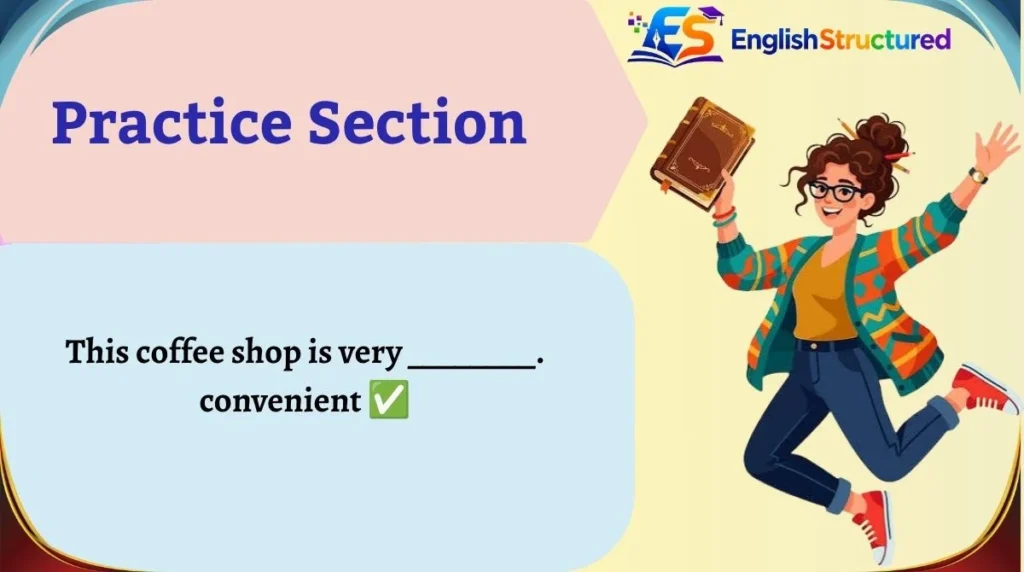
Choose the correct word: convenient or convenience.
Questions
- This coffee shop is very ________.
- We enjoy the ________ of online banking.
- Please contact us at your ________.
- The new office is in a ________ location.
- Modern technology gives people more ________.
Answers
- convenient ✅
- convenience ✅
- convenience ✅
- Convenient or Convenience
- convenience ✅
If you answered all five correctly, you have a good understanding of the difference.
FAQs
1. What is the difference between convenient and convenience?
Convenient or Convenience. Convenience is a noun that refers to the quality or benefit of being easy or practical. One describes, while the other names the idea.
2. Can we use convenient in questions?
Yes. It is very common in questions about time, place, or arrangements.
Examples:
- Is this time convenient for you?
- Would tomorrow be convenient?
3. Is convenience formal or informal?
Convenience is suitable in both formal and informal English. It appears in everyday conversations, business emails, advertisements, and official notices.
Examples include:
- For your convenience
- At your convenience
4. Can convenient describe a person?
Usually, convenient describes things, places, times, or situations rather than people.
Correct:
- Convenient or Convenience
Less natural:
- She is convenient.
When talking about a person, English usually uses words such as helpful, available, or flexible, depending on the meaning.
5. Why do learners confuse these two words?
They have similar spelling and come from the same word family. Many languages also use one word where English uses two different forms. Learning the grammar role of each word makes the difference much clearer.
6. How can I remember which word to use?
Ask yourself one question:
Am I describing something?
Convenient or Convenience
If you are talking about the benefit or ease of something, choose convenience.
This simple check works in most everyday situations.
Conclusion
Convenient or Convenience
Although the words are closely related, each has its own grammar role. Convenient is an adjective that describes a person, place, thing, time, or situation as easy, practical, or suitable.
Convenience is a noun that refers to the ease, comfort, or advantage something provides.
The easiest way to avoid mistakes is to focus on the job the word does in your sentence. If you are describing something, choose convenient.
If you are naming the benefit or quality of being easy, choose convenience. With regular reading, listening, and speaking practice, these choices will soon become natural.
Try using both words in your own sentences every day.
Write short examples, notice how native speakers use them, and review the common patterns like for your convenience and at your convenience.
A little practice each day will help you speak and write English with greater accuracy and confidence.