I Worked vs I Was Working vs I Have Been Working
All three talk about work in the past, but they do not mean the same thing.
Using the wrong tense can change the meaning of your sentence and make your English sound unnatural.
Imagine someone asks, “What were you doing yesterday?” If you answer, “I worked,” it simply tells them you did your job.
But if you say, “I was working,” it shows that your work was happening at a particular time. Now think about someone asking, “Why are you tired?”
You might answer, “I have been working all day.”
This tells them your work started earlier and continued until now or has just finished.
These small grammar differences are very common in everyday English. Native speakers use them in conversations, emails, job interviews, and daily life.
Understanding them will help you speak more naturally, write more clearly, and avoid common mistakes.
The good news is that the rules are easier than they look.
Once you understand when an action finished, when it was in progress, and when it continued over time, choosing the correct tense becomes much simpler.
By the end of this guide, you will know when to use each expression, how their meanings change, and how to avoid the mistakes that many English learners make.
What Does “I Worked” Mean?
“I worked” is the simple past tense of the verb work.
It tells us that the action started and finished in the past. The speaker is simply saying that the work happened. The sentence does not focus on how long the work lasted or whether it was happening at a certain moment. It only tells us that the action is complete.
When Do We Use “I Worked”?
I Worked vs I Was Working vs I Have Been Working
- A finished action happened in the past.
- The time is finished or understood.
- You are talking about a completed job or activity.
- The result is not connected to the present.
Grammar Rule
Subject + worked + time expression (optional)
Examples:
- I worked yesterday.
- I Worked vs I Was Working vs I Have Been Working
- I worked at a hospital for five years.
- I worked late last night.
The sentence tells us only that the work happened and is now finished.
Easy Examples
Here are some simple examples.
- I worked all day yesterday.
- I worked in London before moving here.
- I worked until midnight.
- I worked at a restaurant during college.
- I Worked vs I Was Working vs I Have Been Working
- I worked hard for the final exam.
- I worked with a great team.
- I worked from home during the holiday.
Each sentence describes a completed action in the past.
Common Time Expressions
I Worked vs I Was Working vs I Have Been Working
- yesterday
- last week
- last month
- last year
- two days ago
- in 2022
- during my vacation
- before I moved
These expressions show that the action belongs to a finished time.
Common Learner Confusion
I Worked vs I Was Working vs I Have Been Working
For example:
❌ I have worked yesterday.
✅ I worked yesterday.
The word “yesterday” refers to a finished time, so the simple past is the correct choice.
Another common mistake is using “I worked” when talking about an action that was happening at a particular moment.
For example:
Someone asks:
“What were you doing at 8 p.m.?”
❌ I worked.
✅ I was working.
The question asks about an action in progress, so the past continuous tense is more natural.
Why Native Speakers Use “I Worked”
I Worked vs I Was Working vs I Have Been Working
For example:
- I Worked vs I Was Working vs I Have Been Working
- “I worked yesterday.”
- “I worked all weekend.”
The focus is on completion, not on the process.
What Does “I Was Working” Mean?
I Worked vs I Was Working vs I Have Been Working
It shows that the action was happening at a particular time in the past. The work was in progress. It may have continued after that moment, or it may have been interrupted by another action.
Think of it as taking a picture of the past. The picture shows the action while it is happening.
When Do We Use “I Was Working”?
Use “I was working” when:
- The action was in progress at a certain time.
- Another action interrupted it.
- You want to describe the background of a past event.
- You want to emphasize the activity instead of its completion.
Grammar Rule
Subject + was + verb-ing
Examples:
- I was working.
- I was working at 8 p.m.
- I Worked vs I Was Working vs I Have Been Working
Easy Examples
- I was working when my friend arrived.
- I was working at 9 o’clock last night.
- I Worked vs I Was Working vs I Have Been Working
- I was working from home during the storm.
- I was working when the power went out.
- I was working all afternoon.
- I was working on a new project.
- I was working when my phone rang.
Each sentence shows that the action was still happening at a certain moment.
Common Time Expressions
I Worked vs I Was Working vs I Have Been Working
- when
- while
- at that time
- at 8 p.m.
- all morning
- all afternoon
- during the meeting
These expressions help show that the action was continuing.
Interrupted Actions
One of the most common uses of the past continuous is to describe an action that another event interrupted.
Examples:
- I was working when the fire alarm started.
- I Worked vs I Was Working vs I Have Been Working
- I was working when the internet stopped.
- I was working when you sent the message.
Here, the work was already happening before something else occurred.
Describing the Background
The past continuous also helps paint a picture of a past situation.
Examples:
- I was working while it was raining outside.
- I Worked vs I Was Working vs I Have Been Working
- I was working as music played in the office.
- I was working while my children were studying.
These sentences describe what was happening around the same time.
Common Learner Confusion
I Worked vs I Was Working vs I Have Been Working
Question:
What were you doing at 6 p.m.?
❌ I worked.
I Worked vs I Was Working vs I Have Been Working
The question asks about an action in progress, so the past continuous is the correct answer.
Another mistake is forgetting to use was.
I Worked vs I Was Working vs I Have Been Working
✅ I was working yesterday evening.
Always remember that the past continuous needs the helping verb “was” (or “were”) plus the -ing form of the main verb.
Why Native Speakers Use “I Was Working”
I Worked vs I Was Working vs I Have Been Working
Compare these two sentences:
- I worked when you called. ❌ (unnatural)
- I Worked vs I Was Working vs I Have Been Working
The second sentence clearly shows that the work was already in progress before the phone call happened.
It helps listeners understand the sequence of events and makes conversations sound much more natural.
What Does “I Have Been Working” Mean?
“I have been working” is the present perfect continuous tense.
It tells us that an action started in the past and continued for some time. The action is still happening now or has just stopped, and its result is important in the present.
Unlike “I worked,” which talks about a finished action, and “I was working,” which focuses on an action in progress at a past moment, “I have been working” connects the past with the present.
Think of it this way:
- I Worked vs I Was Working vs I Have Been Working
- I was working → The work was happening at a specific time in the past.
- I have been working → The work started earlier and continued until now or has only recently ended.
When Do We Use “I Have Been Working”?
I Worked vs I Was Working vs I Have Been Working
- An action started in the past and is still continuing.
- An action has recently finished, but you can still see its result.
- You want to emphasize the duration of the action.
- You answer questions like “Why are you tired?” or “What have you been doing?”
Grammar Rule
Subject + have/has + been + verb-ing
Examples:
- I Worked vs I Was Working vs I Have Been Working
- I have been working for five hours.
- I have been working on a new project.
- I have been working from home lately.
Easy Examples
- I have been working since 8 a.m.
- I have been working all day.
- I have been working on my English grammar.
- I Worked vs I Was Working vs I Have Been Working
- I have been working hard to save money.
- I have been working with this company since 2023.
- I have been working overtime this week.
- I have been working on the report all afternoon.
Each example shows that the action continued over a period of time.
Common Time Expressions
I Worked vs I Was Working vs I Have Been Working
- since
- for
- all day
- lately
- recently
- this week
- these days
- all morning
Examples:
- I Worked vs I Was Working vs I Have Been Working
- I have been working for six hours.
- I have been working lately.
- I have been working all week.
These expressions help show how long the action has continued.
Still Happening or Just Finished
This tense is useful when the action is still happening or has only recently stopped.
For example:
Why are your clothes dirty?
I Worked vs I Was Working vs I Have Been Working
The work may have just finished, but the dirty clothes show the result.
Another example:
Why are you so tired?
I Worked vs I Was Working vs I Have Been Working
The work explains your current condition.
Common Learner Confusion
I Worked vs I Was Working vs I Have Been Working
Look at these examples:
❌ I have been working yesterday.
✅ I worked yesterday.
The word “yesterday” refers to a finished time, so the simple past is correct.
Now compare:
I Worked vs I Was Working vs I Have Been Working
Here, the work started yesterday and is still continuing, so the present perfect continuous is the correct choice.
Another mistake is forgetting been.
❌ I have working all day.
✅ I have been working all day.
The word been is necessary in the present perfect continuous tense.
Why Native Speakers Use “I Have Been Working”
Native speakers use this tense when they want to emphasize time and continuity.
Examples:
- “I have been working here for ten years.”
- I Worked vs I Was Working vs I Have Been Working
- “I have been working since this morning.”
The focus is not only on the action but also on how long it has continued.
Difference Between “I Worked,” “I Was Working,” and “I Have Been Working”
These three sentences all talk about work, but they answer different questions.
Understanding their differences will help you sound more natural in both speaking and writing.
Quick Comparison Table
| Expression | Tense | Main Idea | Time Focus | Example |
|---|---|---|---|---|
| I worked | Simple Past | Finished action | Completed past | I worked yesterday. |
| I was working | Past Continuous | Action in progress | Specific time in the past | I was working when you called. |
| I have been working | Present Perfect Continuous | Action continued over time | Past until now or just finished | I have been working all day. |
1. Completed Action vs Ongoing Action
The biggest difference is whether the action is finished or continuing.
I Worked vs I Was Working vs I Have Been Working
The action is complete.
Example:
- I worked last Saturday.
The work is over.
I was working
The action was happening at a certain moment.
Example:
- I was working at 3 p.m.
You are describing what was happening at that time.
I Worked vs I Was Working vs I Have Been Working
The action started earlier and continued.
Example:
- I have been working since 8 a.m.
The work is still going on or has just ended.
2. Time Reference
Each tense uses time differently.
Simple Past
Used with finished times.
Examples:
- yesterday
- last week
- last month
- in 2024
Example:
- I worked yesterday.
Past Continuous
Used with a specific moment or another action.
Examples:
- when
- while
- at 6 p.m.
- during the meeting
Example:
- I was working when my boss arrived.
Present Perfect Continuous
Used with periods of time connected to now.
Examples:
- since
- for
- all day
- lately
- recently
Example:
- I have been working for six hours.
3. What Is the Speaker Emphasizing?
Each tense highlights something different.
I worked
The speaker emphasizes that the action finished.
Example:
I Worked vs I Was Working vs I Have Been Working
The job is over.
I Worked vs I Was Working vs I Have Been Working
The speaker emphasizes the activity in progress.
Example:
“I was working when the lights went out.”
The important point is that the work was happening at that moment.
I Worked vs I Was Working vs I Have Been Working
The speaker emphasizes duration.
Example:
“I have been working since morning.”
The important point is how long the action has continued.
4. Picture the Timeline
Think about these three timelines.
I Worked vs I Was Working vs I Have Been Working
Past → ✅ Finished
Past --------X-------- NowThe action ended.
I was working
Past ----(Working)---- Now
         ↑
     Specific moment
The sentence describes what was happening at one point in the past.
I Worked vs I Was Working vs I Have Been Working
Past ==========> NowThe action continued toward the present.
5. Same Situation, Different Meaning
Notice how the meaning changes.
Situation: Yesterday
“I worked yesterday.”
The sentence simply reports a completed fact.
Situation: At 4 p.m. yesterday
I Worked vs I Was Working vs I Have Been Working
The work was happening at that exact time.
Situation: Today
“I have been working since this morning.”
The work began earlier today and continues now or has only recently finished.
6. Which Question Does Each One Answer?
I worked
Answers:
- What did you do yesterday?
- Where did you work?
- Did you work last weekend?
I was working
Answers:
- What were you doing at 8 p.m.?
- What were you doing when I called?
- Why didn’t you answer the phone?
I Worked vs I Was Working vs I Have Been Working
Answers:
- What have you been doing?
- Why are you tired?
- How long have you been working?
7. Sentence Structure Comparison
| Tense | Structure | Example |
|---|---|---|
| Simple Past | Subject + worked | I worked yesterday. |
| Past Continuous | Subject + was + working | I was working when you called. |
| Present Perfect Continuous | Subject + have been + working | I have been working all morning. |
Learning these patterns makes it easier to build correct sentences.
8. Side-by-Side Examples
Read these carefully.
Example 1
- I Worked vs I Was Working vs I Have Been Working
- I was working at 2 p.m. yesterday.
- I have been working since this morning.
Example 2
- I worked at that company for five years.
- I was working there when we first met.
- I have been working there for five years.
Example 3
- I worked until midnight.
- I was working when the fire alarm rang.
- I have been working all night.
Notice how the action changes depending on the tense, even though the verb stays the same.
Grammar Rules You Must Remember
Rule #1: Use “I worked” for completed past actions.
Example:
- I worked late yesterday.
- She worked all weekend.
The action is finished.
Rule #2: Use “I was working” for actions in progress at a specific time.
Example:
- I Worked vs I Was Working vs I Have Been Working
- They were working during the meeting.
The action was happening at that moment.
Rule #3: Use “I have been working” to show duration from the past until now.
Example:
- I have been working since 9 a.m.
- We have been working for three hours.
The action continues or has just ended.
Rule #4: Match the tense with the correct time expressions.
- Yesterday, last week, ago → I worked
- When, while, at 5 p.m. → I was working
- Since, for, all day, lately → I have been working
Examples:
- I worked yesterday.
- I was working when my friend arrived.
- I have been working since Monday.
Choosing the correct time expression makes it much easier to choose the correct tense.
Common Mistakes Students Make
Learning these three tenses takes practice. Many students make the same mistakes because all three sentences talk about work in the past. The key is to think about whether the action finished, was happening at a certain time, or continued over a period of time.
Here are the most common mistakes and how to fix them.
Mistake #1: Using “I have been working” with a Finished Time
A finished time expression like yesterday, last week, or two days ago does not work with the present perfect continuous.
❌ I have been working yesterday.
✅ I worked yesterday.
Tip: If the time is completely finished, use the simple past.
Mistake #2: Using “I worked” for an Action in Progress
Sometimes learners use the simple past when they should describe an action that was happening.
Question:
What were you doing at 8 p.m.?
❌ I worked.
I Worked vs I Was Working vs I Have Been Working
Tip: If someone asks about a specific moment in the past, use the past continuous.
Mistake #3: Forgetting “Been”
The present perfect continuous always includes have/has + been + verb-ing.
❌ I have working all morning.
✅ I have been working all morning.
Tip: Never remove been from this tense.
Mistake #4: Using the Wrong Time Expressions
Each tense works with different time words.
❌ I was working yesterday for five hours.
✅ I worked yesterday for five hours.
Or:
✅ I was working when you arrived.
Tip: Match the tense with the correct time expression.
Mistake #5: Confusing Duration with Completion
Compare these two sentences.
- I worked here for five years.
- I have been working here for five years.
The first sentence usually means the job is finished.
The second sentence usually means the person still works there.
This small difference changes the meaning completely.
Easy Correction Tips
Whenever you are unsure, ask yourself these questions:
- I Worked vs I Was Working vs I Have Been Working
- Was the action happening at a certain time? → Use I was working.
- Did the action continue until now or just finish? → Use I have been working.
These three questions can help you choose the correct tense in most situations.
Easy Trick to Remember the Difference
You can remember these tenses by thinking of three different cameras.
Camera 1: A Finished Photo
Imagine taking a picture after the work is done.
I worked.
The job is complete.
Example:
“I worked yesterday.”
The photo shows the finished result.
Camera 2: A Live Video
Now imagine recording a video.
I was working.
The action is happening while the video is playing.
Example:
I Worked vs I Was Working vs I Have Been Working
The camera captures the action in progress.
Camera 3: A Long Movie
Imagine watching a movie that started earlier and is still playing.
I have been working.
The action continues over time.
Example:
“I have been working since this morning.”
The movie has not ended yet, or it has only just finished.
The Three-Question Memory Trick
Ask yourself these simple questions.
Question 1
Is the action finished?
I Worked vs I Was Working vs I Have Been Working
Question 2
Was it happening at one moment in the past?
✔ Use I was working.
Question 3
Has it continued until now or just ended?
✔ Use I have been working.
This simple trick helps many English learners choose the correct tense without memorizing long grammar rules.
Daily Life Examples
Here are some natural conversations that show how native speakers use these tenses.
Example 1
A: What did you do yesterday?
B: I worked all day.
Example 2
A: What were you doing when I called?
B: I was working, so I couldn’t answer.
Example 3
A: Why do you look tired?
B: I have been working since early morning.
Example 4
A: Did you enjoy your weekend?
B: Not really. I worked both days.
Example 5
A: What were you doing at 10 last night?
B: I was working on my school project.
Example 6
A: How long have you been working here?
B: I have been working here for four years.
Example 7
A: Why is your desk so messy?
B: I have been working on several reports.
Example 8
A: Where were you when the meeting started?
B: I was working in another office.
Example 9
A: Did you work during the holiday?
B: Yes, I worked every day.
Example 10
A: Why haven’t you replied to my messages?
I Worked vs I Was Working vs I Have Been Working
These examples show how the correct tense depends on the situation, not just the verb.
Practice Section
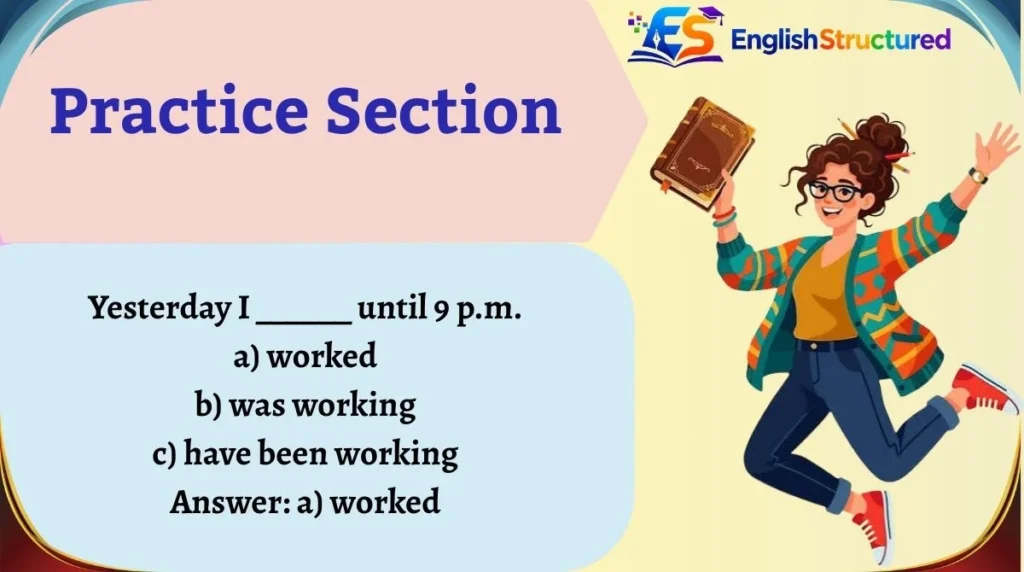
Choose the correct answer.
1.
Yesterday I ______ until 9 p.m.
a) worked
b) was working
c) have been working
Answer: a) worked
2.
I ______ when my brother knocked on the door.
a) worked
b) was working
c) have been working
Answer: b) was working
3.
I ______ here for six years.
a) worked
b) was working
c) have been working
Answer: c) have been working
4.
At 7 o’clock yesterday evening, I ______.
a) worked
b) was working
c) have been working
Answer: b) was working
5.
Last Saturday, we ______ from home.
a) worked
b) were working
c) have been working
Answer: a) worked
FAQs
1. What is the difference between I worked and I was working?
I worked describes a completed action in the past. I was working describes an action that was happening at a specific moment in the past. The first focuses on completion, while the second focuses on the action in progress.
2. What is the difference between I worked and I have been working?
I worked refers to a finished action with no connection to the present. I have been working shows that the action started in the past and continues until now or has only recently finished.
3. Can I use I have been working with yesterday?
No.
Because yesterday is a finished time, you should say:
I Worked vs I Was Working vs I Have Been Working
Use I have been working with words like since, for, all day, or lately.
4. Can these tenses be used in questions?
Yes.
Examples:
- Did you work yesterday?
- Were you working when I called?
- Have you been working all morning?
Each question asks about a different time or situation.
5. Which tense is more common in everyday English?
All three are common because they have different purposes.
Native speakers choose the tense that best matches the meaning they want to express. Learning when to use each one will make your English sound more natural.
6. How can I remember which tense to use?
Think about the timeline.
- Finished action → I worked
- Action in progress in the past → I was working
- Action continuing until now or just finished → I have been working
This simple timeline makes choosing the correct tense much easier.
Conclusion
I Worked vs I Was Working vs I Have Been Working
I worked tells us that an action started and finished in the past. I was working describes an action that was in progress at a specific moment in the past.
I have been working shows that an action began in the past and continued until now or has only recently ended.
Instead of trying to memorize every grammar rule, focus on the meaning.
Ask yourself whether the action is finished, was happening at a particular time, or has continued over a period of time. The answer will usually tell you which tense to choose.
The best way to master these tenses is through regular practice. Listen to native speakers, read English articles, and create your own example sentences.
The more you use these forms in real conversations, the more natural they will become.
With consistent practice, you’ll soon use I worked, I was working, and I have been working confidently and accurately in everyday English.