Regardless of vs Regardless If vs Regardless of If
These expressions often confuse English learners because they seem to have the same meaning.
You may hear all three in conversations, read them online, or see them in books. However, they are not always used in the same way.
Learning the difference is important because using the wrong phrase can make your writing sound unnatural or grammatically incorrect.
Native speakers usually prefer one form over the others, especially in formal writing, school assignments, business emails, and exams.
Knowing the correct choice helps you write with more confidence and avoid common grammar mistakes.
The good news is that this topic is much easier than it first appears.
Once you understand how each phrase works in a sentence and what kind of words should follow it, choosing the correct expression becomes simple.
By the end of this guide, you will understand the meaning of each phrase, know when it is appropriate to use it, recognize common mistakes, and feel comfortable using these expressions in everyday conversations and formal writing.
Plenty of clear examples will help you remember the rules naturally.
What Does “Regardless of” Mean?
“Regardless of” is the standard and grammatically correct expression in English. It means without considering something, despite something, or no matter what.
It introduces a noun, pronoun, or noun phrase. It can also be followed by a gerund (a verb ending in -ing that acts like a noun).
Simple Definition
Regardless of = without paying attention to something or despite something.
When to Use “Regardless of”
Use regardless of when you want to say that something does not change a decision, action, or result.
It is common in:
- Everyday conversations
- School writing
- Business communication
- Academic writing
- News articles
- Formal speeches
Regardless of vs Regardless If vs Regardless of If
Grammar Rule
The word of is a preposition. A preposition must be followed by:
- A noun
- A pronoun
- A noun phrase
- A gerund (-ing form)
Correct pattern:
Regardless of vs Regardless If vs Regardless of If
Examples
- regardless of the weather
- regardless of the cost
- Regardless of vs Regardless If vs Regardless of If
- regardless of their age
It can also follow this pattern:
Regardless of vs Regardless If vs Regardless of If
Examples:
- regardless of working late
- regardless of studying hard
- regardless of feeling tired
Examples of “Regardless of”
Here are several examples you can use in daily English.
- We went hiking regardless of the heavy rain.
- She smiled regardless of the bad news.
- Regardless of vs Regardless If vs Regardless of If
- They finished the project regardless of the deadline pressure.
- He accepted the job regardless of the low salary.
- You should tell the truth regardless of the consequences.
- The children kept playing regardless of the cold weather.
- Everyone is welcome regardless of their background.
Using “Regardless of” with -ing Verbs
Many learners forget that a verb must change into an -ing form after regardless of.
Correct examples:
- Regardless of vs Regardless If vs Regardless of If
- They kept driving regardless of getting lost.
- We finished cooking regardless of feeling tired.
- Regardless of vs Regardless If vs Regardless of If
- The team practiced regardless of raining outside.
Notice that the verb becomes a gerund, not the base verb.
Common Learner Confusion
Many students mistakenly remove the preposition of because they hear native speakers speak quickly.
Incorrect:
- Regardless the weather, we went outside.
Correct:
- Regardless of vs Regardless If vs Regardless of If
Another common mistake is placing a base verb after of.
Incorrect:
- Regardless of study hard.
Correct:
- Regardless of studying hard.
Remember this simple rule:
After “regardless of,” think “noun or -ing verb.”
If you remember that one sentence, you will avoid many grammar mistakes.
What Does “Regardless If” Mean?
The phrase “regardless if” appears in spoken English and on some websites, but most grammar experts consider it nonstandard. In careful writing, it is usually better to replace it with regardless of whether, whether or not, or simply regardless of when possible.
People often use regardless if to mean whether something happens or not. Although listeners usually understand the meaning, many teachers, editors, and style guides recommend avoiding it in formal English.
Simple Definition
Regardless of vs Regardless If vs Regardless of If
When People Use “Regardless If”
You may hear this phrase in:
- Casual conversations
- Informal online comments
- Social media posts
- Everyday speech in some regions
However, it is uncommon in:
- Academic writing
- Professional emails
- Newspapers
- Books
- Official documents
Regardless of vs Regardless If vs Regardless of If
Grammar Rule
The word if introduces a clause, not a noun.
Structure:
Regardless if + subject + verb
Example:
- Regardless of vs Regardless If vs Regardless of If
Although this sentence is understandable, many editors would rewrite it.
Better:
- Regardless of whether he comes, we will start.
Or:
- Whether or not he comes, we will start.
Examples of “Regardless If”
These examples show how the phrase is commonly used in informal English.
- We’ll leave regardless if it rains.
- She will support you regardless if you agree.
- The game will continue regardless if peRegardless of vs Regardless If vs Regardless of Ifople complain.
- He will travel regardless if anyone joins him.
- Regardless of vs Regardless If vs Regardless of If
- I’ll help you regardless if you’re busy.
- We are meeting tomorrow regardless if everyone arrives on time.
- She kept smiling regardless if people laughed at her.
These sentences communicate the intended meaning, but they are not the best choice for formal English.
Better Alternatives
Instead of:
- Regardless of vs Regardless If vs Regardless of If
Use:
- Regardless of vs Regardless If vs Regardless of If
- Whether or not it rains, we’ll go.
- We’ll go regardless of the weather.
Instead of:
- Regardless if she agrees, we’ll continue.
Use:
- Regardless of whether she agrees, we’ll continue.
- Whether she agrees or not, we’ll continue.
These alternatives sound more natural and are accepted in formal writing.
Why Learners Get Confused
The confusion happens because if is often used to introduce conditions.
For example:
- If it rains, we’ll stay home.
Learners sometimes think they can simply place regardless before if to create the opposite meaning.
However, English grammar does not always work that way. The phrase regardless of has been established in English for a long time, while regardless if is still considered nonstandard by many grammar authorities.
Regardless of vs Regardless If vs Regardless of If
What Does “Regardless of If” Mean?
The phrase “regardless of if” is sometimes used when people want to connect “regardless of” with a complete clause that begins with if. It usually means whether something happens or not.
Although you may hear native speakers say regardless of if, many grammar experts and style guides recommend using regardless of whether instead. The word whether fits better after regardless of because of is a preposition, and whether clearly introduces two possible situations.
Simple Definition
Regardless of if means without considering whether something happens or is true.
When People Use “Regardless of If”
You may see this phrase in:
- Informal conversations
- Blogs
- Online forums
- Social media posts
- Casual emails
However, it is less common in formal English. Most editors prefer regardless of whether because it sounds smoother and follows standard grammar more closely.
Grammar Rule
The basic structure is:
Regardless of vs Regardless If vs Regardless of If
Examples:
- Regardless of if he calls, I will leave.
- Regardless of if they agree, we will continue.
These sentences are understandable, but many grammar experts recommend changing them to:
- Regardless of whether he calls, I will leave.
- Regardless of vs Regardless If vs Regardless of If
Examples of “Regardless of If”
Here are some examples that you may hear in everyday English.
- We’ll finish the project regardless of if it takes longer.
- She will attend the meeting regardless of if her manager joins.
- They decided to travel regardless of if flights become more expensive.
- He plans to exercise regardless of if it rains tomorrow.
- I’ll support you regardless of if you change your mind.
- Regardless of vs Regardless If vs Regardless of If
- We are leaving early regardless of if the traffic improves.
- Regardless of vs Regardless If vs Regardless of If
These examples sound natural in casual speech, but for school, business, or professional writing, replacing if with whether is a better choice.
Better Alternatives
Instead of writing:
- Regardless of if she comes, we’ll begin.
Write:
- Regardless of vs Regardless If vs Regardless of If
Instead of:
- Regardless of if they win, we’ll celebrate.
Write:
- Regardless of whether they win, we’ll celebrate.
Or simply write:
- Whether they win or not, we’ll celebrate.
Common Learner Confusion
Many English learners think that adding of before if automatically makes the sentence correct.
For example:
❌ Regardless of if he agrees, we’ll continue.
While this is understandable, many teachers and editors still prefer:
✅ Regardless of whether he agrees, we’ll continue.
The difference is small, but choosing whether makes your English sound more natural and polished.
Difference Between Regardless of, Regardless If, and Regardless of If
All three expressions talk about something that does not change a decision or result, but they are not equally correct or equally common.
Understanding their grammar and level of formality will help you choose the best one every time.
Comparison Table
| Feature | Regardless of | Regardless if | Regardless of if |
|---|---|---|---|
| Standard English | ✅ Yes | ❌ Usually no | ⚠ Sometimes, but not preferred |
| Formal writing | ✅ Excellent | ❌ Avoid | ❌ Better to replace |
| Everyday conversation | ✅ Very common | ✅ Heard sometimes | ✅ Heard sometimes |
| Followed by | Noun or -ing verb | Clause | Clause |
| Best replacement | — | Regardless of whether | Regardless of whether |
Meaning Comparison
All three expressions can express nearly the same basic idea.
- Regardless of = despite something
- Regardless if = whether something happens or not
- Regardless of if = whether something happens or not
Although their meanings are similar, their grammar is different.
Grammar Difference
The biggest difference is what comes after each phrase.
Regardless of
This phrase is followed by a noun, pronoun, or gerund.
Examples:
- Regardless of vs Regardless If vs Regardless of If
- Regardless of the cost
- Regardless of working late
- Regardless of their opinion
Regardless if
This phrase introduces a complete clause.
Examples:
- Regardless if he arrives.
- Regardless if they agree.
- Regardless if she calls.
Many grammar experts recommend replacing it with regardless of whether.
Regardless of if
This phrase also introduces a clause.
Examples:
- Regardless of vs Regardless If vs Regardless of If
- Regardless of if she studies.
- Regardless of if they win.
Regardless of vs Regardless If vs Regardless of If
Sentence Structure Difference
Notice how each expression changes the sentence.
Pattern 1
Regardless of + noun
Example:
- We played soccer regardless of the rain.
Pattern 2
Regardless of vs Regardless If vs Regardless of If
Example:
- We played soccer regardless if it rained.
Pattern 3
Regardless of vs Regardless If vs Regardless of If
Example:
- We played soccer regardless of if it rained.
Preferred formal version
Regardless of whether + clause
Example:
- Regardless of vs Regardless If vs Regardless of If
This final version is the one you should use in essays, reports, exams, and professional writing.
Which One Should You Use?
If you want your English to sound correct in every situation, follow these simple tips.
- Use regardless of before nouns and -ing verbs.
- Use regardless of whether before complete clauses.
- Avoid regardless if in formal writing.
- Regardless of vs Regardless If vs Regardless of If
These choices will make your writing clearer and more natural.
Grammar Rules You Must Remember
Remembering a few simple rules will help you avoid mistakes every time you use these expressions.
Rule #1: Use “Regardless of” Before a Noun
Regardless of vs Regardless If vs Regardless of If
Correct:
- We continued regardless of the weather.
Incorrect:
- We continued regardless if the weather.
Rule #2: Use a Gerund After “Regardless of” When a Verb Follows
Regardless of vs Regardless If vs Regardless of If
Correct:
- She kept smiling regardless of feeling tired.
Incorrect:
- She kept smiling regardless of feel tired.
Rule #3: Use “Regardless of Whether” Before a Clause
When a complete subject and verb follow, whether is usually the best choice.
Correct:
- Regardless of vs Regardless If vs Regardless of If
Less preferred:
- We’ll leave regardless if it rains.
Rule #4: Formal Writing Needs Standard Grammar
If you’re writing for school, work, or an English exam, use the standard forms.
Best choices:
- Regardless of the cost
- Regardless of vs Regardless If vs Regardless of If
- Regardless of whether she agrees
Regardless of vs Regardless If vs Regardless of If
Common Mistakes Students Make
Many learners make the same mistakes because these expressions sound very similar. Once you know why the errors happen, they become much easier to avoid.
Mistake 1: Leaving Out “of”
❌ Regardless the weather, we’ll go.
✅ Regardless of the weather, we’ll go.
Regardless of vs Regardless If vs Regardless of If
Mistake 2: Using a Base Verb After “of”
❌ Regardless of study hard, she failed.
✅ Regardless of studying hard, she failed.
Tip: After a preposition like of, use a noun or an -ing verb.
Mistake 3: Using “Regardless If” in Formal Writing
❌ Regardless if he agrees, we’ll continue.
Regardless of vs Regardless If vs Regardless of If
Tip: Choose whether instead of if in professional or academic writing.
Mistake 4: Confusing “If” and “Whether”
Many students believe if and whether are always interchangeable.
That is not true.
Regardless of vs Regardless If vs Regardless of If
Easy Trick to Remember the Difference
Here is a simple memory trick that many students find helpful.
Think of “of” as a bridge leading to things.
If a thing comes next—a person, place, object, idea, or -ing verb—use:
Regardless of
Examples:
- regardless of money
- regardless of time
- regardless of traffic
- regardless of studying
Now think of whether as the word that introduces choices or possibilities.
If the next part is a complete idea with a subject and a verb, use:
Regardless of vs Regardless If vs Regardless of If
Examples:
- regardless of whether he comes
- regardless of whether it rains
- Regardless of vs Regardless If vs Regardless of If
A quick way to remember it is:
- Thing = regardless of
- Choice or possibility = regardless of whether
If you follow this simple rule, you’ll almost always choose the correct expression.
Daily Life Examples
These examples show how native speakers naturally express these ideas in everyday situations.
- We’ll go for a walk regardless of the weather.
- She smiles regardless of what people say.
- He finished his homework regardless of feeling tired.
- The shop stays open regardless of holidays.
- We’ll have the picnic regardless of whether it rains.
- They plan to move regardless of whether they find a larger house.
- Regardless of vs Regardless If vs Regardless of If
- She keeps practicing regardless of the difficulties.
- The children kept laughing regardless of the noise around them.
- Our team will continue working regardless of whether the plan changes.
These examples reflect the most natural and widely accepted usage in modern English.
Practice Section
Now it’s time to test what you’ve learned. Read each sentence and choose the best option.
Choose the Correct Answer
1. We will continue the trip _____ the bad weather.
A. regardless of
B. regardless if
C. regardless of if
Answer: ✅ A. regardless of
Why? The phrase is followed by the noun the bad weather, so regardless of is the correct choice.
2. We’ll start the meeting _____ everyone arrives on time.
A. regardless of whether
B. regardless of
C. regardless the
Answer: ✅ A. regardless of whether
Why? The phrase is followed by a complete clause (everyone arrives on time), so regardless of whether is the best option.
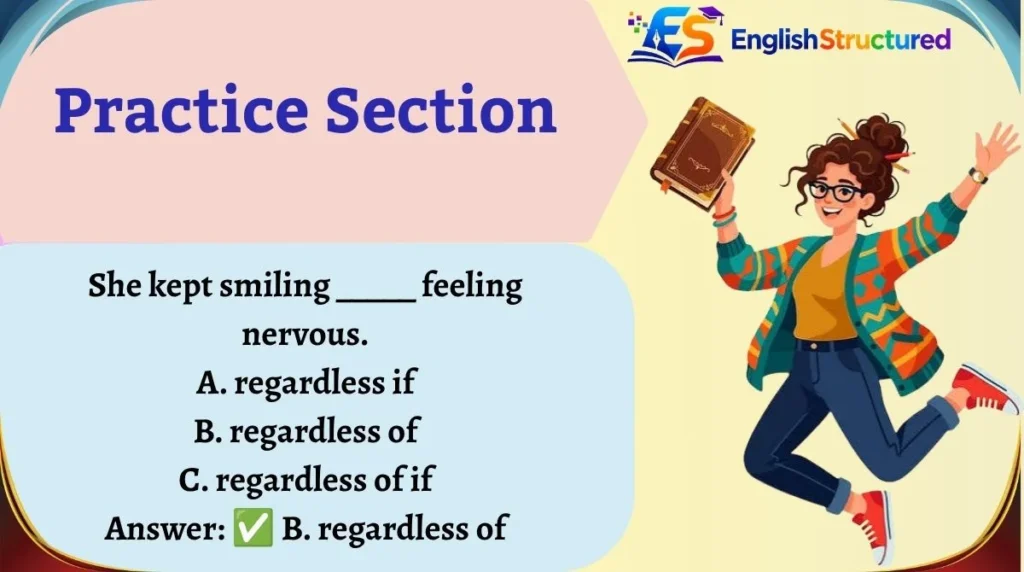
3. She kept smiling _____ feeling nervous.
A. regardless if
B. regardless of
C. regardless of if
Answer: ✅ B. regardless of
Why? Feeling is a gerund (-ing form), which correctly follows the preposition of.
4. _____ they agree, we’ll move forward with the plan.
A. Regardless if
B. Regardless of whether
C. Regardless the
Answer: ✅ B. Regardless of whether
Why? Formal English prefers regardless of whether before a clause.
5. Choose the most natural sentence.
A. Regardless if it rains, we’ll play.
B. Regardless of if it rains, we’ll play.
C. Regardless of whether it rains, we’ll play.
Regardless of vs Regardless If vs Regardless of If
Why? This is the most natural and grammatically accepted version, especially in formal writing.
Quick Review Quiz
Can you remember these simple rules?
- ✔ Use regardless of before a noun or -ing verb.
- ✔ Use regardless of whether before a complete clause.
- ✔ Avoid regardless if in formal writing.
- ✔ Regardless of if is understandable but usually less preferred than regardless of whether.
If you can remember these four points, you’re already using these expressions more accurately than many English learners.
FAQs
1. What is the difference between “regardless of” and “regardless if”?
The main difference is grammar. Regardless of is the standard expression and is followed by a noun, pronoun, or -ing verb. Regardless if introduces a clause but is generally considered nonstandard in formal English. In professional writing, regardless of whether is the preferred alternative.
2. Is “regardless if” grammatically correct?
Many native speakers use regardless if in everyday conversation, but many grammar experts and style guides recommend avoiding it in formal writing. If you want your English to sound polished and correct, use regardless of whether instead.
3. Is “regardless of if” better than “regardless if”?
Some people consider regardless of if slightly more natural because it keeps the preposition of. However, most editors still prefer regardless of whether. It is clearer, more widely accepted, and appropriate in both formal and informal English.
4. Can I use “regardless of” before a verb?
Yes, but the verb must be in its -ing form because of is a preposition.
Correct examples:
- Regardless of working late.
- Regardless of studying every day.
- Regardless of feeling tired.
Using the base form of the verb after of is incorrect.
5. Which expression should I use in academic or business writing?
Regardless of vs Regardless If vs Regardless of If. These expressions are accepted by teachers, editors, and major style guides. Avoid regardless if unless you’re quoting informal speech or writing dialogue.
6. How can I remember the correct usage easily?
Think about what comes next in the sentence.
- If the next word is a noun or an -ing verb, use regardless of.
- If the next part is a complete clause with a subject and a verb, use regardless of whether.
This simple rule works in almost every situation.
Conclusion
Regardless of vs Regardless If vs Regardless of If
Regardless of is the standard phrase and should be your first choice when it comes before a noun, pronoun, or -ing verb.
When you need to introduce a complete clause, regardless of whether is the most natural and widely accepted option.
Although you may hear regardless if and regardless of if in everyday conversations, they are generally less suitable for formal writing.
Choosing the standard forms will make your English sound clearer, more accurate, and more professional.
The best way to remember the difference is to practice using these expressions in real-life situations.
Read English books, listen to native speakers, and try writing your own sentences. The more you use these patterns, the more natural they will feel.
With regular practice, you’ll soon choose the correct expression without even thinking about it.