Preventive vs Preventative
They have similar spellings, they sound alike, and both relate to stopping something bad from happening. Because of this, many students wonder if one of them is wrong.
The good news is that both words are correct. However, they are not used equally.
In modern English, preventive is much more common, especially in formal writing, education, healthcare, business, and news articles.
Preventative is also accepted, but it appears less often and is more common in everyday speech or some regional varieties of English.
Understanding the difference is important because choosing the right word can make your writing sound more natural and more professional.
Whether you are writing an email, preparing for an English exam, or speaking with native speakers, knowing which word fits the situation can improve your confidence.
Many dictionaries list both words with the same meaning, which makes the topic even more confusing.
The real difference is not about meaning. Instead, it is about usage, style, and preference.
By the end of this guide, you will clearly understand when to use preventive, when preventative also works, which form is more common, and how to avoid common mistakes.
With simple explanations and plenty of examples, this topic will become much easier to remember.
What Does Preventive Mean?
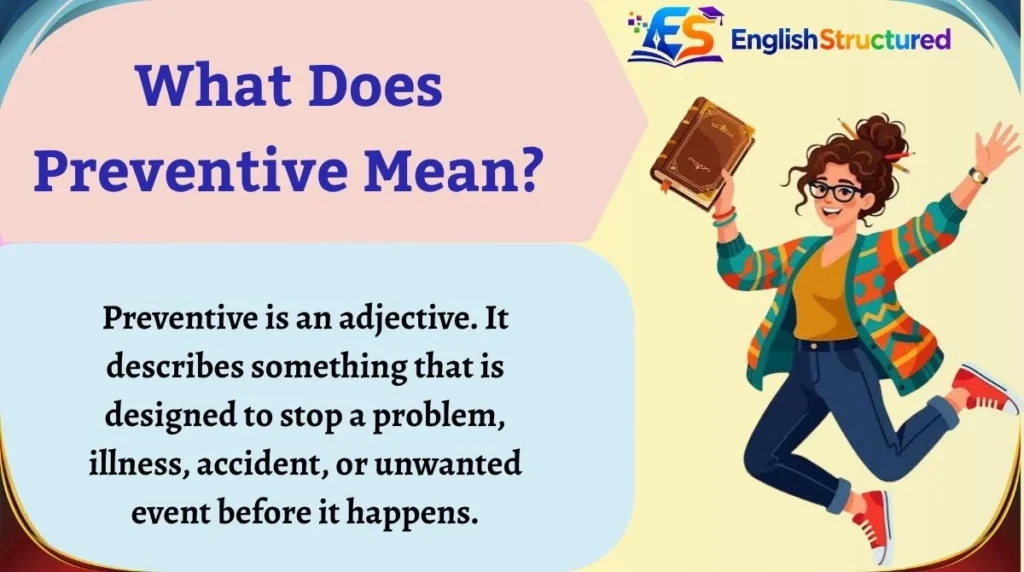
Preventive is an adjective. It describes something that is designed to stop a problem, illness, accident, or unwanted event before it happens.
Preventive vs Preventative
Today, preventive is the preferred spelling in most dictionaries and style guides. It appears more often in newspapers, medical writing, academic books, government publications, and professional communication.
Simple Definition
Preventive means:
Intended to stop something harmful before it happens.
It focuses on taking action early instead of fixing a problem later.
When to Use Preventive
Preventive vs Preventative
- Healthcare
- Medicine
- Safety measures
- Security
- Education
- Business planning
- Maintenance
- Risk management
- Public health
- Everyday protection
Preventive vs Preventative
Grammar Rule
Preventive vs Preventative
It comes before a noun or follows a linking verb.
Pattern 1
preventive + noun
Examples:
- preventive care
- preventive medicine
- Preventive vs Preventative
- preventive action
- preventive measures
Pattern 2
be + preventive
Example:
- This policy is preventive rather than reactive.
Preventive vs Preventative
✔ preventive action
✘ preventive acted
Example Sentences Using Preventive
Here are some everyday examples.
- The doctor recommended preventive care for everyone in the family.
- Wearing a helmet is a preventive measure against head injuries.
- Preventive vs Preventative
- Regular exercise is a preventive habit that supports good health.
- Schools teach preventive strategies to reduce bullying.
- The mechanic performed preventive maintenance on the machine.
- Preventive vs Preventative
- Installing smoke alarms is a preventive step that can save lives.
These examples show that the action happens before a problem begins.
Common Phrases with Preventive
You will often hear these expressions.
- preventive care
- preventive medicine
- preventive treatment
- Preventive vs Preventative
- preventive action
- preventive measures
- preventive healthcare
- Preventive vs Preventative
- preventive services
- preventive approach
These combinations are very common in both spoken and written English.
Real-Life Situations
Imagine these situations.
At the doctor’s office
Preventive vs Preventative
Patient: So they help find problems early?
Doctor: Exactly.
At work
Preventive vs Preventative
Employee: That should reduce expensive repairs.
At school
Teacher: Wearing safety goggles is a preventive measure during science experiments.
Student: That helps protect our eyes.
Why Is Preventive So Common?
Preventive vs Preventative
Medical organizations, universities, government agencies, and international companies often choose preventive in their official writing.
For example, you are much more likely to read:
- preventive healthcare
- preventive medicine
- preventive maintenance
Preventive vs Preventative
That does not mean preventative is incorrect. It simply means preventive is the more widely accepted choice in professional English.
Common Learner Confusion About Preventive
Preventive vs Preventative
They do not.
Both words describe something that helps stop a problem before it happens.
The difference is mainly one of preference and frequency.
Preventive vs Preventative
That is incorrect.
You can use it in many areas, including:
- business
- education
- engineering
- sports
- technology
- home safety
- environmental protection
As a general rule, if you are unsure which spelling to choose, preventive is usually the safest option because it is more common in modern English.
What Does Preventative Mean?
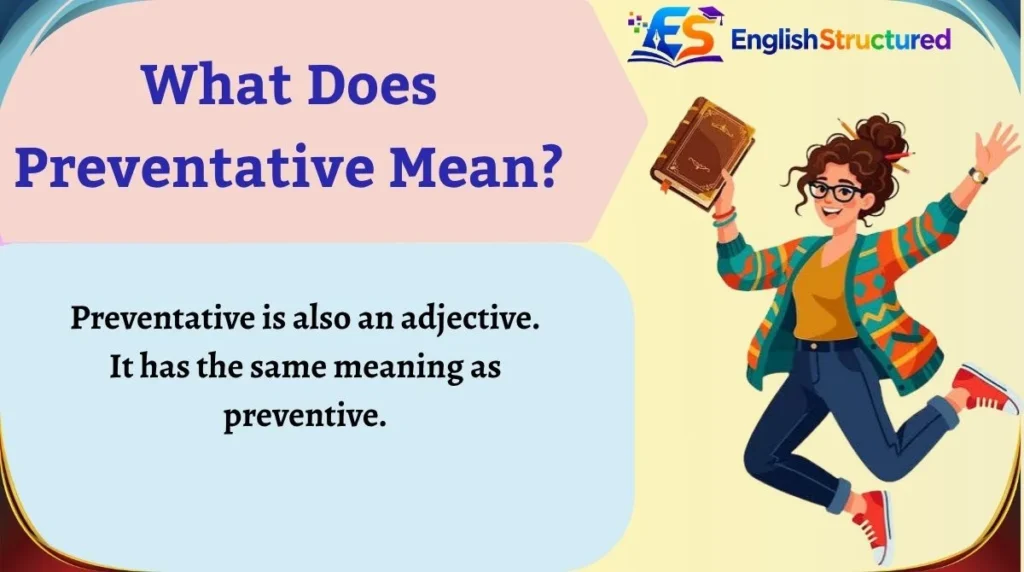
Preventative is also an adjective. It has the same meaning as preventive. It describes something that is intended to stop a problem, illness, accident, or unwanted event before it happens.
Unlike many confusing English word pairs, there is no difference in meaning between preventive and preventative. Both words come from the verb prevent, and both can be used to describe actions, treatments, plans, or measures that help avoid future problems.
The main difference is how often people use each word. Preventive vs Preventative.
Simple Definition
Preventative means:
Designed to stop something from happening before it begins.
The meaning is exactly the same as preventive.
When to Use Preventative
You may see preventative in:
- Everyday conversations
- Personal blogs
- Local newspapers
- Some books
- Informal writing
- Certain regional varieties of English
Some native speakers simply prefer the longer form because it sounds more natural to them.
Preventive vs Preventative
Grammar Rule
Like preventive, preventative is an adjective.
It usually comes before a noun.
Examples:
- preventative medicine
- preventative action
- Preventive vs Preventative
- preventative treatment
It can also appear after a linking verb.
Example:
- Preventive vs Preventative
Example Sentences Using Preventative
- The dentist explained several preventative treatments for healthy teeth.
- The school introduced preventative measures to improve student safety.
- Preventive vs Preventative
- Parents often teach preventative habits to keep children safe.
- Vaccination is considered a preventative method against many diseases.
- Fire drills are a preventative practice in many schools.
- The city created preventative programs to reduce traffic accidents.
- Preventive vs Preventative
Common Phrases with Preventative
Although less common, you may still encounter phrases such as:
- preventative care
- preventative medicine
- Preventive vs Preventative
- preventative action
- preventative measures
- preventative treatment
- preventative strategy
- preventative healthcare
Preventive vs Preventative
Real-Life Situations
At the dentist
Preventive vs Preventative
Patient: That helps avoid cavities.
At home
Parent: Wearing sunscreen is a preventative measure before going outside.
Child: It protects my skin from the sun.
At the office
Preventive vs Preventative
Employee: That should help prevent breakdowns.
Why Do Some People Prefer Preventative?
Many English speakers naturally add -ative to words because it sounds similar to other adjectives such as:
- informative
- imaginative
- decorative
- Preventive vs Preventative
As a result, preventative feels natural to some people, even though preventive became the more common standard over time.
Preventive vs Preventative
Common Learner Confusion About Preventative
A common misunderstanding is that preventative is incorrect.
That is false.
Preventive vs Preventative
Another common mistake is believing that preventative is stronger or has a different meaning than preventive.
Again, this is not true.
The two words mean the same thing. The difference is simply that preventive is more common in modern formal English, while preventative is an accepted alternative that appears less frequently.
As a learner, you should recognize both words. However, if you want your English to sound more natural in professional or academic settings, preventive is usually the preferred choice.
Difference Between Preventive and Preventative
At first, preventive and preventative seem like different words with different meanings. Preventive vs Preventative
The biggest difference is how often people use them. In modern English, preventive is the preferred choice in most formal situations, while preventative is an accepted alternative that appears less often.
If you compare newspapers, textbooks, medical websites, and business documents, you will notice that preventive is used much more frequently.
Preventive vs Preventative Comparison Table
| Feature | Preventive | Preventative |
|---|---|---|
| Meaning | Stops a problem before it happens | Stops a problem before it happens |
| Part of Speech | Adjective | Adjective |
| Correct English? | ✅ Yes | ✅ Yes |
| Formal Writing | Preferred | Less common |
| Academic Writing | Very common | Rare |
| Medical Writing | Standard choice | Sometimes used |
| Everyday Conversation | Common | Also common in some regions |
| Dictionaries | Accepted | Accepted |
| Best Choice for Learners | ✅ Recommended | Acceptable alternative |
Usage Difference
Although both words are correct, native speakers often choose one depending on the situation.
Choose “preventive” when writing:
- School assignments
- Essays
- Research papers
- Business emails
- Government documents
- Medical reports
- Professional websites
Examples:
- preventive healthcare
- preventive maintenance
- preventive action
- preventive medicine
Choose “preventative” when:
- Quoting someone who uses it
- Following a company’s style guide
- Writing in a region where it is common
- Speaking casually with friends or family
Preventive vs Preventative
Grammar Logic
Preventive vs Preventative
Prevent (verb)
↓
Preventive (adjective)
↓
Preventive vs Preventative
Neither word changes the meaning of the sentence.
Compare these examples:
- Preventive medicine helps people stay healthy.
- Preventative medicine helps people stay healthy.
Both sentences are correct.
The only difference is the preferred style.
Sentence Structure Difference
The sentence pattern stays exactly the same.
Pattern
Adjective + Noun
Examples:
- preventive care
- preventative care
- preventive treatment
- Preventive vs Preventative
- preventive strategy
- preventative strategy
You cannot use either word as a verb.
Correct:
✔ We need preventive action.
✔ We need preventative action.
Incorrect:
Preventive vs Preventative
✘ We preventative the problem.
Use the verb prevent instead.
Correct:
✔ We prevented the accident.
✔ Good planning prevents mistakes.
Meaning Comparison
The meanings completely overlap.
Both words describe:
- protection
- preparation
- avoiding future problems
- reducing risk
- staying safe
- stopping illness before it starts
There is no hidden difference in meaning.
Many learners spend hours trying to discover which one has a stronger meaning. The answer is simple:
Neither does.
The choice is mainly based on style and frequency.
Which Word Should You Use?
Preventive vs Preventative
It is:
- shorter
- more common
- preferred by many editors
- widely used in schools
- common in dictionaries
- standard in healthcare and business
Preventive vs Preventative
Knowing both forms helps improve your reading skills.
Grammar Rules You Must Remember
Learning a few simple grammar rules makes choosing the correct word much easier.
Rule #1: Both Words Are Adjectives
Preventive vs Preventative
They describe nouns.
Correct:
- preventive medicine
- preventative treatment
Incorrect:
- We preventive disease.
- They preventative accidents.
Use prevent as the verb.
Correct:
- We prevent disease through vaccination.
- Exercise prevents many health problems.
Rule #2: Preventive Is Preferred in Formal English
If you are unsure which spelling to choose, use preventive.
It is more common in:
- universities
- newspapers
- government writing
- business communication
- scientific articles
Example:
✔ The company introduced preventive safety measures.
This sounds more natural in professional English.
Rule #3: Both Words Have the Same Meaning
Do not try to assign different meanings.
These two sentences communicate exactly the same idea.
- Regular exercise is preventive.
- Regular exercise is preventative.
Both are correct.
The difference is simply one of preference.
Rule #4: Match the Style of Your Writing
Consistency is important.
If you begin a report using preventive, continue using preventive throughout the document.
Avoid switching between the two forms without a reason.
Better:
- preventive care
- preventive medicine
- preventive measures
Instead of:
- preventive care
- preventative medicine
- preventive measures
Using one style throughout your writing looks more professional.
Common Mistakes Students Make
Because the two words look so similar, learners often make small mistakes.
Here are the most common ones.
Mistake 1: Thinking One Word Is Wrong
Many students believe preventative is incorrect.
Wrong idea:
❌ Preventative isn’t an English word.
Correct:
✅ Both preventive and preventative are correct.
Remember that dictionaries recognize both spellings.
Mistake 2: Thinking the Meanings Are Different
Some learners believe:
- preventive = medicine
- preventative = safety
This is incorrect.
Both words can describe medicine, safety, maintenance, education, planning, and many other topics.
Correct examples:
- preventive healthcare
- preventative healthcare
Both are acceptable.
Mistake 3: Using Them as Verbs
Incorrect:
❌ The vaccine preventive disease.
❌ Exercise preventative illness.
Correct:
✅ The vaccine prevents disease.
✅ Exercise helps prevent illness.
Remember:
Prevent is the verb.
Preventive and preventative are adjectives.
Mistake 4: Mixing Styles in One Piece of Writing
Example:
The company introduced preventive maintenance.
The preventative program reduced costs.
Although both words are correct, changing styles in the same document may confuse readers.
Better:
The company introduced preventive maintenance.
The preventive program reduced costs.
Consistency makes your writing smoother.
Mistake 5: Assuming the Longer Word Is More Formal
Many learners think longer words sound more professional.
That is not always true.
Preventive vs Preventative
Easy Correction Tips
Whenever you write, ask yourself these questions:
- Am I describing a noun?
- Is this formal writing?
- Do I want the most common spelling?
Preventive vs Preventative
If you read preventative, do not worry. It is still correct English.
Easy Trick to Remember the Difference
Many students want a simple way to remember which word to use.
Here is an easy trick.
Memory Trick
Think about the verb:
prevent
The shorter adjective stays closer to the original verb.
prevent
↓
preventive
Since it changes less, it became the preferred spelling in modern English.
Another Easy Way to Remember
Think about professional places.
Imagine these signs:
- Preventive Health Center
- Preventive Maintenance Department
- Preventive Care Clinic
These sound natural because professionals usually choose preventive.
Now imagine your neighbor talking casually.
“I believe preventative care is important.”
This also sounds completely natural.
So remember:
- Professional writing → preventive
- Casual speech → preventive or preventative
Real-Life Logic
Imagine buying a bicycle.
You oil the chain every month.
Why?
Because you want to stop future problems.
That is called preventive maintenance.
Your friend calls it preventative maintenance.
Are you talking about different things?
No.
Both of you mean the same maintenance.
Only the wording is different.
One Sentence to Remember Forever
If you can remember just one sentence, make it this:
Both words are correct, but preventive is usually the better choice in formal English.
That simple rule will help you in school, at work, and on English exams.
Quick Summary
Before moving to the next section, remember these key points:
- ✅ Both preventive and preventative are correct adjectives.
- ✅ They have the same meaning.
- ✅ Preventive is more common in modern English.
- ✅ Preventative is less common but still accepted.
- ✅ Use prevent when you need a verb.
- ✅ Stay consistent by using one form throughout a piece of writing.
These simple rules will help you choose the right word with confidence in almost every situation.
Daily Life Examples
Preventive vs Preventative. Since both words have the same meaning, you will notice that replacing one with the other usually does not change the sentence. However, preventive is the form you will hear and read more often in formal situations.
Here are some real-life examples.
- Doctor: You should have a yearly checkup as part of your preventive care.
Patient: That sounds like a good idea. - Preventive vs Preventative
- My dentist says regular cleanings are an important part of preventive dental care.
- Our company schedules preventive maintenance every three months to avoid equipment failures.
- Wearing sunscreen is a simple preventive habit that protects your skin.
- The coach taught preventive exercises to reduce the risk of injuries before the season started.
- We installed smoke detectors as a preventive safety measure for our home.
- Good handwashing is one of the best preventive practices during flu season.
- My neighbor prefers the word preventative, but my teacher usually writes preventive.
- Taking action early is always better than fixing a problem later, which is the idea behind preventive planning.
These examples show that the word is commonly used when talking about health, safety, education, business, and everyday life.
Practice Section
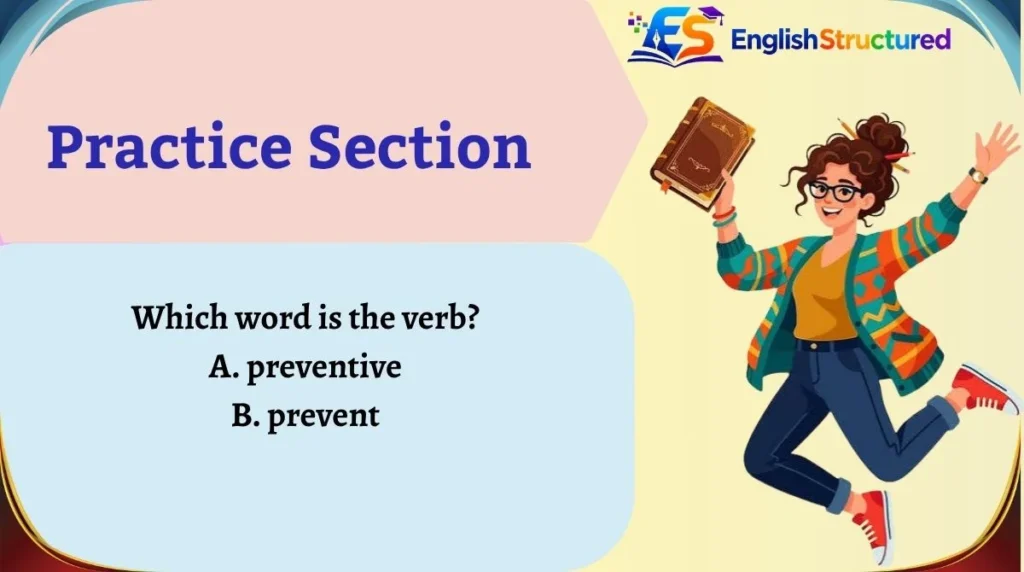
Try these short exercises to check your understanding. Choose the correct option in each sentence.
Questions
1. The doctor recommended ________ care to keep patients healthy.
A. preventive
B. preventative
2. The company performs ________ maintenance every month.
A. preventive
B. preventative
3. Which sentence is generally preferred in formal writing?
A. Preventative medicine is important.
B. Preventive medicine is important.
4. Which word is the verb?
A. preventive
B. prevent
5. Which statement is correct?
A. Preventive and preventative have different meanings.
B. Preventive and preventative have the same meaning.
Answers
1. A. preventive
Although both are correct, preventive care is the standard phrase in formal English.
2. A. preventive
“Preventive maintenance” is the expression most commonly used in business and engineering.
3. B. Preventive medicine is important.
This is the preferred style in professional and academic writing.
4. B. prevent
Prevent is the verb. Preventive and preventative are adjectives.
5. B. Preventive and preventative have the same meaning.
The difference is mainly in usage and preference, not meaning.
FAQs
What is the difference between preventive and preventative?
Both words have the same meaning. They describe something that helps stop a problem before it happens. Preventive vs Preventative.
Is preventive more correct than preventative?
No. Both words are correct. However, preventive is generally preferred in academic writing, professional documents, healthcare, and most modern style guides because it is used more frequently.
Can I use preventative in formal writing?
Yes, you can. Most readers will understand it without any problem. However, many editors and teachers recommend using preventive because it is the more widely accepted standard in formal writing.
Which word is more common in American English?
Preventive is more common in American English, especially in medicine, education, business, and government publications. You may still see preventative, but it appears less often.
Is preventive a noun or an adjective?
Preventive is an adjective. It describes a noun, such as preventive care, preventive medicine, or preventive action. The verb is prevent.
Can preventive and preventative be used in questions?
Yes. Both words can be used naturally in questions.
Examples:
- Is preventive care covered by your insurance?
- Preventive vs Preventative
The meaning stays the same regardless of whether the sentence is a statement or a question.
Conclusion
Preventive vs Preventative
The most important thing to remember is that both are correct English words.
They both describe actions, treatments, or plans that help stop problems before they happen.
The real difference is not about grammar or meaning. It is about usage and style.
In modern English, preventive is the preferred choice in formal writing, professional communication, healthcare, education, and business.
Preventative is still accepted and used by many native speakers, especially in everyday conversation and some regional varieties of English.
If you are unsure which word to choose, preventive is usually the safest option. It is more common, widely accepted, and recommended by many style guides.
At the same time, you should recognize preventative when reading books, articles, or listening to native speakers.
The best way to remember the difference is to read, write, and use these words in real-life situations.
With regular practice, choosing the right form will soon become natural, and your English will sound more confident and polished.