Things Have or Has Changed
They may ask, “Should I say things have changed or things has changed?” The two forms look similar, but only one is correct.
This confusion happens because learners often focus on the word changed and forget to check the subject.
In English, the helping verb must agree with the subject. A singular subject usually works with has, while a plural subject usually works with have.
The word things is plural. It means more than one thing. Therefore, we say:
Things have changed. ✅
We do not say:
Things Have or Has Changed
This grammar point is useful in daily conversations. You may use it when talking about changes in your life, work, school, family, town, or relationships. For example:
Things have changed since we were children.
The sentence means that life is different now from how it was before.
After reading this guide, you will understand why “things have changed” is correct, when to use have and has, how the present perfect tense works, and how to avoid common mistakes.
You will also see simple examples, daily conversations, practice questions, and easy memory tricks.
What Does “Have” Mean?
The word have can be a main verb or a helping verb. In the sentence “Things have changed,” it is a helping verb.
Here, have works with the past participle changed to form the present perfect tense.
Simple meaning
The sentence:
Things Have or Has Changed
means that some changes happened in the past, and those changes are still important or noticeable now.
For example:
Things Have or Has Changed
This means that changes began after the speaker started the new job, and the situation is different now.
When do we use “have”?
Use have with:
- I
- You
- We
- They
- Plural nouns
Plural nouns name more than one person, place, animal, object, or idea.
Examples of plural nouns include:
- things
- students
- books
- cars
- people
- ideas
Things Have or Has Changed
Grammar rule
The basic present perfect structure is:
Subject + have + past participle
Examples:
I have changed my plans.
You have learned a lot.
We have finished our work.
Things Have or Has Changed
Things Have or Has Changed
Things have changed.
In these sentences, have is the helping verb. The final verb is in its past participle form.
Examples with “have”
- Things Have or Has Changed
- My plans have changed.
- The rules have changed.
- Things Have or Has Changed
- We have changed our minds.
- The children have grown very quickly.
- Many things have changed in this town.
- You have changed a lot.
Common learner confusion
Some learners think that has sounds more natural because things may feel like one group. However, grammar looks at the form of the noun.
Things Have or Has Changed
Therefore:
Things have changed. ✅
Not:
Things has changed. ❌
Even when many things are part of one situation, the word things is still plural.
For example:
Things have changed at work.
Things Have or Has Changed
What Does “Has” Mean?
Like have, the word has can be a main verb or a helping verb. In present perfect sentences, has is used with singular subjects.
Simple meaning
The sentence:
Things Have or Has Changed
means that the speaker’s life was one way before, but it is different now.
The change happened in the past, and the result matters in the present.
When do we use “has”?
Use has with:
- He
- She
- It
- A singular person
- A singular thing
- A singular noun
Examples:
- Ahmed
- my sister
- the car
- the weather
- the situation
- everything
Grammar rule
The basic structure is:
Singular subject + has + past participle
Examples:
She has changed.
He has finished his work.
The weather has improved.
Things Have or Has Changed
The situation has become difficult.
Things Have or Has Changed
Examples with “has”
- My life has changed a lot.
- The city has changed over the years.
- The weather has changed suddenly.
- She has changed her hairstyle.
- He has changed his opinion.
- Things Have or Has Changed
- The situation has changed.
- Things Have or Has Changed
Common learner confusion
Learners sometimes use have with a singular noun because they remember the phrase “I have.” However, English changes the helping verb with third-person singular subjects.
Compare:
I have changed. ✅
You have changed. ✅
Things Have or Has Changed
They have changed. ✅
She has changed. ✅
He has changed. ✅
It has changed. ✅
The important question is:
Is the subject singular or plural?
Things Have or Has Changed
For example:
The situation has changed. ✅
The word situation is singular, so we use has.
The situations have changed. ✅
The word situations is plural, so we use have.
Difference Between “Things Have Changed” and “Thing Has Changed”
The main difference is the number of things being discussed.
| Feature | Things have changed | Thing has changed |
|---|---|---|
| Subject | Things | Thing |
| Subject type | Plural | Singular |
| Helping verb | Have | Has |
| Meaning | More than one thing is different | One thing is different |
| Correct structure | Plural + have + changed | Singular + has + changed |
| Example | Things have changed at school | One thing has changed at school |
Usage difference
Use things have changed when several parts of a situation are different.
For example:
Things have changed in our family.
This may mean that several changes happened. Perhaps someone moved away, a child started school, or the family changed its daily routine.
Use a thing has changed when you are talking about one specific change.
For example:
One thing has changed in our family.
This means that only one important detail is different.
Grammar logic
The grammar rule is based on the subject.
Things is plural:
Things have changed.
Thing is singular:
Things Have or Has Changed
The same pattern appears with many other nouns:
The plans have changed.
The plan has changed.
The rules have changed.
The rule has changed.
The people have changed.
The person has changed.
Sentence structure difference
Plural structure:
Plural subject + have + past participle
Things + have + changed.
Singular structure:
Singular subject + has + past participle
The situation + has + changed.
Meaning comparison
Look at these examples:
Things have changed between us.
This means that the relationship is different in several ways.
Something has changed between us.
This means that one unknown or unclear change has happened.
The meaning is close, but the subjects are different.
Things Have or Has Changed
Something is singular, so it uses has.
Grammar Rules You Must Remember
Rule #1: Use “have” with plural subjects
When the subject names two or more people or things, use have.
The students have finished the lesson.
My friends have changed their plans.
Things have changed.
The subject comes before have, so check whether it is singular or plural.
Rule #2: Use “has” with singular subjects
Use has with one person, one thing, or a third-person singular pronoun.
My brother has changed jobs.
The weather has changed.
She has changed her mind.
The subject is singular in each sentence, so has is correct.
Rule #3: Use “have” with I, you, we, and they
These words follow a special pattern.
I have improved my English.
You have done a great job.
We have changed our schedule.
They have moved to a new house.
Even though I means one person, it uses have, not has.
Rule #4: Use the past participle after “have” or “has”
The present perfect tense needs:
Have/has + past participle
Examples:
Things Have or Has Changed
She has gone home.
Things Have or Has Changed
He has written a letter.
Do not use the simple past form after have or has when the verb is irregular.
Wrong:
She has went home. ❌
Correct:
She has gone home. ✅
Things Have or Has Changed
They changed the plan yesterday.
They have changed the plan.
The first sentence uses the simple past. The second sentence uses the present perfect.
Common Mistakes Students Make
Many mistakes happen because learners remember the words have and has but forget to check the subject.
Mistake 1: Using “has” with “things”
Wrong:
Things has changed. ❌
Correct:
Things have changed. ✅
Why?
Things is plural. Plural subjects take have.
Mistake 2: Using “have” with a singular noun
Wrong:
The situation have changed. ❌
Correct:
The situation has changed. ✅
Why?
Situation is singular. Singular subjects take has.
Mistake 3: Using “changed” without a helping verb
Wrong:
Things changed since last year. ⚠️
Correct:
Things have changed since last year. ✅
The first sentence may be possible in some contexts, but it does not clearly show the present perfect meaning. When the past change still matters now, have changed is often the better choice.
Mistake 4: Saying “things is changed”
Wrong:
Things Have or Has Changed
Correct:
Things have changed. ✅
The phrase have changed shows that a change happened.
The phrase is changed usually has a different meaning and may describe an action done to something.
For example:
The password is changed every month.
This means someone changes the password regularly.
Mistake 5: Using “has” after “people”
Wrong:
People has changed. ❌
Correct:
Things Have or Has Changed
The word people is plural.
Easy correction tip
Things Have or Has Changed
How many people or things does the subject mean?
If it means more than one, use have.
If it means one, use has.
Easy Trick to Remember the Difference
A simple memory trick is:
Many = have. One = has.
Think about the subject first.
Things means many things.
Therefore:
Things Have or Has Changed
Everything may sound like many things, but grammatically it is singular.
Therefore:
Everything has changed.
This is an important point.
Compare:
Things have changed. ✅
Everything has changed. ✅
Why are the helping verbs different?
The word things is a plural noun.
The word everything is an indefinite pronoun that takes a singular verb.
You can also use this short pattern:
He, she, it = has
I, you, we, they = have
For nouns:
One thing = has
Many things = have
Imagine one book and several books.
The book has changed.
The books have changed.
The same rule works with thing and things.
Daily Life Examples
These examples show how people may use the phrase in normal conversations.
Example 1
A: You look happier these days.
B: Yes, things have changed for the better.
Example 2
A: Do you still live near the school?
B: No. Things have changed since I moved.
Example 3
A: Is your old office the same?
B: Not really. Things have changed there.
Example 4
A: Do you still talk to your school friends?
B: Some of them. But things have changed over time.
Example 5
A: You seem very busy now.
B: I know. Things have changed since I became a parent.
Example 6
A: Is the town still quiet?
B: No. Things have changed a lot in the last ten years.
Example 7
A: Are you still afraid of speaking English?
B: No. Things have changed because I practise every day.
Example 8
A: Why is the team working differently?
B: Things have changed since the new manager arrived.
Example 9
A: Is your family life the same?
B: No, things have changed, but we are happy.
Example 10
A: Do you still use the same phone?
B: No. Many things have changed since then.
These sentences sound natural because they describe a past change that has a result in the present.
Practice Section
Things Have or Has Changed
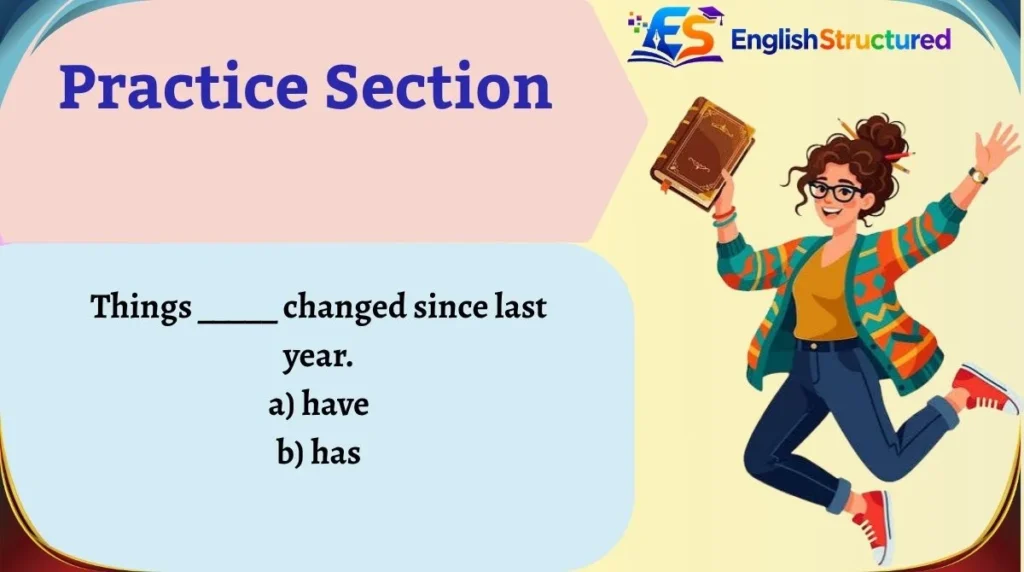
1. Things _____ changed since last year.
a) have
b) has
2. My life _____ changed a lot.
a) have
b) has
3. The rules _____ changed.
a) have
b) has
4. Everything _____ changed.
a) have
b) has
5. My friends _____ changed their plans.
a) have
b) has
Answers
- have — Things is plural.
- has — My life is singular.
- have — Rules is plural.
- has — Everything takes a singular verb.
- have — Friends is plural.
FAQs
1. What is the correct sentence: “Things have changed” or “Things has changed”?
Things Have or Has Changed. The word things is plural, so it takes have. The sentence means that several parts of a situation are different now.
2. Why do we say “things have changed”?
We say things have changed because things means more than one thing. English uses have with plural subjects. The complete structure is plural subject + have + past participle.
3. Can we use “things have changed” in a question?
Yes. You can ask:
Things Have or Has Changed
You can also say:
Have things changed since you moved?
In questions, have usually comes before the subject.
4. Is “things have changed” formal or informal?
The phrase is natural in both formal and informal English. You can use it in daily conversations, emails, stories, meetings, and writing. The meaning depends on the situation.
5. Is “everything has changed” correct?
Yes. Everything has changed is correct because everything is grammatically singular. Although it refers to many parts of life, it takes has, not have.
6. Can I say “things changed”?
Yes, but the meaning may be different. Things changed uses the simple past and often refers to a finished time. Things Have or Has Changed
Conclusion
Things Have or Has Changed
Remember this easy rule:
One thing has changed.
Things Have or Has Changed
The same grammar pattern works with other words. For example, the plan has changed, but the plans have changed. Always look at the subject before choosing the helping verb.
The phrase things have changed is common in everyday English. People use it when life, work, relationships, technology, places, or personal situations become different.
It often suggests that the past is connected to the present.
Do not worry if you make mistakes at first. Grammar becomes easier when you practise with short sentences. Try making your own examples:
Things have changed at school.
Things Have or Has Changed
Things have changed for the better.
Things Have or Has Changed