English has many words that look alike or sound alike, and that can make learning the language confusing.
Peaked vs Peeked vs Piqued
Many students accidentally choose the wrong word when writing emails, school assignments, social media posts, or even text messages.
A single spelling mistake can change the meaning of a sentence and make your writing less clear. That is why understanding these words is so important.
The good news is that the difference is not difficult once you know what each word means.
Every word has its own purpose, grammar pattern, and common situations where it is used.
Learning them with simple explanations and real-life examples makes them much easier to remember.
By the end of this guide, you will know when to use “peaked,” “peeked,” and “piqued” with confidence.
You will also learn common mistakes, easy memory tips, and practical examples that help these words become part of your everyday English.
Whether you are a beginner, a student, or an English learner preparing for exams, this lesson will help you avoid one of the most common spelling mix-ups.
What Does “Peaked” Mean?
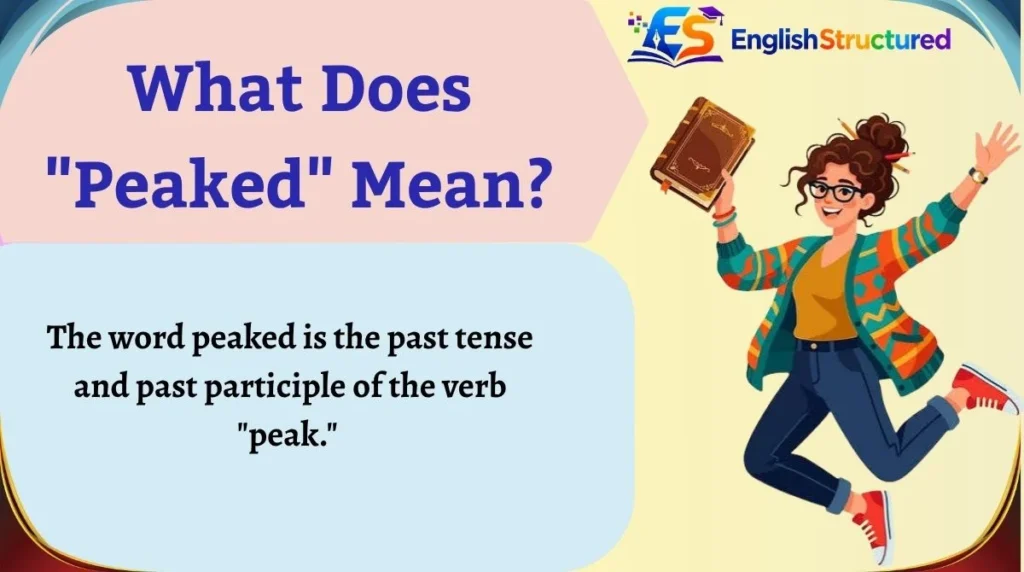
The word peaked is the past tense and past participle of the verb “peak.” It means to reach the highest point, greatest level, or maximum amount. It can describe numbers, emotions, performance, popularity, or even mountains.
In some contexts, especially British English, peaked can also describe someone who looks pale, tired, or unwell. However, this meaning is less common than “reached the highest point.”
When to Use “Peaked”
Peaked vs Peeked vs Piqued
- Reaches its highest level.
- Hits its maximum point.
- Achieves its best performance.
- Stops rising after reaching the top.
Grammar Rule
- Peak = base verb
- Peaked vs Peeked vs Piqued
- Often followed by words such as at, in, during, after, before, or a specific time.
Example Sentences
- Sales peaked in December because of holiday shopping.
- The singer’s career peaked in the early 2000s.
- My excitement peaked when I saw the surprise.
- The temperature peaked at 39°C yesterday.
- The crowd’s cheers peaked as the team scored the winning goal.
- Traffic peaked during the morning rush hour.
- Her confidence peaked after winning the competition.
- Peaked vs Peeked vs Piqued
Common Learner Confusion
Many learners write:
Peaked vs Peeked vs Piqued
This is incorrect because your interest reaches a high level. It does not secretly look at something.
✅ My interest peaked after reading the first chapter.
Peaked vs Peeked vs Piqued
Common Situations Where “Peaked” Is Used
Peaked vs Peeked vs Piqued
- Business and sales
- Weather reports
- Sports performance
- Music charts
- Population growth
- Emotions
- Energy levels
- Website traffic
For example:
- Website visitors peaked after the new product launch.
- Peaked vs Peeked vs Piqued
- Electricity use peaked in the evening.
These examples all show something reaching its maximum level.
Tips for Remembering “Peaked”
Think about a mountain peak. A mountain has a peak, which is its highest point. Peaked vs Peeked vs Piqued
What Does “Peeked” Mean?
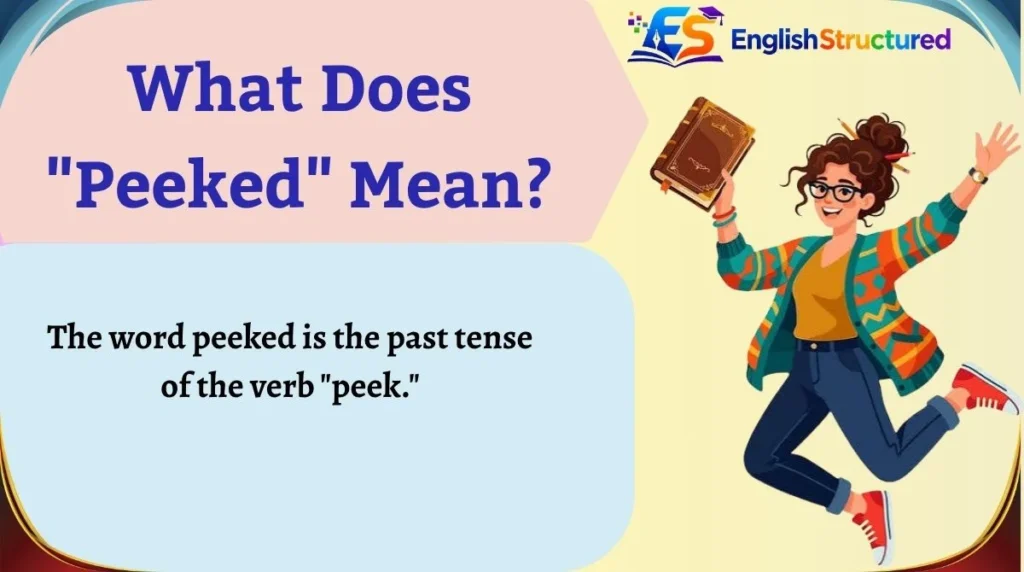
The word peeked is the past tense of the verb “peek.” It means to look quickly, secretly, or through a small opening. A peek is usually short and done because someone is curious or does not want to be noticed.
Peaked vs Peeked vs Piqued
When to Use “Peeked”
Use peeked when someone:
- Looked secretly.
- Took a quick look.
- Looked through a small space.
- Tried to see something without being noticed.
Grammar Rule
- Peek = base verb
- Peaked vs Peeked vs Piqued
- Often followed by at, into, through, around, behind, or another preposition showing where someone looked.
Example Sentences
- The little boy peeked through the window.
- Peaked vs Peeked vs Piqued
- I peeked at my phone during the meeting.
- The cat peeked around the corner.
- He peeked through the curtain to see who was outside.
- We peeked into the classroom before entering.
- Peaked vs Peeked vs Piqued
- The child peeked from behind the sofa.
Common Learner Confusion
Many learners mistakenly write:
❌ She peaked through the keyhole.
This is incorrect because she did not reach a high point. She simply looked through a small opening.
Peaked vs Peeked vs Piqued
Common Situations Where “Peeked” Is Used
Peaked vs Peeked vs Piqued
- Looking at presents before opening them.
- Looking through curtains.
- Looking around corners.
- Looking inside a room.
- Checking your phone quietly.
- Looking through a door or window.
Examples:
- I peeked at the movie ending online.
- Peaked vs Peeked vs Piqued
- The puppy peeked out from under the bed.
These actions all involve taking a quick or secret look.
Tips for Remembering “Peeked”
Notice the two “ee” letters in peek. Imagine they are two eyes looking at something.
Peek = Eyes = Look.
This simple picture makes it much easier to remember the correct spelling.
What Does “Piqued” Mean?
The word piqued is another past tense verb, but its meaning is very different from both peaked and peeked. It comes from the verb pique, which means to arouse, stimulate, or excite a feeling, especially interest, curiosity, or sometimes annoyance.
Unlike peeked, it has nothing to do with looking. Peaked vs Peeked vs Piqued. Instead, piqued describes a feeling that has been awakened or triggered.
What Does “Piqued” Mean?
The word piqued is the past tense and past participle of the verb “pique.” It means to arouse, awaken, or stimulate a feeling, especially interest, curiosity, or sometimes annoyance.
You will often hear the expression “piqued my interest.” This means that something made you curious and encouraged you to learn more.
Although piqued can also mean slightly offended or irritated, that meaning is less common in everyday English. Most of the time, it refers to creating curiosity or interest.
When to Use “Piqued”
Peaked vs Peeked vs Piqued
- Makes someone curious.
- Sparks interest.
- Catches someone’s attention.
- Causes mild annoyance or hurt feelings.
Grammar Rule
- Pique = base verb
- Peaked vs Peeked vs Piqued
- It is commonly followed by nouns such as interest, curiosity, attention, pride, or anger.
Example Sentences
- The mystery novel piqued my curiosity.
- Her question piqued my interest in science.
- The travel video piqued our desire to visit Japan.
- His unusual idea piqued everyone’s attention.
- The documentary piqued my interest in history.
- Peaked vs Peeked vs Piqued
- Her rude comment piqued his pride.
- The advertisement piqued many customers’ interest.
Common Learner Confusion
Many English learners write:
Peaked vs Peeked vs Piqued
This is incorrect because the trailer did not look at your interest.
Others write:
Peaked vs Peeked vs Piqued
This is also incorrect because your interest did not reach its highest point because of the trailer. Instead, the trailer created or awakened your interest.
✅ The movie trailer piqued my interest.
This is the correct expression.
Common Situations Where “Piqued” Is Used
Peaked vs Peeked vs Piqued
- Reading books
- Watching movie trailers
- Seeing advertisements
- Hearing surprising news
- Discovering a new hobby
- Learning interesting facts
- Listening to inspiring speeches
For example:
- The teacher’s story piqued the students’ curiosity.
- The new phone design piqued consumer interest.
- Peaked vs Peeked vs Piqued
Tips for Remembering “Piqued”
Peaked vs Peeked vs Piqued
If something sparks your curiosity, it has piqued your curiosity.
A simple memory trick is:
Piqued = Prompted curiosity.
Whenever someone or something makes you interested in learning more, piqued is usually the correct word.
Difference Between Peaked and Peeked (Detailed)
Although peaked and peeked sound exactly the same, they have completely different meanings. One refers to reaching the highest point, while the other means looking quickly or secretly.
Choosing the wrong spelling can completely change the meaning of your sentence. Understanding the purpose of each word makes it much easier to use them correctly.
Comparison Table
| Word | Meaning | Part of Speech | Common Use | Example |
|---|---|---|---|---|
| Peaked | Reached the highest point | Verb (past tense) | Performance, numbers, emotions, popularity | Sales peaked in July. |
| Peeked | Looked quickly or secretly | Verb (past tense) | Looking through windows, doors, or at something secretly | She peeked through the curtain. |
| Piqued | Created interest or curiosity | Verb (past tense) | Interest, curiosity, attention | The story piqued my interest. |
Usage Difference
Each word answers a different question.
- Peaked answers “Did something reach its highest point?”
- Peaked vs Peeked vs Piqued
- Piqued answers “Did something create interest or curiosity?”
Look at these examples:
- My excitement peaked during the concert.
- I peeked behind the door.
- Peaked vs Peeked vs Piqued
Although the words sound alike, their meanings are unrelated.
Grammar Logic
Each verb belongs to a different action.
| Action | Correct Word |
|---|---|
| Reach the highest level | Peaked |
| Look secretly | Peeked |
| Create curiosity | Piqued |
Always think about the action, not the pronunciation.
Sentence Structure Difference
Each word is commonly used in different sentence patterns.
Peaked
- Subject + peaked + at + number
- Peaked vs Peeked vs Piqued
- Subject + peaked + in + year
Examples:
- Prices peaked at $200.
- Demand peaked during summer.
- His career peaked in 2024.
Peeked
- Subject + peeked + at + object
- Subject + peeked + through + opening
- Subject + peeked + into + place
Examples:
- She peeked at the answers.
- The child peeked through the fence.
- We peeked into the room.
Piqued
- Subject + piqued + someone’s + interest
- Subject + piqued + curiosity
- Subject + piqued + attention
Examples:
- The article piqued my interest.
- Peaked vs Peeked vs Piqued
- The headline piqued everyone’s attention.
Meaning Comparison
Imagine these three situations:
Situation 1
Your exam score rises from 60 to 95.
Peaked vs Peeked vs Piqued
Situation 2
You quietly look inside a gift box before your birthday.
You peeked inside the box.
Situation 3
You see an interesting book cover and suddenly want to read it.
Peaked vs Peeked vs Piqued
Each sentence describes a completely different action.
Grammar Rules You Must Remember
Learning a few simple grammar rules will help you avoid confusing these three words.
Rule #1: Use Peaked for the Highest Point
Whenever something reaches its maximum level, choose peaked.
Examples:
- The river peaked after the heavy rain.
- His confidence peaked before the final match.
- Peaked vs Peeked vs Piqued
Remember:
Highest point = Peaked
Rule #2: Use Peeked for Looking Quickly
Whenever someone takes a quick or secret look, choose peeked.
Examples:
- I peeked through the window.
- Peaked vs Peeked vs Piqued
- The children peeked behind the curtain.
Remember:
Peaked vs Peeked vs Piqued
Rule #3: Use Piqued for Interest or Curiosity
If something creates curiosity, excitement, or attention, use piqued.
Examples:
- The headline piqued my curiosity.
- Peaked vs Peeked vs Piqued
- The museum exhibit piqued the children’s imagination.
Remember:
Created curiosity = Piqued
Rule #4: Focus on the Meaning, Not the Sound
These three words are homophones, which means they sound alike but have different spellings and meanings.
Before writing one of them, ask yourself:
- Did something reach its highest point?
- Did someone take a quick look?
- Did something create interest?
Your answer will tell you which spelling is correct.
Common Mistakes Students Make
Peaked vs Peeked vs Piqued. Spell checkers may not catch these mistakes because all three are real English words.
Here are some of the most common errors.
Mistake 1: Using “Peeked” Instead of “Peaked”
❌ Sales peeked in December.
Peaked vs Peeked vs Piqued
Why?
Sales reached their highest level. They did not look at anything.
Mistake 2: Using “Peaked” Instead of “Peeked”
❌ She peaked through the window.
Peaked vs Peeked vs Piqued
Why?
She looked through the window. She did not reach a high point.
Mistake 3: Using “Peaked” Instead of “Piqued”
❌ The article peaked my interest.
Peaked vs Peeked vs Piqued
Why?
The article created your interest. It did not reach a maximum level.
Mistake 4: Using “Peeked” Instead of “Piqued”
❌ His speech peeked everyone’s curiosity.
Peaked vs Peeked vs Piqued
Why?
A speech cannot secretly look at curiosity. It can only create or increase curiosity.
Easy Correction Tips
Before choosing the word, ask yourself these questions:
- Did something reach the top? → Peaked
- Did someone take a quick look? → Peeked
- Did something spark curiosity? → Piqued
This simple habit can prevent most spelling mistakes and make your writing much clearer.
Easy Trick to Remember the Difference
Many students remember these three words by sound, which often leads to mistakes. A better way is to connect each word with a simple picture or idea.
Trick #1: Peaked = Peak of a Mountain
Think about a mountain. The peak is the highest part.
If something reaches its highest point, use peaked.
Examples:
- The temperature peaked at noon.
- Peaked vs Peeked vs Piqued
- Website traffic peaked after the sale began.
Memory clue:
Peak = Top = Peaked
Trick #2: Peeked = Eyes Looking
The word peek has two “e” letters.
Imagine those two e’s are two eyes taking a quick look.
Examples:
- He peeked behind the curtain.
- I peeked into the classroom.
- Peaked vs Peeked vs Piqued
Memory clue:
Two e’s = Two eyes = Peeked
Trick #3: Piqued = Sparked Interest
Whenever you hear the phrase “piqued my interest,” think of someone becoming curious.
Examples:
- The book piqued my curiosity.
- Her story piqued everyone’s attention.
- The advertisement piqued our interest.
Memory clue:
Piqued = Sparked curiosity
One Easy Sentence to Remember All Three
My excitement peaked, I peeked inside the box, and what I found piqued my curiosity.
This sentence uses all three words correctly. Read it a few times, and the meanings become much easier to remember.
Daily Life Examples
Here are some simple conversations that show how these words are used in everyday English.
Example 1
A: How was the concert?
B: My excitement peaked when the band played my favorite song.
Example 2
A: Did you look inside the gift?
B: I only peeked for a second.
Example 3
A: Why did you buy that book?
B: The title piqued my interest.
Example 4
A: When was the mall busiest?
B: It peaked on Saturday afternoon.
Example 5
A: Did anyone see you?
B: No. I just peeked through the window.
Example 6
A: Why are you learning Spanish?
B: A travel video piqued my curiosity.
Example 7
A: When did your stress become the worst?
B: It peaked during final exams.
Example 8
A: Were the children behaving?
B: Not really. They kept peeking into the kitchen to see the cake.
Example 9
A: What made you join the photography club?
B: My friend’s amazing pictures piqued my interest.
Example 10
A: Did you check the surprise?
B: I peeked, but I closed the box right away.
Practice Section
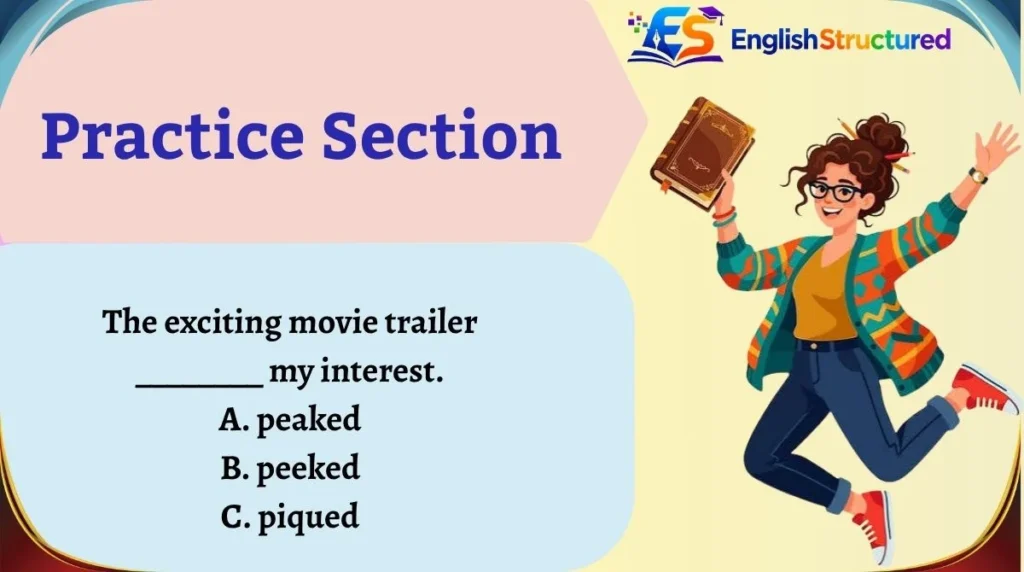
Choose the correct word: peaked, peeked, or piqued.
Question 1
The exciting movie trailer ________ my interest.
A. peaked
B. peeked
C. piqued
Question 2
The child ________ through the fence.
A. peaked
B. peeked
C. piqued
Question 3
Electricity use ________ during the hot afternoon.
A. peaked
B. peeked
C. piqued
Question 4
I quietly ________ inside the room.
A. peaked
B. peeked
C. piqued
Question 5
The science experiment ________ the students’ curiosity.
A. peaked
B. peeked
C. piqued
Answers
- C. piqued
- B. peeked
- A. peaked
- B. peeked
- C. piqued
If you answered all five correctly, you have a solid understanding of these commonly confused words. If not, review the meanings and memory tricks, then try the questions again.
FAQs
What is the difference between peaked, peeked, and piqued?
Peaked vs Peeked vs Piqued. Peeked means looked quickly or secretly. Piqued means sparked interest or curiosity. Although they sound alike, they have different meanings and spellings.
Is the phrase “piqued my interest” correct?
Yes. “Piqued my interest” is the correct and widely accepted expression. It means something made you curious or encouraged you to learn more. The spellings “peaked my interest” and “peeked my interest” are incorrect in standard English.
Can peaked describe people?
Yes. It often means someone reached their best performance or highest level.
Examples:
- She peaked as an athlete in her twenties.
- Peaked vs Peeked vs Piqued
In British English, peaked can also describe someone who looks pale or unwell, although this use is less common.
Can peeked be used in formal writing?
Yes. Peeked is acceptable in both formal and informal English when it means taking a quick look.
Examples include stories, news articles, essays, and everyday conversations.
Why do people confuse these words?
They are homophones, which means they sound the same but have different spellings and meanings. Many writers choose the spelling they recognize first instead of thinking about the meaning.
How can I remember the correct spelling?
Use these simple memory clues:
- Peaked → highest point.
- Peaked vs Peeked vs Piqued
- Piqued → sparked curiosity.
Thinking about the meaning before writing is the easiest way to avoid mistakes.
Conclusion
Peaked vs Peeked vs Piqued
Peaked is used when something reaches its highest point. Peeked describes taking a quick or secret look. Piqued means creating interest or curiosity.
The easiest way to choose the correct word is to stop for a moment and think about the action in your sentence.
Is something reaching a maximum level? Is someone taking a quick look? Or is something making a person curious?
Once you answer that question, the correct spelling becomes much clearer.
Don’t worry if you mix them up at first. Even native English speakers sometimes make this mistake.
The more you read, write, and practice, the more natural these words will become.
Review the examples, try creating your own sentences, and use the memory tricks whenever you need a quick reminder.
With regular practice, you’ll soon use peaked, peeked, and piqued correctly and confidently in both speaking and writing.