Aloud vs Out Loud
Many English learners notice that aloud and out loud often appear in the same sentences and seem to have the same meaning.
The good news is that this is one of those English questions that is easier than it first appears.
In most everyday situations, aloud and out loud mean the same basic thing: using your voice so that other people can hear what you are saying, reading, or thinking.
Still, there are small differences in style, tone, and common usage. Aloud can sound a little more formal or literary, while out loud is very common in normal conversation.
You may hear someone say, “I laughed out loud,” much more often than “I laughed aloud” in casual speech.
Understanding the difference helps you choose the phrase that sounds natural for the situation. It also makes reading, writing, and speaking English easier.
By the end of this guide, you will know what aloud means, what out loud means, how they differ, when to use each one, and which mistakes to avoid.
You will also see plenty of simple examples from everyday English.
What Does “Aloud” Mean?
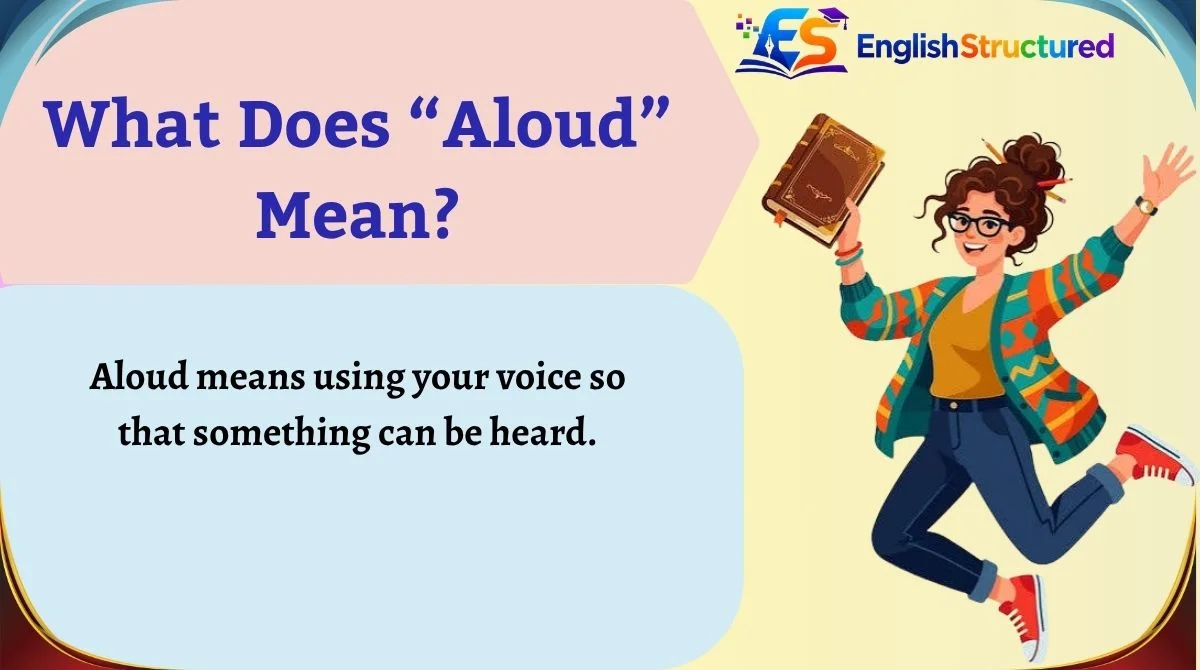
Aloud means using your voice so that something can be heard. It is usually used when someone speaks, reads, thinks, laughs, cries, or says something in a voice that can be heard by another person.
Aloud vs Out Loud
For example:
- She read the letter aloud.
- Aloud vs Out Loud
- I laughed aloud when I heard the joke.
The main idea is simple: if something is done aloud, it is expressed through the voice rather than kept silent.
When Should You Use “Aloud”?
Aloud is especially common with actions such as:
- read
- speak
- say
- think
- laugh
- cry
- pray
- repeat
- recite
It can be used when a person makes words or sounds that can be heard.
Consider this sentence:
Aloud vs Out Loud
Maria does not simply read the words silently in her head. She uses her voice, allowing the teacher and other students to hear them.
You can also use aloud with thoughts or feelings that become spoken words:
Aloud vs Out Loud
Here, the thought is not private anymore. She actually says it.
Grammar Rule for “Aloud”
Aloud normally comes after the verb or after the object of the verb.
Common patterns include:
Subject + verb + aloud
He laughed aloud.
Subject + verb + object + aloud
She read the poem aloud.
Aloud vs Out Loud
He repeated the question aloud.
The word aloud does not normally describe a person or thing. It describes the way an action happens.
Examples of “Aloud”
- Please read the instructions aloud.
- She spoke the words aloud.
- He laughed aloud at the funny story.
- The student recited the poem aloud.
- I accidentally said my thoughts aloud.
- She repeated the sentence aloud.
- The children counted aloud during the game.
- He read the names aloud one by one.
All these sentences describe something that is spoken or expressed with the voice.
A Common Confusion About “Aloud”
Aloud vs Out Loud
For example:
Please read the sentence aloud.
This does not necessarily mean “read it very loudly.” It means read it using your voice so that it can be heard.
You can read something aloud in a quiet voice.
Compare:
Aloud vs Out Loud
This tells us that she used her voice.
She read the story loudly.
This tells us that the volume of her voice was high.
So, aloud is about being spoken or heard, while loudly is about volume.
What Does “Out Loud” Mean?
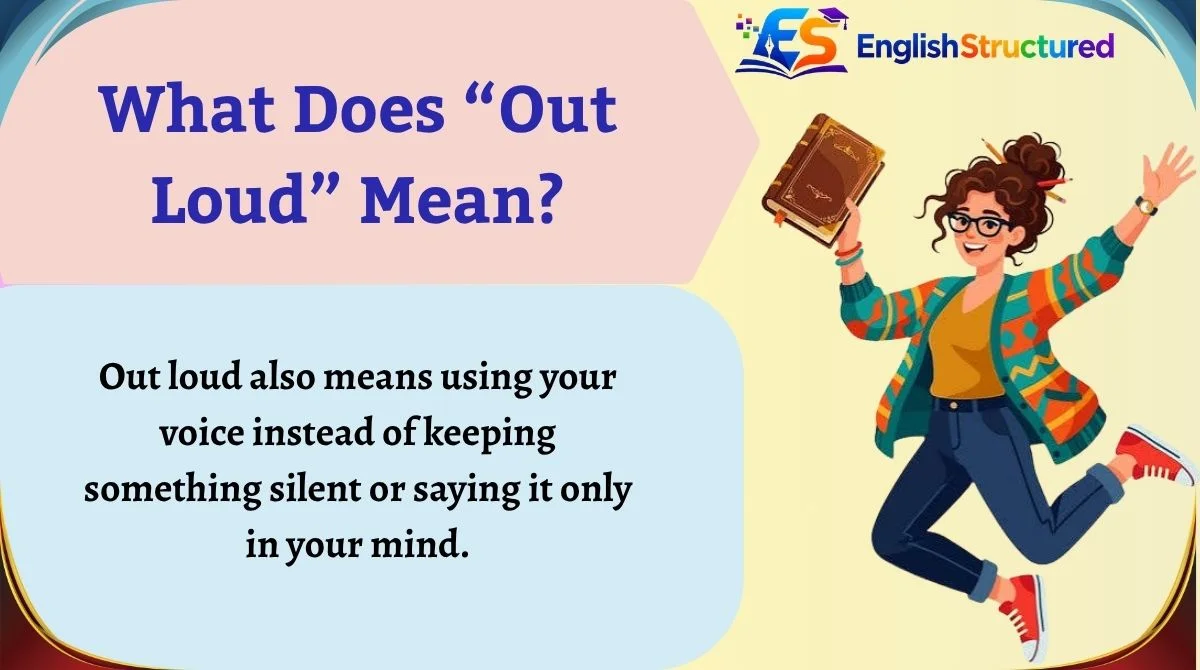
Out loud also means using your voice instead of keeping something silent or saying it only in your mind.
It is a two-word adverbial phrase. In everyday conversation, it is extremely common.
For example:
Aloud vs Out Loud
The person had the thought in their mind but did not speak it.
You can also say:
Please read this out loud.
This means:
Please use your voice when you read it.
The meaning is almost the same as read this aloud.
When Should You Use “Out Loud”?
Aloud vs Out Loud
You may hear it when people talk about:
- reading
- speaking
- laughing
- saying thoughts
- repeating words
- asking questions
- reacting to something
For example:
Aloud vs Out Loud
This is a very natural everyday sentence.
Another common expression is:
I was laughing out loud.
This simply means that the person laughed audibly rather than silently.
Grammar Rule for “Out Loud”
Like aloud, out loud usually works as an adverbial phrase.
Common patterns include:
Subject + verb + out loud
Aloud vs Out Loud
Subject + verb + object + out loud
Aloud vs Out Loud
Subject + say + something + out loud
I didn’t mean to say that out loud.
The phrase usually comes after the main action.
Examples of “Out Loud”
- Can you read this out loud?
- Aloud vs Out Loud
- I accidentally spoke out loud.
- He laughed out loud at the video.
- Don’t say that out loud.
- She repeated the name out loud.
- I was wondering about it out loud.
- Aloud vs Out Loud
These examples show why out loud is so common in everyday speech.
A Common Confusion About “Out Loud”
Learners sometimes think out loud means “outside loudly.” It does not.
For example:
Aloud vs Out Loud
It does not mean:
Don’t say that outside.
Here, out loud is one phrase meaning audibly or using your voice.
The word out does not refer to being outdoors.
Difference Between “Aloud” and “Out Loud”
The biggest point to remember is this:
Aloud and out loud usually have the same basic meaning.
Both can describe something that is spoken or expressed with the voice rather than silently.
However, they are not always equally natural in every situation. The main difference is usually style and tone, rather than meaning.
| Point | Aloud | Out loud |
|---|---|---|
| Basic meaning | Spoken so it can be heard | Spoken so it can be heard |
| Word type | One-word adverb | Adverbial phrase |
| Everyday speech | Common | Very common |
| Formal writing | More common | Less formal |
| Casual conversation | Natural | Very natural |
| Meaning of “audibly” | Yes | Yes |
| Means “very loudly”? | No | No |
| Common with “read” | Yes | Yes |
| Common with “laugh” | Yes | Yes |
1. Meaning
In many sentences, there is no important difference in meaning.
Aloud vs Out Loud
and
She read the book out loud.
Both mean that she used her voice to read the book.
Likewise:
Aloud vs Out Loud
and:
He laughed out loud.
Both describe audible laughter.
2. Formality
Aloud can sound slightly more formal, traditional, or literary.
For example:
The poem was recited aloud.
This sounds perfectly natural in a formal description.
Out loud tends to sound more conversational:
Why did I say that out loud?
That sentence feels very natural in everyday speech.
This does not mean out loud is incorrect in formal writing. It simply has a more conversational feel in many situations.
3. Modern Everyday English
If you are speaking with friends, family, classmates, or coworkers, out loud is often the phrase you will hear.
For example:
I was just thinking out loud.
This is a common expression. It means the speaker is saying their thoughts so they can explore an idea.
You can also say:
Aloud vs Out Loud
This is correct too, but thinking out loud is very common in modern conversational English.
4. Sentence Structure
There is no major difference in sentence structure.
You can say:
Read the sentence aloud.
or:
Aloud vs Out Loud
You can say:
Aloud vs Out Loud
or:
She said it out loud.
The grammar is different in form but similar in function.
Aloud is one word.
Out loud is a phrase made up of two words.
Grammar Rules You Must Remember
Rule #1: Both Usually Mean “Using Your Voice”
The most important rule is that both expressions usually tell us that something is spoken or made audible.
Aloud vs Out Loud
Please say your answer out loud.
Both sentences are correct.
The listener understands that the answer should be spoken rather than kept in the speaker’s mind.
Rule #2: Neither One Means “Very Loud”
This is an important distinction.
Aloud vs Out Loud
means to read it using your voice.
It does not necessarily mean to shout.
Similarly:
Read the sentence out loud.
does not mean that you should use a very high volume.
If you want to talk about high volume, use loudly.
The teacher spoke loudly because the students were far away.
Here, loudly describes volume.
Rule #3: “Out Loud” Is Very Natural in Conversation
When speaking casually, out loud often sounds more relaxed.
For example:
Aloud vs Out Loud
This is a very natural question.
You might also hear:
I was just thinking out loud.
This expression is common when someone is explaining an idea while they are still working through it.
Rule #4: “Aloud” Can Sound More Formal or Literary
Aloud is completely normal English, but it can have a more formal or literary feeling in some sentences.
For example:
Aloud vs Out Loud
This works very well in educational writing.
You may also see aloud in stories, novels, poems, and formal descriptions.
Remember, though, that this is a tendency, not a strict grammar rule.
Common Mistakes Students Make
Mistake 1: Thinking “Aloud” Means “Loudly”
Incorrect idea:
Aloud vs Out Loud
That is not true.
Correct understanding:
Aloud means using your voice so that something can be heard.
For example:
Aloud vs Out Loud
The sentence does not tell us how loud she was.
She could have spoken softly.
Mistake 2: Writing “Outloud”
This is a spelling mistake that learners sometimes make.
Out loud is written as two separate words.
Correct:
He said it out loud.
Incorrect:
He said it outloud.
Remember that aloud is one word, but out loud is two words.
Mistake 3: Thinking They Have Completely Different Meanings
Some learners search for a major difference between the two expressions.
Usually, there is no major difference.
Aloud vs Out Loud
She read the note out loud.
Both sentences tell us that she read the note using her voice.
The main difference is often the style or situation, not the basic meaning.
Mistake 4: Using “Aloud” When Talking About Volume
If you want to say that someone used a strong or high volume, use loudly.
He spoke loudly.
This is different from:
He spoke aloud.
The first focuses on volume.
The second focuses on the fact that he spoke audibly.
Mistake 5: Forgetting the Difference Between Silent and Spoken
Both aloud and out loud often create a contrast with silent actions.
Compare:
She read the book silently.
with:
She read the book aloud.
In the first sentence, she does not speak the words.
In the second, she uses her voice.
Easy Trick to Remember the Difference
Here is a simple trick:
Aloud = voice
Out loud = voice
Yes, the trick is really that simple because the two expressions are usually very close in meaning.
If you are talking about something being spoken rather than kept in your head, either one may work.
For example:
I said the answer aloud.
I said the answer out loud.
Both are fine.
Now use this second trick for style:
Aloud → slightly more formal
Out loud → more conversational
Imagine a student reading a passage during a class:
Please read the paragraph aloud.
Now imagine two friends talking:
Did I just say that out loud?
Both expressions are correct, but each fits a slightly different conversational setting.
One more helpful idea is to remember:
“Loudly” = volume
“Aloud” / “out loud” = audible speech
This small distinction can prevent many mistakes.
Daily Life Examples
Here are some natural examples you might hear in real conversations.
Example 1: In the Classroom
Teacher: Can you read the next paragraph aloud?
Student: Sure. I’ll read it now.
The teacher wants the student to use their voice so everyone can hear the paragraph.
Example 2: With a Friend
Friend: What are you thinking?
You: Nothing. I was just thinking out loud.
Here, the speaker is saying their thoughts while trying to work through an idea.
Example 3: Accidentally Saying Something
“Oops! Did I say that out loud?”
This is common when someone accidentally reveals a thought.
Example 4: Reading a Message
Can you read this message out loud? I can’t see the screen clearly.
The speaker wants the other person to use their voice.
Example 5: Practicing English
I like to read English sentences aloud when I practice speaking.
This is a useful way for learners to connect written English with spoken English.
Example 6: Laughing
She laughed out loud when she saw the picture.
The laughter was audible.
You could also use:
She laughed aloud when she saw the picture.
Example 7: A Library
He read the note aloud, even though the room was quiet.
The word aloud works naturally here.
Example 8: Thinking Through a Problem
“If I take this road, I can get there faster,” he said out loud.
He is speaking his thoughts so that someone else can hear them.
Example 9: A Family Conversation
Dad: Why are you smiling?
Son: I was just remembering something funny.
Dad: You were laughing out loud a minute ago!
This is natural conversational English.
Example 10: Reading a Poem
The student stood in front of the class and recited the poem aloud.
This sounds especially natural in a school or formal setting.
Practice Section

Choose aloud or out loud in each sentence.
1. Please read the instructions ________.
2. Why did you say that ________?
3. She laughed ________ when she heard the joke.
4. The student recited the poem ________.
5. I was just thinking ________.
Answers
1. aloud / out loud
Both are correct.
Please read the instructions aloud.
Please read the instructions out loud.
2. out loud
Why did you say that out loud?
This is especially natural in casual conversation. Aloud is also grammatically possible.
3. aloud / out loud
Both work.
She laughed aloud when she heard the joke.
She laughed out loud when she heard the joke.
4. aloud / out loud
Both are possible, although aloud can sound especially natural in this formal or classroom context.
5. out loud / aloud
Both are correct.
I was just thinking out loud.
I was just thinking aloud.
The first version is very common in everyday conversation.
FAQs
What is the difference between aloud and out loud?
In most cases, there is little or no difference in basic meaning. Both mean that something is spoken or expressed with the voice so that it can be heard.
The main difference is style. Out loud is very common in casual conversation, while aloud can sound slightly more formal or literary.
Can I say “read aloud” and “read out loud”?
Yes. Both are correct.
Please read the sentence aloud.
and
Aloud vs Out Loud
Both mean that the person should use their voice rather than read silently.
Is “aloud” more formal than “out loud”?
Often, yes, but this is not an absolute rule.
Aloud can have a more formal, traditional, or literary sound. Out loud is very common in normal conversation.
However, both can be used in many types of writing and speech.
Can “aloud” and “out loud” be used in questions?
Yes. Both can appear in questions.
For example:
Did I say that aloud?
and:
Aloud vs Out Loud
Both are grammatically correct. The second often sounds more natural in casual spoken English.
Does “out loud” mean “very loudly”?
No.
Out loud means that something is spoken or expressed with the voice. It does not tell us that the volume is high.
If you want to describe high volume, use loudly:
She spoke loudly.
Is “aloud” one word or two words?
Aloud is one word.
Out loud is two words.
So write:
He read it aloud.
and:
He read it out loud.
Do not write “outloud.”
Conclusion
The difference between aloud and out loud is much smaller than many English learners expect.
In most situations, both expressions mean speaking or making a sound with your voice so that it can be heard.
You can usually use either one with verbs such as read, say, speak, laugh, repeat, and think.
The main difference is style. Out loud is especially common in everyday conversation, while aloud may sound a little more formal, traditional, or literary.
Still, both are correct in many of the same sentences.
Most importantly, do not confuse either expression with loudly. Aloud and out loud tell us that something is audible. Loudly tells us about the volume.
Once you remember this simple idea, choosing between the two becomes easy. When you are speaking casually, out loud will often feel very natural.
When you are writing or describing a reading or recitation, aloud may fit nicely.
Keep noticing these phrases in real English, and soon the difference will feel natural rather than something you have to think about.