Your vs Youre
That is why many English learners mix them up. But even though they sound similar, they have different meanings and different jobs in a sentence.
This small difference matters a lot in everyday English. You may see these words in text messages, emails, schoolwork, social media posts, and conversations.
Using the wrong one can make a sentence look careless or confusing.
For example, look at these two sentences:
- Your phone is ringing.
- You’re using your phone.
The first sentence talks about something that belongs to you. The second sentence means “you are.”
The good news is that the rule is quite simple once you understand it. Your shows ownership or connection. You’re is a short form of “you are.”
By the end of this guide, you will know exactly when to use your vs youre, how to tell them apart quickly, and how to avoid common mistakes.
You will also see simple examples from daily English and practice questions to help the rule stick in your mind.
What Does “Your” Mean?
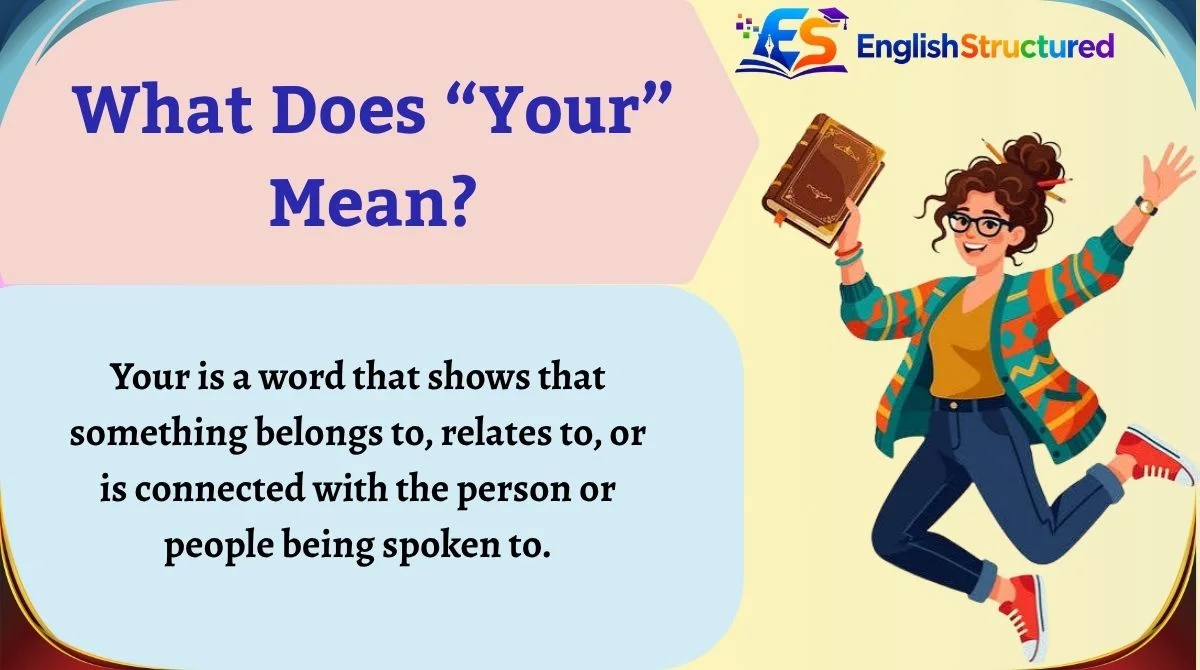
Your is a word that shows that something belongs to, relates to, or is connected with the person or people being spoken to.
It is called a possessive determiner. You normally use your before a noun.
For example:
- Your vs Youre
- your house
- your name
- your teacher
- your idea
- your friends
When you say “your book,” you mean the book belongs to you or is connected with you.
When Should You Use “Your”?
Use your when you want to show ownership or a relationship with the person you are speaking to.
It does not always mean that the person legally owns something. It can simply show a connection.
For example:
Your vs Youre
Here, “your” shows the relationship between the listener and the mother.
Your favorite color is blue.
The color does not belong to the person like a phone or a bag does. Instead, it is connected to that person’s preference.
Grammar Rule for “Your”
The basic pattern is:
your + noun
Examples:
- your car
- Your vs Youre
- your answer
- your room
- your dog
You can also use your before an adjective and noun:
- your new car
- your beautiful house
- your best friend
- your old shoes
The word your itself does not change for one person or many people.
You can say:
- Your brother is here.
- Your brothers are here.
You can also use your when talking to one person or several people:
- Your seat is over there.
- Your seats are over there.
Examples of “Your”
- Your vs Youre
- What is your name?
- I like your new shoes.
- Where is your brother?
- Please check your email.
- Your vs Youre
- Have you finished your homework?
- I really like your idea.
In every sentence above, your comes before something that is being talked about.
A Common Confusion
Many learners write “you’re” when they actually need “your.”
For example:
❌ You’re phone is ringing.
This is wrong because “you’re” means “you are.”
Try replacing it:
You are phone is ringing.
That does not make sense.
The correct sentence is:
Your vs Youre
Here, your shows that the phone belongs to or is connected with the person.
What Does “You’re” Mean?
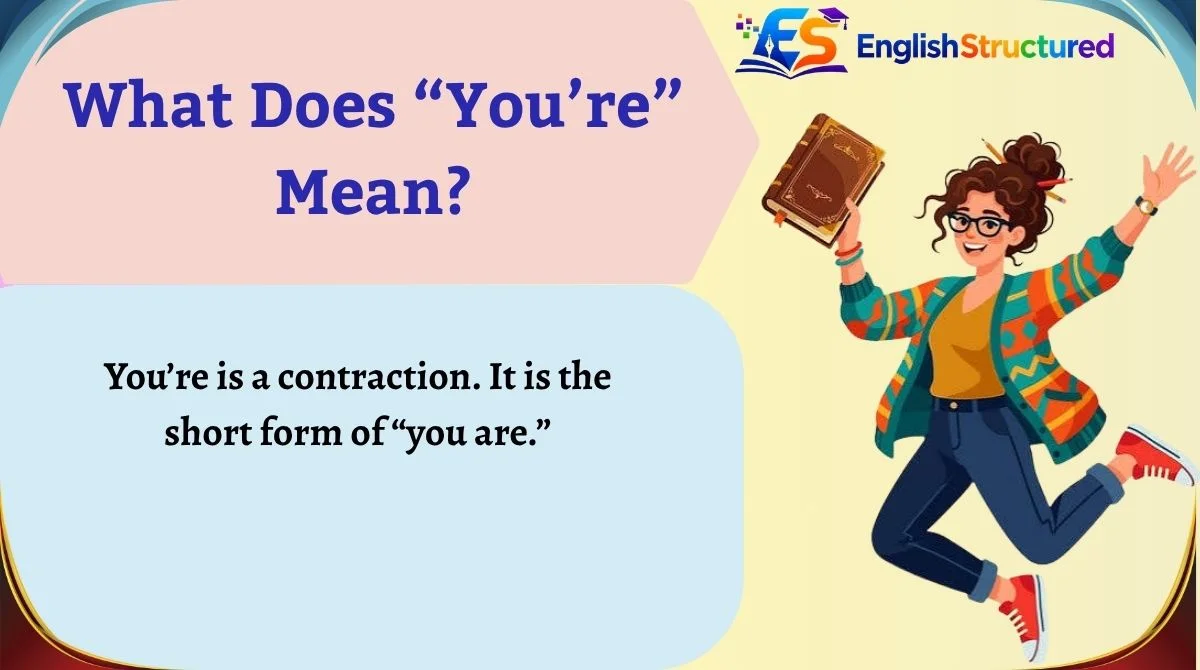
You’re is a contraction. It is the short form of “you are.”
The apostrophe in you’re is important because it shows that letters have been left out.
You’re = you are
For example:
- You’re happy. = You are happy.
- You’re late. = You are late.
- You’re my friend. = You are my friend.
- You’re working hard. = You are working hard.
When Should You Use “You’re”?
Use you’re whenever the full words “you are” would work in the sentence.
This is the easiest test for this word.
Take this sentence:
Your vs Youre
Replace “you’re” with “you are”:
You are very kind.
The sentence still makes sense, so you’re is correct.
Another example:
I think you’re right.
Replace it:
I think you are right.
It works, so you’re is correct.
Grammar Rule for “You’re”
The basic rule is:
you’re = you are
Your vs Youre
- an adjective
- a noun
- a verb ending in -ing
- other words that normally follow you are
For example:
You’re tired.
Here, “tired” is an adjective.
You’re a great student.
Here, “a great student” is a noun phrase.
You’re learning English.
Here, “learning” is a present participle used with “are.”
Examples of “You’re”
- You’re very helpful.
- I think you’re correct.
- You’re my best friend.
- You’re working too hard.
- Are you sure you’re ready?
- You’re going to love this movie.
- I know you’re busy.
- You’re doing a great job.
In each example, you can replace you’re with you are.
A Common Confusion
Learners sometimes forget the apostrophe and write “your” when they mean “you are.”
For example:
❌ Your very kind.
This sentence is incorrect because “your” needs a noun after it in normal use.
Try the replacement test:
You are very kind.
That makes sense.
So the correct sentence is:
Your vs Youre
Difference Between Your and You’re
The main difference is simple:
Your shows possession or connection. You’re means “you are.”
Although the two words sound very similar, their grammar is completely different.
| Word | Meaning | Grammar Job | Example |
|---|---|---|---|
| your | belonging or connected to you | Possessive determiner | Your car is fast. |
| you’re | you are | Contraction | You’re very fast. |
Usage Difference
Use your when something belongs to you or is connected with you.
Your vs Youre
Here, the jacket is connected with the person.
Use you’re when you mean you are.
You’re wet.
Here, “you’re” describes the person. It means you are wet.
Notice how one small apostrophe changes the meaning.
Compare These Sentences
Your late. ❌
This is incorrect if you mean that someone arrived late.
The correct version is:
You’re late. ✅
Why?
Because the full sentence is:
You are late.
Now compare:
Your shoes are dirty. ✅
Here, “your” is correct because it describes whose shoes they are.
You would not say:
You’re shoes are dirty. ❌
That would mean:
You are shoes are dirty.
That does not work.
Grammar Logic
A useful way to understand the difference is to look at what comes next.
If the word is followed by a noun, you often need your:
- Your vs Youre
- your teacher
- your house
- your question
- your car
If the word can be expanded to you are, use you’re:
- you’re happy
- you’re right
- you’re late
- you’re learning
- you’re ready
This is not a perfect “look at the next word” rule in every possible sentence, but it is very useful for beginners.
Meaning Comparison
Consider this pair:
Your smart. ❌
Your vs Youre
The second sentence means:
You are smart.
Now consider:
Your smart friend is here. ✅
Here, “your” describes the friend. The friend is connected with you.
This is why context matters.
Grammar Rules You Must Remember
Rule #1: Your Shows Possession or Connection
Use your when something belongs to or is related to the person you are talking to.
Examples:
- Your keys are on the desk.
- Where is your sister?
- I like your new haircut.
Think of your as a word that points to the listener’s thing, person, idea, or connection.
Rule #2: You’re Means “You Are”
Use you’re when you can write you are instead.
Examples:
- You’re very kind.
- You’re late today.
- You’re doing well.
The replacement test works perfectly here:
Your vs Youre
If the expanded sentence works, you’re is the right choice.
Rule #3: The Apostrophe Matters
The apostrophe in you’re is not decoration.
It tells us that you’re is a shortened form of you are.
Compare:
- Your vs Youre
- you’re
The apostrophe changes the grammar and meaning.
A missing apostrophe can make your writing incorrect:
❌ Your doing great.
✅ You’re doing great.
Rule #4: Do Not Use “You’re” to Show Ownership
This is one of the most common mistakes.
❌ You’re car is outside.
“Your” is needed because the car is connected with the person.
Your vs Youre
Likewise:
❌ I like you’re idea.
✅ I like your idea.
Remember: your + noun is a very common pattern.
Common Mistakes Students Make
These two words cause problems because they sound alike. When people speak quickly, you may not hear the difference at all.
That is why spelling can become difficult, especially in texting.
Mistake 1: “Your” Instead of “You’re”
Incorrect:
❌ Your going to be late.
Correct:
✅ You’re going to be late.
Why?
The sentence means:
You are going to be late.
Your vs Youre
Mistake 2: “You’re” Instead of “Your”
Incorrect:
❌ You’re phone is ringing.
Correct:
✅ Your phone is ringing.
Why?
“Phone” is a noun connected with the listener. The meaning is not “you are phone.”
Mistake 3: Forgetting the Apostrophe
Incorrect:
❌ I think your right.
Correct:
✅ I think you’re right.
The full form is:
I think you are right.
So the apostrophe is needed.
Mistake 4: Using “Your” Before an Adjective Alone
A sentence such as:
❌ Your beautiful.
is incorrect when you mean “You are beautiful.”
Correct:
✅ You’re beautiful.
But your can come before an adjective if a noun follows it:
✅ Your beautiful dress looks expensive.
Here, “beautiful” describes “dress,” and “your” shows whose dress it is.
Easy Correction Tip
Whenever you are unsure, ask yourself:
Can I replace the word with “you are”?
If yes, use you’re.
If no, and you are showing ownership or connection, use your.
Easy Trick to Remember the Difference
Here is a very simple memory trick:
YOU’RE has an apostrophe because it is two words joined together: YOU + ARE.
Think:
Your vs Youre
The apostrophe is like a little sign that some letters have been removed.
Now think of YOUR as the ownership word.
You can remember examples such as:
- Your vs Youre
- your house
- your name
- your car
A second trick is to imagine two questions.
Whose? → YOUR
Who are? → YOU’RE
For example:
Whose phone is this?
Your vs Youre
Who are you?
→ You’re a student.
Of course, “who are” is not always the exact question you will ask, but the basic idea helps: you’re contains “are.”
The Five-Second Test
When writing a message, stop for a second.
Read the sentence with you are.
If it sounds right, choose you’re.
For example:
Your vs Youre
→ I know you are tired. ✅
But:
I like your jacket.
→ I like you are jacket. ❌
So your must be correct.
This quick test can save you from many mistakes.
Daily Life Examples
The best way to learn the difference is to see how these words appear in normal conversations.
Example 1: Talking About a Phone
A: Where is your phone?
B: It’s on the table.
Here, your shows that the phone belongs to or is connected with the person.
Example 2: Talking About Being Late
A: Hurry up! You’re late.
B: Sorry! I got stuck in traffic.
Your vs Youre
Example 3: Talking About a Bag
A: Is this your bag?
B: Yes, it is.
“Your” tells us whose bag it is.
Example 4: Giving a Compliment
A: You’re very good at English.
B: Thank you!
Your vs Youre
Example 5: Talking About Someone’s Work
A: Your work looks great.
B: Thanks! I spent all morning on it.
“Your” shows that the work belongs to or is connected with the person.
Example 6: Checking If Someone Is Ready
A: Are you ready?
B: Yes, I’m ready.
A: Great. You’re ready to go!
Here, “you’re” means you are.
Example 7: Talking About a Family Member
A: Your brother called earlier.
B: Really? I’ll call him back.
“Your” shows the relationship between the listener and the brother.
Example 8: Giving Advice
A: You’re making a small mistake here.
B: Oh, I see it now.
Your vs Youre
Example 9: Talking About an Idea
A: Your idea could work.
B: I hope so.
“Your” connects the idea with the person who suggested it.
Example 10: A Friendly Message
You’re always welcome at my house.
Here, “you’re” means:
You are always welcome at my house.
This is a very common type of sentence in everyday English.
Practice: Choose Your or You’re
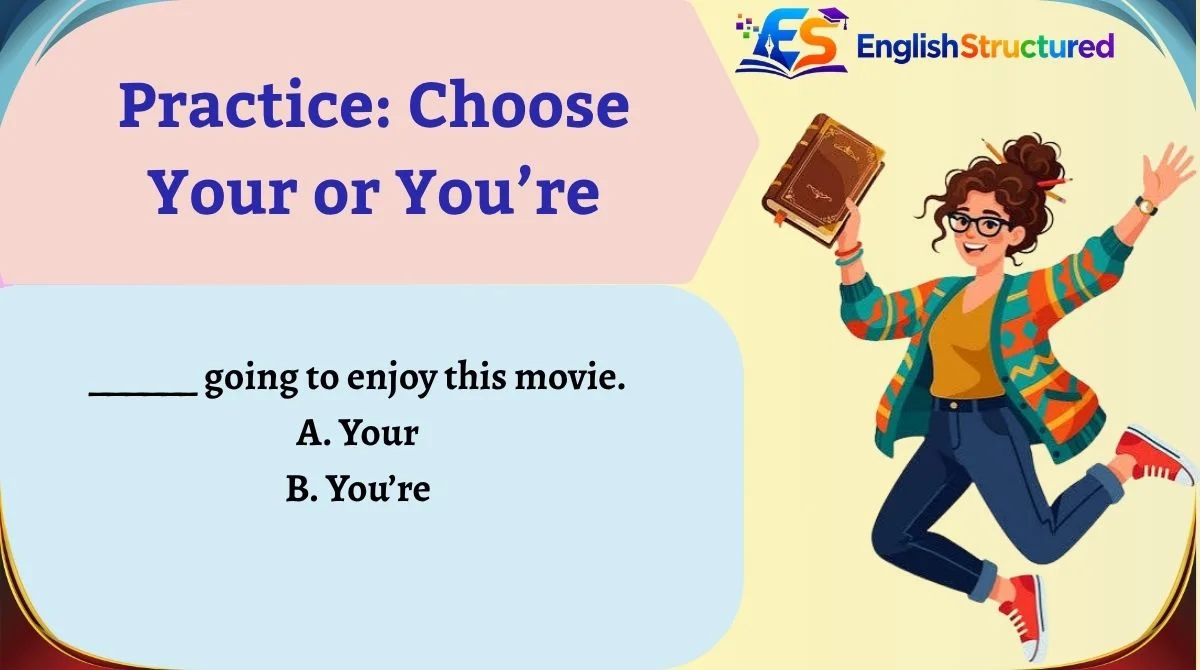
Try these sentences before checking the answers.
1. ______ going to enjoy this movie.
A. Your
B. You’re
2. Where is ______ jacket?
A. your
B. you’re
3. I think ______ right.
A. your
B. you’re
4. Is this ______ notebook?
A. your
B. you’re
5. ______ one of my best friends.
A. Your
B. You’re
Answers
1. You’re — “You’re” means “you are.”
2. Your — It shows whose jacket it is.
3. You’re — “You are right” works.
4. Your — The notebook is connected with the person.
5. You’re — “You’re one of my best friends” means “You are one of my best friends.”
FAQs
What is the difference between your and you’re?
Your shows possession or a connection with someone. For example, “your car” means the car belongs to or is connected with you.
You’re is the short form of “you are.” For example, “you’re happy” means “you are happy.”
Can we use “you’re” in questions?
Yes. You’re can appear in questions, especially inside longer questions.
For example: “Do you know why you’re late?”
Here, “you’re” means “you are.” The same replacement test works: “Do you know why you are late?”
Is “your” formal or informal?
Your is neither strictly formal nor informal. It is a normal English word used in all kinds of writing and speech.
You can use it in conversations, schoolwork, business emails, and formal writing.
Is “you’re” formal or informal?
You’re is a normal contraction of “you are.” It is common in everyday speech and most general writing.
In very formal writing, some writers may prefer the full form “you are,” but “you’re” is not incorrect or slang.
Why do your and you’re sound the same?
In most varieties of modern English, your and you’re are pronounced the same or very similarly in normal speech.
That means you usually cannot depend on sound to choose the correct spelling. You need to look at the meaning and grammar of the sentence.
How can I remember your vs you’re easily?
Use the “you are” test.
If you can replace the word with you are, choose you’re.
If you are showing that something belongs to or is connected with someone, choose your.
For example, “You’re ready” becomes “You are ready,” so it is correct. “Your bag” cannot become “you are bag,” so your is correct.
Conclusion
Your vs Youre
Your shows ownership, connection, or a relationship. It is commonly followed by a noun, such as your phone, your house, your name, or your idea.
You’re is simply the shortened form of you are. You can use it in sentences such as you’re right, you’re ready, and you’re doing well.
When you are unsure, use the easiest test: replace the word with “you are.” If the sentence still makes sense, use you’re.
If you are talking about something that belongs to or is connected with the person, use your.
Do not worry if you mix them up at first. These words sound almost the same, so the mistake is very common.
A little practice will make the difference feel natural. Before long, choosing between your and you’re will become automatic.